
Pakistan's devotion to spin comes back to bite them
If the spinners had an "off day" as Salman Agha surmised post-match, why did they end up bowling 18 of Pakistan's 20 overs?

Danyal Rasool
Feb 15, 2026, 9:23 PM • 15 hrs ago
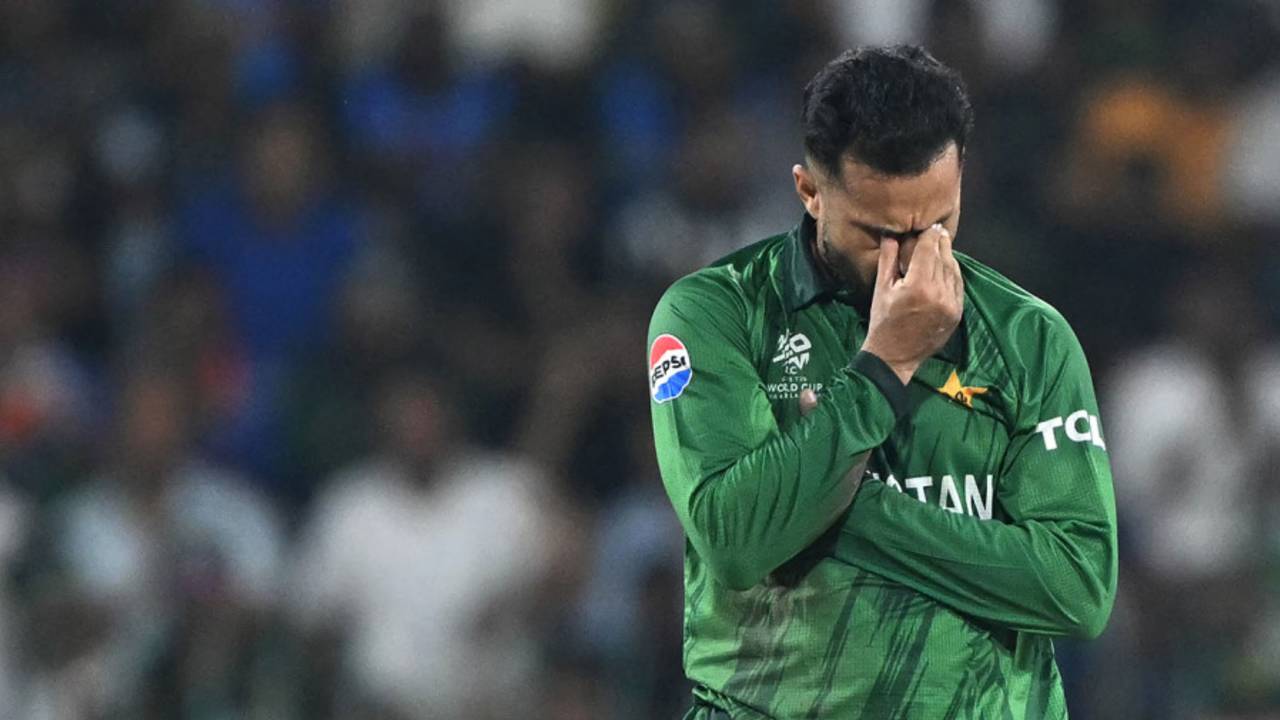
Mohammad Nawaz reacts as the writing starts to appear on the wall • S. Kodikara/AFP via Getty Images
"Our spinners had an off day today," Salman Agha said to Mpumelelo Mbangwa after the match with the cavalier nonchalance that has become the Pakistan captain's trademark. Which is only partially true, but with Agha's hurried spill of syllables, you can only ever catch the general drift of the point being made before filling the rest in yourself, the linguistic equivalent of an IKEA shopping trip.
Abrar Ahmed did indeed have an off day, conceding 38 in three, his third-most expensive T20I figures. In his solitary over, Shadab Khan saw fit to feed Ishan Kishan full on leg stump repeatedly - his most prolific scoring zone - and paid with 17 runs.
But the others were okay. Saim Ayub had a sensational day, taking 3 for 25, while Mohammad Nawaz and Usman Tariq kept things ticking along. That's a lot of spinners, you might catch yourself saying, and we haven't even got to Agha himself, who bowled a couple up top. So if the spinners had an off day, why did they end up bowling 18 of Pakistan's 20 overs?
One person virtually guaranteed not to have an off day was Hardik Pandya. Even when he scooped his first ball straight up to long-off and fetched himself a golden duck. Because he still had to bowl, and Hardik with ball in hand against Pakistan is as bankable an asset as they come.
He sent the first ball down just back of a length, a length Pakistan find virtually irresistible not to give up wickets to. It had a touch of swing, and Sahibzada Farhan defended this one, but the wheels of fate began their inevitable whirring.
When Hardik sends that delivery down to start with, he never goes wicketless in a T20I against Pakistan. In nine bowling innings against Pakistan, he has taken 17 wickets at an average under 14, nearly half his career T20I average, and a strike rate of 10.7, again halving his overall numbers.
Of the 16 bowlers to have bagged at least 15 Pakistani wickets, he has the second-best strike rate, just a whisker behind Jacob Duffy, whose exploits have almost exclusively needed New Zealand's conditions. Meanwhile, witnesses of Hardik's heroics can be found in Mirpur, Dubai, Melbourne, Kolkata, New York, and now Colombo.
Two hours earlier, Shaheen Shah Afridi, bowling the innings' second over, had banged his first ball in well short at a height that sat up for Ishan Kishan to smite over square leg for the six that set up his dazzling innings. It was an over that bled 15. From a bowler who, at 25, is already beginning to see his heyday recede into the sepia filters of nostalgia.
In the last four games against India over the past five months, he has conceded 114 in 11.5 overs, 31 of which were added in just 12 balls he sent down today. If Abrar hadn't gone for 14 in his third over, it is likely that first over to Kishan would have been Afridi's lot today.
It was entirely in keeping with the build-up to the game, with Pakistan adamant that fast bowling had been bullied into irrelevance by the magic of their spin department. They had, in Ayub, the carrom-ball specialist who turns it both ways without his wrist betraying him. In Tariq, upon whom the attention before this game reached near-hysterical levels, they had a spinner who pauses interminably before a delivery and whose very elbow joints appear to defy science. And of course, there was Abrar, Harry Potter himself, in addition to the more conventional utility options of Nawaz and Agha.
In Sri Lanka, surely, that was all Pakistan needed. So confident have Pakistan been in this bounty of slow bowlers they have been content to carry with them seam-bowling allrounder Faheem Ashraf, who has not bowled a ball all tournament and faced just 27 at No. 8. The one extra seamer Pakistan did carry in the first game, Salman Mirza, was swiftly benched for yet one more spinner.
Pace, they had decided, was like carrying a credit card at a dinner one hopes someone else will pay for - only there in case of an unpleasant emergency, and carrying as little in reserve as possible. After all, what could go wrong with a strategy that had worked against Netherlands and USA?
India, too, carried plenty of spinners, but they existed as part of a healthy diet, unlike Pakistan, who had avariciously hoarded them. As such, they were happy not to pay heed to Pakistan's bowling strategy, which had led to Hardik bowling that first over to Farhan.
It took just four balls for this match-up's most reliable pattern to hold, rewarding Hardik with a wicket after three dot balls induced Farhan into a panic-laden hack straight up in the air. Hardik signed off with a wicket maiden, and Suryakumar Yadav didn't need to dart his eyes for the closest slow bowler in sight. He had Jasprit Bumrah to toss the ball to.
It turns out that bowling 145 full into the pads with a new ball that still tails in is difficult to play, even if the air it swings through is of the humid Colombo variety. It took Bumrah just his second attempt to find that very delivery, putting Pakistan on the mat before the first round had ended.
A punch drunk Agha tried a foolhardy slog across the line before the over was out, only for - who else? - Hardik to nestle underneath the ball. Pakistan's only two overs of seam had cost them 31. By the end of two overs in their own batting innings, all pace, they had slumped to 13 for 3.
As if to prove the point, Suryakumar tossed the ball back to Hardik with India one wicket from victory. At the other end, when the over's final delivery awaited bowling, stood Tariq, the man who so famously lurks at the bowling crease against India's perpetual threat against Pakistan. A standard length delivery, the middle stump knocked back, a metaphor for a comprehensive dismantling faithfully playing out to sign the game off.
Pace, it appeared, was never the problem. And as India's quicks so effectively demonstrated, it is perhaps just a skill issue.
Danyal Rasool is ESPNcricinfo's Pakistan correspondent. @Danny61000