
The decade of entertainment
There's been plenty to moan about in the 2000s, but the cricket itself has been mostly exciting, less draw-prone, and more unpredictable

Rob Steen
11-Nov-2009
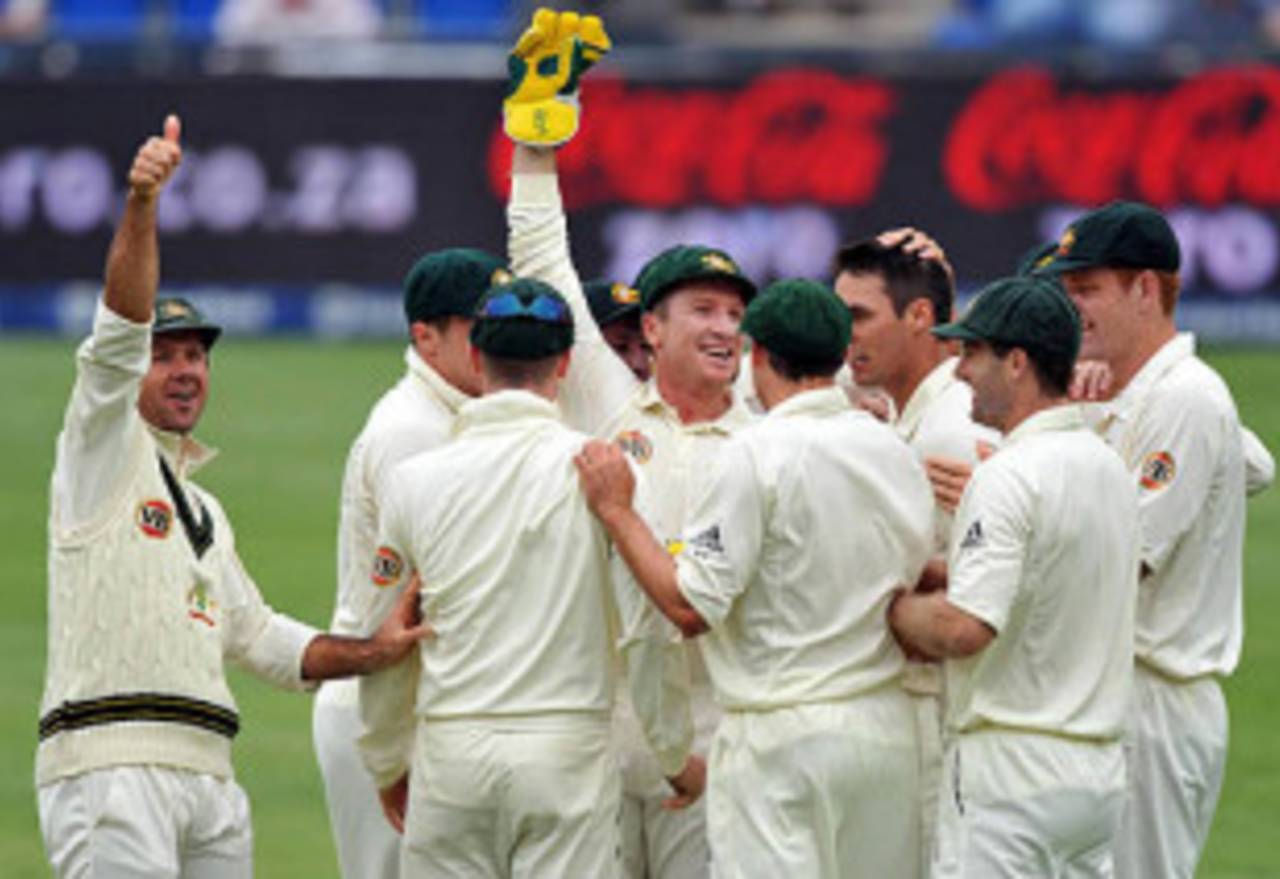
The unpredictable age: Australia lost to South Africa at home, won against them away and then lost to England away, over the last year • Getty Images
Dear Mr Noughties,
I can't quite decide whether to envy you or pity you. What, pray, will future generations make of you? How will posterity treat you?
Will those who view their lot through the prism of a half-empty glass scorn you as the decade that encouraged players to openly question umpires? That saw one Test match decided by a captain's penchant for leather jackets and another by the visiting team's decision to take an extended tea-break, one declared unofficial and another abandoned on the first morning because the bowlers' run-ups resembled a beach? As the decade disfigured by terrorists and haunted by the pitiful decline of the West Indies? As the decade that saw Pakistan robbed of home fixtures, Lord's shamed by a fraudster, India by "Monkeygate" and the Caribbean by a protracted power struggle between players and board? As the decade when two Tests constituted a "series" and one-day rubbers were deemed worthy of seven episodes? As a decade of unprecedented administrative greed and a fixture list so congested it deprived us of air, much less anticipation?
But what of those who see life through a half-full glass? Will they toast you as the decade of innovation, of the Twenty20 revolution, the switch-hit, the Dilscoop and the carrom ball? The decade when sixes flowed as never before and Adam Gilchrist redefined wicketkeeper-batsmanhood? When Australia pulled off the greatest winning streak in Test history? When we were privileged, courtesy the India-Australia tussle of 2000-01 and the England-Australia scrap of 2005, to witness two series fit to be mentioned in the same awed breath as the 1960-61 Australia-West Indies see-sawer? When, after a century of forelock-tugging subservience, domestic cricket finally challenged the international game? When accuracy and justice finally superceded umpires' egos as the priority? When a black man threatened to become South Africa's highest wicket-taker? When, from the jaws of Cronjegate, Dennessgate, Monkeygate and Stanfordgate, the game somehow reclaimed joy?
For now, let's stick with the hard evidence, i.e. the stats, and focus on the only brand of international cricket that has endured from the 19th century to the 21st, namely Tests. An instructive picture can be gleaned by assessing the past 118 months in five categories - matches played, high scores, scoring rates, batting averages and frequency of draws:
| Decade | Tests | 700+ scores | RPO | Bat Average | % of draws |
| 2000s | 452 | 8 | 3.20 | 34.08 | 24 |
| 1990s | 347 | 1 | 2.86 | 31.64 | 35 |
| Overall | 1932 | 16 | 2.80 | 31.90 | 35 |
What these disparate figures, and those that follow, reveal confirms some hard-held theories while confounding others - what a devious decade you are! Superficially at least, the most telling stat can be derived from column one: 23.40% of all Tests have been played during this young millennium. I will therefore concentrate on facts not governed by mere opportunity and frequency (i.e. averages rather than aggregates) and, where they are, on those where the difference is significantly greater than 23.40%.
The nineties conformed to the norm. The average runs-per-over rate differed only marginally from the historical mean, likewise the batting average, while the frequency of draws was identical. In all these categories, this decade has seen a significant improvement - RPO up by almost 12%, batting average up by nearly 8%, draws down by fully 31.5%. Only someone with a PhD in Applied Curmudgeonry could possibly take exception to this. So far so good.
Crunch those numbers more energetically and a less desirable pattern is affirmed, a tale of imbalance. For this, even more than the thirties, is assuredly, grossly, grotesquely, the Age of The Bat and the era of the over-friendly pitch. In the 1990s, two sides - Australia (35.32) and India (35.46) - averaged more than 34 per wicket; six have done so this decade. In the 1990s, West Indies were alone in averaging more than three runs per over; all eight senior nations have done so this decade. In the nineties, six batsmen with 1000 runs to their credit averaged 50-plus, while six progressed at 60 runs per 100 balls; during your time, the number in each case has soared to 22. And while 32 bowlers in the 1990s snared 50-plus wickets at 2.8 runs per over or fewer, just 15 have done so in the noughties.
The evolution of partnership records also testifies to the extent of this imbalance: three world peaks and no fewer than 20 national highs (among the seven senior nations) have been overhauled. Yet the most staggering stat, and much the most damning, relates to those towering totals: half the 16 scores of 700-plus ever made have been amassed this decade. Not one, moreover, came at Bangladesh's expense.
So batsmen have forgotten how to concentrate, have they? Of the 75 knocks that have spanned 10 hours or more, the past two decades, during which just over 43% of all Tests have been played, have been responsible for nearly 59% - 20 this decade and 24 the last. Of the 24 lengthiest occupations, precisely half have occurred during this period; your reign, furthermore, has proffered seven of that dozen. How long this reversal of perceived wisdom persists must be open to considerable doubt, yes, but no predictions are fireproof.
Over the past 15 months a near-perfect circle of results has embodied this unpredictability: South Africa won in England and then Australia, then lost at home to Australia, who then lost to England
And then, glory be, there's the toss. Hitherto, nearly 60% of all wins had begun with the victorious captain prevailing. On your watch, however, the pendulum has swung a refreshingly long way. Among the eight senior nations, after losing this time-dishonoured ritual, only India, New Zealand and Sri Lanka have lost more Tests than they have won.
Another reason for you to puff out your chest is that despite all those broadcaster-friendly tracks, you have overseen the decline of the bore draw. In the nineties, six teams drew at least 35% of their Tests; not one has done so this decade. Granted, this may be attributable, in good part, to the difficulty contemporary batsmen plainly encounter when it comes to enduring exclusively in the interests of survival, an ambition that sits awkwardly with 21st-century mindsets.
On the other hand, resilience among the lower orders appears to have improved massively. Six of the 11 most prolific last-wicket pairs have regaled us with their defiance of convention. Eight of the 17 No. 7s with 10 or more fifties have flexed their off-drives. Owners of the highest average of any regular No. 8 (20 or more innings)? Daniel Vettori, Kamran Akmal and Mark Boucher. The most consistently productive No. 9 ever? Shaun Pollock. Check out the big picture, though, and received wisdom takes a bit of a bashing. On average, wickets seven to 10 have contributed 82.37 runs per innings; in the eighties it was actually more than one run higher.
Yet your greatest contribution to our edification, without doubt, has been an increasingly competitive circuit - witness more than a third of Test cricket's 17 one-wicket victories, 19 of the 32 highest fourth-innings totals, 15 of the 40 toughest chases, and the fact, above all, that six nations have won at least as many games as they have lost, a 50% improvement on both the nineties and the overall score. Over the past 15 months a near-perfect circle of results has embodied this unpredictability: South Africa won in England and then Australia, then lost at home to Australia, who then lost to England. How heartening, furthermore, that the last of these encounters should blow such a raspberry at normality: the hosts prevailed despite being outscored by eight hundreds to two, and despite averaging more than six runs per wicket fewer than their dumbstruck opponents.
Almost as welcome has been the rise in triumphs on terra unfamiliar: six teams have won at least 25% of their away games, compared with four in the nineties and overall, and just one in the eighties. Again, this may reflect an increasing homogeneity pitch-wise; more pertinently perhaps, it could be traced to the growing familiarity that stems from more regular tours.
The remarkable aspect, given that enhanced parity, is that there have been so few stalemates. One obvious explanation is the helter-skelter schedule: with teams knowing the next game and flight are seldom far away, should we be shocked at any apparent disinclination to maintain focus while a match slips away, let alone muster the drive to reverse the tide? Yet the statistics mock such an interpretation: of the 31 instances where a side has lost after tallying 400 batting first, once deemed to be insurance against defeat, nearly half - 15 - have occurred during your tenure. The possible has been redefined. Sure, that turbocharged RPO has something to do with it, but so have resilience and determination, virtues that are that much easier to instil when the financial rewards, and the price of failure, are greater.
So where, our naughty Mr Noughties, does all this leave you? Or, rather, those who still believe Test cricket to be the finest of all trivial pursuits? Yes, the imbalance between bat and ball is moving towards the intolerable. Yes, a world championship is imperative. But let's hail the upside.
What we have on our hands is a more entertaining game, a game where, on any given day, home or away, win the toss or lose, any one of the eight leading teams has a decent chance of beating the others, where the strong are encouraged, even obliged, to play ball with the weak and the unprofitable, and where the top three wicket-takers of all time are all unorthodox spinners who beguiled batsmen and audiences for at least half the decade. As John Lennon so eloquently put it, you know that can't be bad.
Wishing you luck with that villainous Mr Posterity.
Yours respectfully,
An Admirer
Rob Steen is a sportswriter and senior lecturer in sports journalism at the University of Brighton