
PSL expands from millions to billions as Hyderabad and Sialkot fetch record bids
The two franchises were procured for a combined annual fee of PKR 3.6 billion, about a third more than that of all the existing teams combined

Danyal Rasool
09-Jan-2026
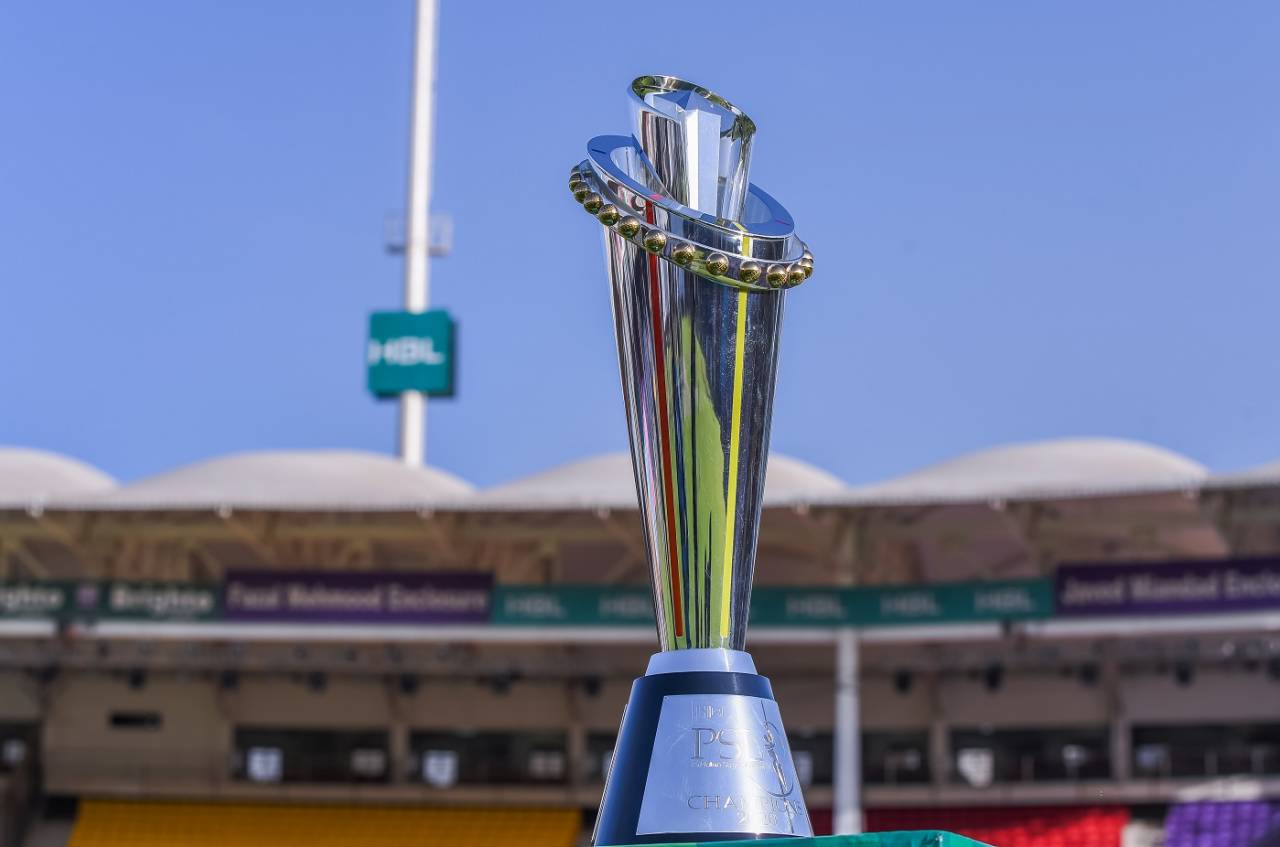
Eight teams will now compete for the PSL trophy • PCB/PSL
"Remember," Salman Naseer, the CEO of the Pakistan Super League (PSL), said partway through the auction for the seventh PSL side, "that this is an annual fee, not just a one-time payment." The most recent bid, from technology firm i2c, had just clocked in at PKR 1.7 billion (approx. US$6 million). Naseer, of course, was explaining the magnitude of the proposed investment for the benefit of the viewers, both at the Convention Centre in Islamabad as well as the scores watching on TV, with the auction live-streamed to a sizeable interest.
He might just as easily have been reminding the potential owners themselves, or even the PCB, of what these figures meant for the league that has become the financial bloodstream for Pakistan cricket. The two franchises up for sale were eventually procured for a combined PKR 3.6 billion (approx. US$13 million) per year, effectively guaranteeing fees of PKR 36 billion (approx. US$130 million) over the next decade from these two franchises alone.
The value vastly exceeded expectations, both external and internal. For context, the most expensive of the existing franchises, Lahore Qalandars, will pay a comparatively modest fee of PKR 670 million (approx. US$2.3 million). Qalandars, Karachi Kings, Peshawar Zalmi, Islamabad United and Quetta Gladiators' combined annual fee clocks out to PKR 2.62 billion (approx. US$9.2 million), about a third less than what Hyderabad and Sialkot, the two new sides, will pay.
The PCB had gone all out to make a grand occasion of what was ultimately an administrative event. The road leading up to the Convention Centre was adorned with billboards of the auction; a group of young men wandering around the path leading up to the building asked if this was a player auction. The PCB and PSL officials were dotted about the entrance, and the arriving bidders were greeted like celebrity guests at a showbiz party.
That glitz carried on into the hall, with a red carpet, quite literally, laid out where the owners stood on an inclined platform to talk to the media, quite literally looking down upon the press pack and the hall itself. Before they walked into the auction auditorium, bathed in half light like a cross between a magician's sanctum and a Victorian tavern, the trophy was tantalisingly placed in a display at the entrance. Right by it was a list of the winners of each previous edition with a cricket bat signed by the winning team, like gum or chocolate bars laid out at a counter just before you swipe your credit card at a hotel checkout.
That the PSL was itself unsure of what sort of investment interest they'd get was evidenced in the base price set for each new franchise. Naseer announced at the auction for the first of the two teams that bidding would begin at PKR 1.1 billion (approx. US$3.9 million), already nearly twice that of any existing team.
But as the value began to explode in 4K, livestreamed real-time, the PSL was sober-headed enough to pull off a trick of their own. The base price for the second team would begin at PKR 1.7 billion (approx. US$6 million), the highest failed bid from the previous round.
Telecommunications firm Jazz, one of the most prominent sponsors of the PSL of the past decade and a pre-auction favourite to acquire a team, never made a bid throughout the auction. Solar energy firm Inverex, another perceived heavyweight, rolled the boat out with the first bid, raising the base price by the minimum required PKR 10 million (approx. US$36,000), but never once attempted another bid.
But the PSL appears to have firmly caught the imagination of overseas Pakistanis, whom the PCB spent much of December trying to woo with networking events in London and New York. Dubbed as "roadshows", interested parties were encouraged to bid for the two new sides; notably, both new owners, FKS and OZ Group, attended one of those events last month.
The auction made clear why procuring that overseas investment was such a coveted goal of the PSL. Ultimately, there were just three serious contenders for the two teams up for grabs, with each drawing its financial heft from businesses overseas. FKS is an aviation and healthcare conglomerate based in the US whose CEO, Fawad Sarwar, described himself as a cricket tragic in a brief chat with the media before the auction began. He is the owner of Kingsmen Sports and Enterprises and owns Chicago Kingsmen, who recently took part in the Top End T20 series in Australia.
Australian real estate consortium OZ Developers was less fancied, especially as they opted out of the bidding at the first auction early on, but returned to secure the second, which brings Sialkot, a team many felt should have been a PSL founding member, finally into the PSL. Their winning bid came in at PKR 1.85 billion (approx. US$6.55 million), making it the most expensive PSL side.
Given this is an annually recurring fee, there will invariably be concerns about the financial viability of any ostensibly outsized valuation. In 2018, one of the owners, Schon Group, walked away from Multan Sultans after just one year. Even at the lower price point where the other franchises sit, there have been concerns that the path to profitability for the franchises remains uncertain at best. It was cited as one of the factors that Multan Sultans' most recent owner, Ali Tareen, opted not to renew, and ultimately pulled out at the last minute from Thursday's auction.
For now, though, none of that appeared to matter. At the press conference right after, PCB chairman Mohsin Naqvi sat beaming, calling the high sale prices a vindication of the PSL going in the right direction and taking pride of place among T20 franchise leagues. Both Sarwar and Hamza Majeed, OZ Developers' CEO, described owning a PSL team as a "dream come true". That may not sound like a hard-headed, calculated business decision, but the PSL's pull has never exactly been framed as strictly financial.
As everyone filtered out of the venue, the buzz of what had transpired was palpable in the cold night air. Perhaps, when it wears off, FKS and OZ will have time to assess whether the size of the investment they have poured into the PSL was worth the dopamine hit of triumph. The PSL, though, will feel it has set a new benchmark for its value, one that even its most optimistic calculations would have dismissed as a distant pipedream.
Danyal Rasool is ESPNcricinfo's Pakistan correspondent. @Danny61000