
Boy wonder Sameer Minhas runs on timing, not power
He has made his name on feats of quick big-scoring, but the 19-year-old Pakistan opener says his game is all about calculation
Ahsan Iftikhar Nagi
Jan 16, 2026, 5:26 AM
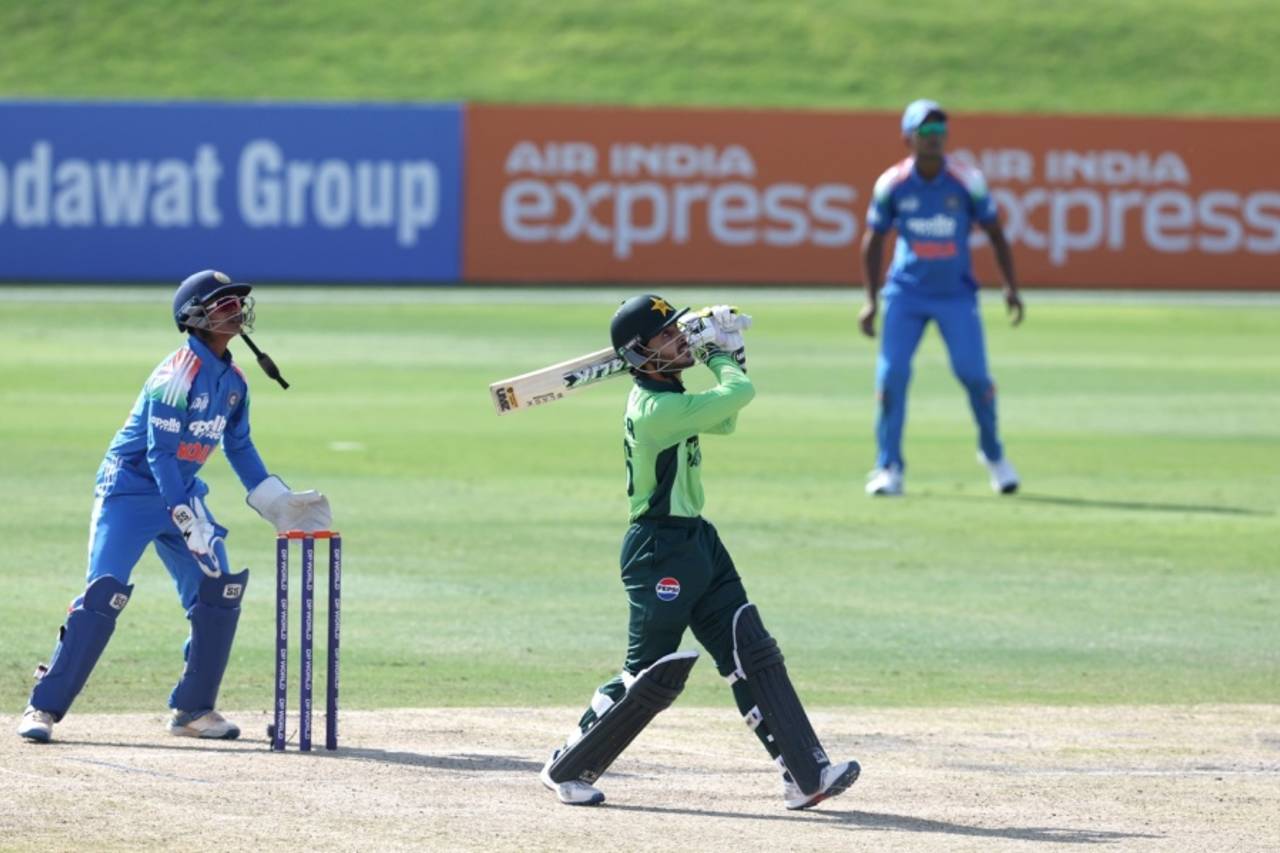
Pakistan will hope Sameer Minhas' good form will give them fiery starts in the World Cup • CREIMAS/ACC
Sameer Minhas burst into a laugh as he narrated one of his earliest cricket memories.
The odds were stacked against nine-year-old Minhas when he was drawn against Arafat, his brother, in a local single-wicket tournament one evening in Multan. Naturally, Arafat was the favourite to win the contest. "He had given me a target of 10 or 12 runs [in an over]," Minhas said. "I needed four or five runs on the last ball and I hit him for a six. They went into wild celebrations."
A decade later he made hundreds of Pakistan fans at the ICC Academy ground in Dubai erupt in raucous celebration over the course of his record-breaking 172 off 113 balls against India in the final of the Under-19 Asia Cup. He hit 17 fours and nine sixes, each shot seemingly better than the last.
There was no zone of the ground Minhas did not access that morning. He pierced gaps with elegant shots as he cut, drove, flicked, pulled and swept. His sixes were timed sweetly, not bludgeoned. He unfurled every stroke in his repertoire with authority on the biggest stage, only about a week into his career in Pakistan colours. The highlight was a checked on-drive that went for six off fast bowler Deepesh Devendran in the ninth over.
That innings catapulted Minhas into the national consciousness in Pakistan. Former and current cricketers, politicians, and leading figures from all walks of life congratulated him on social media. That it came in a year when political tensions between the two countries were heightened brought it more than usual attention.
"It is a memorable innings for me," Minhas said from Zimbabwe ahead of the 2026 U-19 World Cup. "There was pressure, no doubt about it, but I told myself to bat like I was doing throughout the tournament by staying cool, calm, and fearless.
"I followed the same routine [that day as I had] throughout the Asia Cup. I woke up, took a shower, had breakfast, went to the ground, put on my spikes and crossed the rope with a belief that we will win the Asia Cup.

"I had no particular plans for that innings, but I wanted to contribute well for the team. I planned to [put more] pressure [on the opposition] after Hamza [Zahoor, the other opener] had hit early boundaries. They started to bowl wayward and I took advantage of it."
Nine days before, Minhas had scored 177 not out off 148 balls against Malaysia, in his first match for Pakistan. Over the course of his five innings in the Asia Cup, he made 471 runs at the stratospheric average of 157 and a strike rate of over 117.45, for which he was named Player of the Tournament.He hit 41 fours - the most in the tournament - and 19 sixes, the second most after India's destructive top-order batter Vaibhav Sooryavanshi. It marked him as a potentially generational talent.
Eight days on from the India match came another century - this time 142 at quicker than a run a ball, against Zimbabwe in a washed-out game in an U-19 tri-series in Harare. A week later Minhas smashed the fastest ever hundred in Youth ODIs, in 42 balls, over the course of his 114 off 51 against Zimbabwe in the final of that series. Pakistan raced to the target of 159 in under 17 overs, and Minhas was Player of the Series again.
The foundation for that record-breaking innings was laid two days before the 142 against the same opponent, when he made a two-ball duck against Afghanistan in his first match after the Asia Cup final.
"I learnt from that zero," Minhas said. "I realised that you will not be able to score runs every day. It taught me how your fortunes fluctuate as a batter. You can get out on a zero after a good run of form and then you have to pick up the rhythm again.
"I never planned to go for the record," he said of the 42-ball hundred. "The pitch had settled by the time our turn came to bat, and the ball was coming onto the bat nicely. I started to play my shots freely and ended up with the record."
At a time when the riches of T20 cricket encourage young batters to mould their techniques to suit the demands of that format, Minhas' old-fashioned, orthodox batting makes him stand out.
"Some people consider fearless cricket to be 'hit, hit, hit', but for me it is about maximising my scoring opportunities. If a ball is in my zone, regardless if it is first or last, I will attack it and make the most of it"
He comes from a cricket-obsessed Multan family that boasts a current international in left-arm spinner Arafat, who made his senior T20I debut in the 2023 Asian Games, played in the last U-19 World Cup, in South Africa, and featured in four PSL matches for Karachi Kings.
"Arafat and I used to curate 'challenging batting conditions' on our porch and looked to survive as one does in Test cricket," Minhas said, looking back to when he was nine. "We used to tape half of the tennis ball to make it swing, and bowl fast at each other on wet tiles, which sped up the ball [even more]. You were out if you edged or hit the ball out of the house. There used to be cars around us, so we had to be careful, because we were scolded if we did any damage to them."
Their father, Kashif Minhas, who at one time had aspired to be a cricketer himself, and had played tape-ball cricket in Multan, enrolled them in the local Crescent Cricket Club.
"Our father was a fast bowler and it was very tough to play him because he used to bowl off- and legcutters from the same action," Minhas said. "He played a few times with us and encouraged us to move to leather-ball cricket. He provided us all the facilities and environment so we could play cricket at the highest level."
When Covid-19 lockdowns in their home town threatened to bring the cricket careers of the boys to a halt, Kashif rolled a pitch on the roof of their house and covered it with a net. His sons, however, used it for only two days before a fierce thunderstorm demolished it.
Minhas took his first steps in competitive cricket in 2018, when he represented Multan in the PCB's U-13 tournament. He played two U-13 seasons as a legspinner, and was the best bowler for his team - Southern Punjab - with nine wickets at an average of 10.56 in six matches in the second of those. Soon, though, he came to enjoy hitting the ball more than bowling it, and convinced his coach, Tahir Mahmood Faiz, to give him more batting time in the nets,
"My coach taught me how to time the ball and play it on merit. The bat used to rotate in my hands when I tried to hit hard, and the ball looped in the air when I blocked, because I was holding the bat tightly."
What followed was the reconstruction of Minhas as a batter - a process that helped the teenager understand his strengths and limitations.
"[Faiz] taught me how to play with soft hands and hit the ball along the ground," he said. "We worked on my [timing] and I learned the benefits of playing the ball late. It took me a while to understand batting, after which I started to implement all those learnings in matches.
"I realised I am not a power-hitter but a good timer of the ball. I can hit boundaries by timing the ball well. You need to have a very different bat flow to be a power-hitter."
Once assured of his batting ability, Minhas began to break down the process of run-making.
"I know I can score 100 if I play 150 balls," he said. "I also know that I can score more runs if I play more than 150 balls. You have to respect good balls. One or two maidens do not disturb me, because I have confidence that I can improve my strike rate later in the innings once I am settled. I try to stay in the present moment and build my innings by only targeting the balls I can score off.
"There is a trend these days of scoring at faster rates, and we are now seeing that even in Tests. But I try to bide my time and build innings. Once settled, I am able to score rapidly because I start to middle and time the ball better. But you cannot attack every ball and cannot be playing rash shots as a top-order batter.
"Some people consider fearless cricket to be 'hit, hit, hit', but for me it is about maximising my scoring opportunities. If a ball is in my zone, regardless if it is first or last, I will attack it and make the most of it."
In U-16 cricket for Southern Punjab, Minhas shared the dressing room with his brother, who was in his last year at that level and helped Minhas navigate some of the challenges he faced.
"He has had a major impact in my career," Minhas said. "He shares his experiences of PSL and international cricket and tells me how to deal with the pressures of U-19 cricket. There is a lot of pressure on U-19 cricketers because you worry what will happen to your career if you do not perform. He tells me how I can stay focused and continue to do better. He advises me to not be selfish but think about the team and the star [the Pakistan cricket emblem] you are wearing when you bat."
Before graduating to U-19 cricket, Minhas went to a camp for the best 100 teenage players across Pakistan in 2022, organised by the PCB in collaboration with a multinational corporation, for which foreign coaches were engaged. He went on to have a forgettable first U-19 season but scored 411 runs at an average of 59 for Multan in the most recent one, which helped him secure a berth in the Pakistan U-19 side.
He has had a sensational start to his Youth ODIs career. Since his debut, no batter in that bracket has scored more than his 654 runs. He has the best average (81.75) and second best strike rate (126.01), and he is locked with Babar Azam and Shahzaib Khan at No. 2 on the list of batters with the most Youth ODI centuries for Pakistan. Minhas took nine matches to breach the 100-run mark three times, while Babar and Shahzaib did so over 31 and 23 innings.
It has been two decades since Pakistan have won the U-19 World Cup and the fans will be pinning their hopes on Minhas when Pakistan begin their campaign against England today, looking to end the drought. Does it put him under any pressure?
"I am, rather, feeling quite confident because of my form and looking to stretch it into the World Cup," he said. "I don't focus on what is being said on social media or in the news, because I am here to represent my country and I don't want to be distracted."
While many anticipate his rise to the senior side in the coming years, the immediate challenge that awaits him after the World Cup is his higher education. "My mother wants me to continue my education along with cricket, so I have enrolled myself for A Level," he said. He has opted for relatively easy subjects - Business Studies, Urdu and Sociology - since he does not expect to be able to spare much time for studies because of cricket. "I cleared my O Level in Computer Science, which was tough [to manage with cricket]," he said.
Moving from studying for a science degree to an arts or commerce one is a switch many students in Pakistan make after realising how demanding engineering and medical degrees can be. In similar vein, when the time comes, will Minhas prefer the luxuries of T20 to the toil of the longer formats?
"I love all three formats and want to represent Pakistan in them for a long time," he said. "I would love to play Test cricket because it tests your temperament over five days and it demands a lot of effort. I like Test cricket a lot, and currently I am also enjoying white-ball cricket."