
Abhishek Sharma, Babar Azam, and why we need new measures for T20 hitting
Over the last eight-odd years, some batters have worked out new ways to score quickly in T20, while others have stuck with old methods
Kartikeya Date
Feb 5, 2026, 2:11 AM • 5 hrs ago
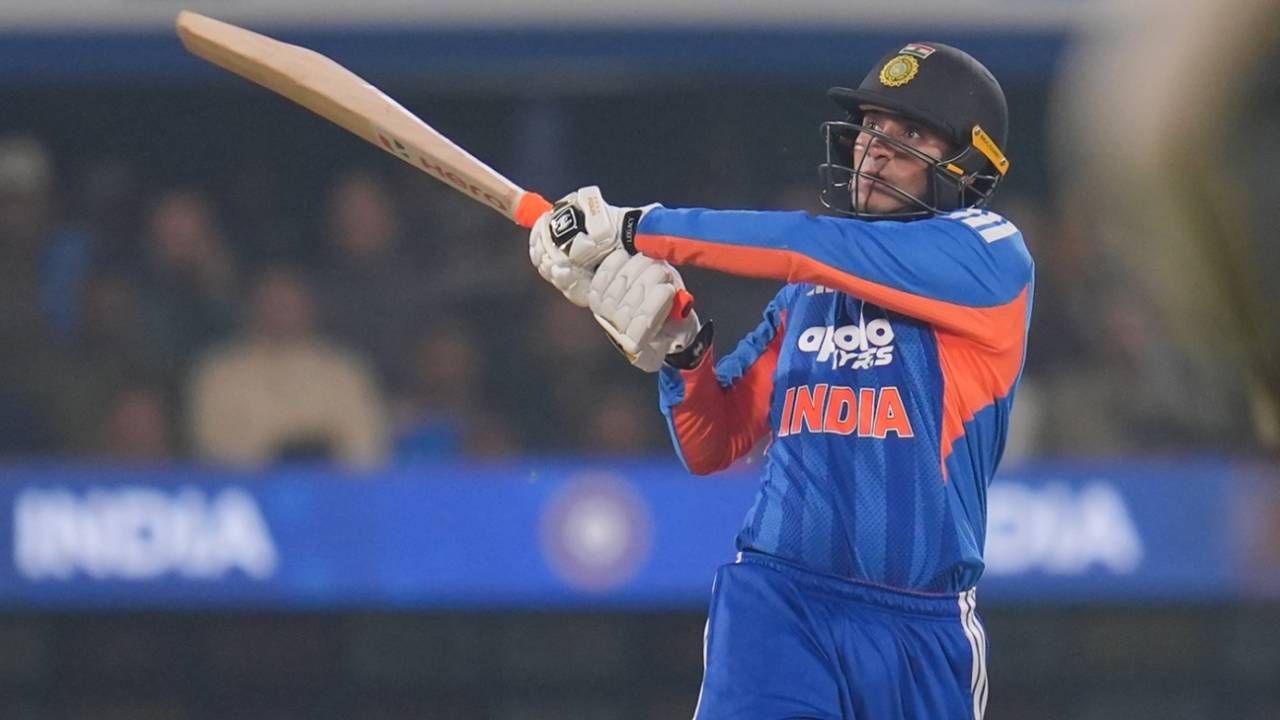
Abhishek Sharma: boundary seeker, not stump defender • BCCI
I have been arguing in these pages for about a dozen years now that T20 is not the same as other cricket, that there is no role for the single in it, and that T20 is a different game that ought to be understood by its own measures of merit.
In 2026, this view is less eccentric than it was ten years ago, though the rules of the T20 format remain unchanged. The Pakistan wicketkeeper-batter Mohammad Rizwan was retired out by his team in a recent BBL fixture when he was on 26 off 23 balls; his last seven balls to that point had produced only four singles. A few days later in the same tournament, Rizwan's Pakistan team-mate Babar Azam seemed surprised when his partner, Steven Smith, declined a single on the last ball of the 11th over of their chase of 190. Babar had made 47 in 37 balls at the time and had not scored from his previous four deliveries. Smith proceeded to take the power surge and got 29 runs off the next five balls.
At the other end of the scale lies Abhishek Sharma. He has hit 37 boundaries (fours or sixes) from his last 100 balls in T20 (including T20I) matches at the time of writing - a boundary every 2.7 balls. Since the beginning of 2025 through to January 27 this year, Babar hit 88 boundaries in 617 balls in all T20s - one every seven balls. Sixteen of Abhishek's 37 boundaries in his last 100 balls in T20s have been sixes; only 14 of Babar's last 617 balls in T20 have been hit for six. The pattern holds since the beginning of 2023, as the table below shows.
This site's ball-by-ball record provides details of the shot each batter attempts (for example, cover drive or flick) in addition to noting whether the batter is in control of the shot. These two details make it possible to estimate an Expected Runs (xR) and Expected Wickets (xW) value for a given attempted shot by a particular type of batter (either left- or right-hander) against a particular style of bowling.
The Expected Wickets measure estimates the likelihood of a false shot to result in a dismissal for a given shot. It is essentially the conversion rate of false shots to dismissals for a bowler-batter-control match-up. For most shots, dismissals from in-control deliveries are vanishingly rare, and so are counted as zero. The Expected Runs provides the runs-per-ball figure for the attempted shot; it is the average runs produced by the shot in in-control and not-in-control situations.
For instance, for a right-hand batter facing a right-arm fast-medium bowler in a T20 match, the expected outcomes can be estimated as shown in the table below. Using this basic summary for all match-ups in the record, it is possible to calculate the Expected Runs and Expected Wickets for each delivery in a match as long as the batting style, bowling style, control and shot type are recorded.
This provides three measurements for each shot - Expected Runs, Expected Wickets, and frequency of false shots. With the hook shot, for example, only about one in ten false shots results in dismissals in T20. But about 63% (242 out of 384) of hook shots tend to be false shots. In comparison, 28% of cover drives tend to be false shots. This provides a picture of the risk, reward and difficulty of each shot attempt for a given match-up.
Using these measures, the Expected Runs and Expected Wickets for a given match-up, over, innings, match, series or career can be estimated. For instance, the records for right-hand batters attempting the cover-drive against bowlers classed as right-arm fast, right-arm fast-medium and right-arm medium-fast, are similar. It is reasonable to combine these three bowling styles into "right-arm pace".
The comparison of Babar with Abhishek against this broad category of bowlers (see table below), shows several interesting things. For shots classed as cover-drives by scorers, Abhishek has hit 52 out of 100 to the boundary, and 18 of those 52 over the boundary. Babar, by contrast, has hit 79 out 266 (or about 30 out of 100) to the boundary, and only two over it. Abhishek makes the more expansive, power-packed attempt as a rule, and plays a false shot 31% of the time, compared to 24% of the time for Babar.
Considering this for every shot type and every match-up, the overall record of expected runs for the two players, for deliveries where data is available, shows a similar pattern. Babar scored 9072 runs for 204 dismissals from 7031 balls; the expected returns from these deliveries are 9436.1 runs for 218.7 dismissals. Abhishek scored 3200/103 from 1847 balls for which the expected returns are 2462.5/91.6. He overshoots expectations on traditional shot categories by a large margin: he scored roughly 740 extra runs for about 11 extra dismissals compared to the expectation. Babar scored roughly 350 fewer runs for 14 fewer dismissals. In T20, where balls are a scarce resource, Abhishek has the ability and the willingness to make the more reasonable trade-off.
Ninety-six per-cent of deliveries in a T20 match are played by batters in the top eight batting positions. A useful measure based on the Expected-Runs calculation described above is a runs-above-average-replacement measure (RAAR). This is simply the difference between the actual runs scored by a player and the expected runs for those shot choices on those match-ups. For instance, over their respective careers, Babar and Abhishek's RAAR measures are -424.1 and +732.5. When normalised per innings, Abhishek produces 6.1 runs above the average replacement, while Babar Azam produces 1.6 runs below the average replacement. In the 2025-26 BBL, for instance, Babar managed -2.8 RAAR per innings. In the 2025 IPL (his most recent tournament), Abhishek Sharma averaged +9.6 RAAR per innings.
In the four years since when the Covid-19 pandemic started to wane, the average top-eight batter scored at 143 runs per 100 balls faced, compared to 132 runs per 100 balls faced in the four years before that. The average innings of a top-eight batter is roughly one ball shorter in the second period versus the first.
The record for some players, like Steven Smith, Suryakumar Yadav and Abhishek, shows that they have worked out new ways to score quicker runs. Other players have not been able to do this. Still others, like Jos Buttler for instance, were already at the cutting edge, and now find that a number of players have caught up with them. The scoring rates for Babar and Rizwan have remained unchanged, even as the game has progressed. Virat Kohli's scoring rate shows a small increase (from 133 to 139 runs per 100 balls faced), but it is still below the average scoring rate of batters in the top eight positions.
The more interesting shift lies in the shot categorisation. Scorers still use traditional shot categories for T20 hitting. These shot categories were developed for Test cricket, where the batter's primary goal is to defend the top of off stump and wait for the run-scoring opportunity. In Test cricket, batters play the line and length of the ball. Babar does this, for the most part, in T20 as well. Abhishek and Suryakumar Yadav don't play the line and length of the ball in T20; they play the field, and have cultivated strokes to target the undefended boundary. Most of Abhishek's cover-drives involve him running down the pitch to loft the ball over cover. This is why he hits so many sixes on the cover-drive.
T20 hitting has now emerged as a distinct cricketing skill, separate from Test match batting. Its purpose is different, as are its measures of merit. Just as Babar's batting is something of an anachronism in contemporary T20, so is the use of cricket's traditional shot categories to describe T20.
T20 scorekeeping requires a "boundary attempt" measure to complement the control measure. Scorers ought to keep the field in mind and decide a simple yes or no question - did the batter try to hit the ball to an undefended boundary? They should ignore the fielders in the infield, only look at which boundaries are defended, and judge whether the batter attempted to hit the ball to or over a part of the boundary that wasn't defended. This would provide a more complete description of T20 hitting than information about whether the shot played looked like a cover-drive. Abhishek Sharma does not hit cover drives. He hits boundaries.
Kartikeya Date writes the blog A Cricketing View. @cricketingview