
Rip me up and start again: cricket's most thrilling art is also the most self-destructive
Cricketers who bowl at high pace will break, sooner or later. That is, and has always been, a given

Greg Chappell
Dec 2, 2025, 6:22 AM
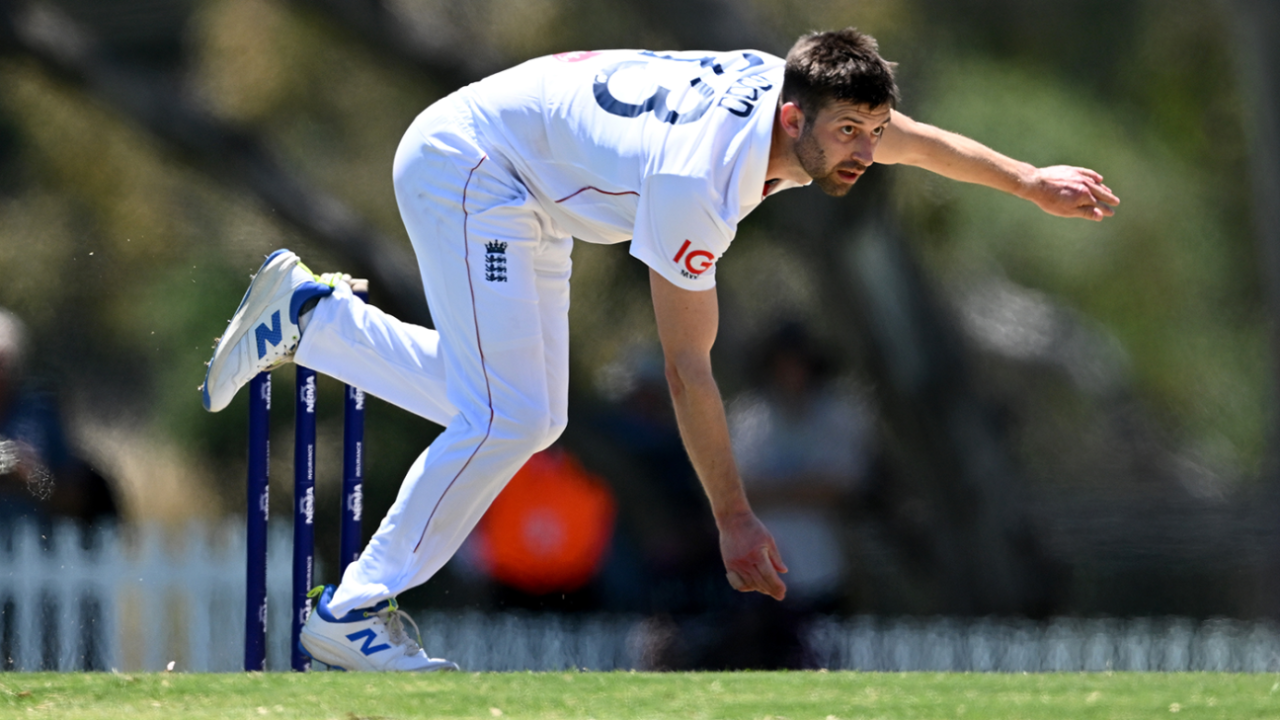
That ain't easy: Mark Wood lets one rip, without tearing himself in half • Getty Images
Imagine a javelin thrower sprinting flat-out before planting their front leg and unleashing the spear with every ounce of power. Biomechanists describe that sudden stop - all that forward momentum slamming to an abrupt halt - as the equivalent of a low-speed car crash. Now picture doing similar a few hundred times over the course of five days, while trying to hit a spot the size of a saucer 22 yards away. That, in essence, is what a Test-match fast bowler signs up for: a deliberate act of repeated self-destruction, which the human body was never designed for.
A couple of weeks ago, as Australia began the Ashes without Pat Cummins and Josh Hazlewood - two of the finest fast bowlers of their generation - the old conversation resurfaced: why do fast bowlers break down so often, and what, if anything, can be done about it?
The brutal truth is that bowling seriously fast means living permanently on the edge of what the skeleton, soft tissue, ligaments, tendons and nervous system can endure. Speed comes at a price, and the bill usually arrives in two instalments: once in adolescence, when bones are still growing, and then around 30, when the years of accumulated impact finally catch up.
Cummins knows both chapters intimately. As a prodigiously quick teenager, he suffered lumbar stress fractures - tiny cracks in the lower spine caused by the explosive twist and arch of the delivery stride. He missed almost two full years. Now, at 32, he is in the second danger zone, managing a body that has carried an enormous workload as captain and strike bowler. Hazlewood's troubles have had more to do with soft tissue - side strains, hamstrings, shoulders - the classic toll borne by a tall man repeatedly bracing against huge ground-reaction forces.
History is littered with similar stories. Dennis Lillee was told in 1973 that multiple spinal stress fractures had ended his career. A relentless two-year schedule with no proper off season had broken him. He rebuilt himself through pioneering strength work, remodelled his action and returned stronger, eventually claiming a world-record tally. I know no one with such iron will.
Dale Steyn, among the most electrifying bowlers of the 21st century, alongside Jasprit Bumrah, Mark Wood and Kagiso Rabada, fractured part of his shoulder blade in 2016; the screw inserted to fix it marked the beginning of the end, sadly. Bumrah and Cameron Green have recently undergone surgery involving screws and titanium wire to bind vertebrae together to stabilise stress fractures. Very few men of pace seem to avoid the inevitable.
The almost indestructible Jeff Thomson - owner of the most efficient, whip-like side-on action ever seen - only suffered one serious injury in his career, and that came from colliding with a fieldsman, not from bowling itself. Ironically, when being scanned for something else, it was discovered that he had had three undiagnosed stress fractures. One can assume that he was on the verge of joining the statistics when an off-season break gave his body time to heal.
Glenn McGrath was another thoroughbred who played at the highest level for 14 years and took 563 Test wickets with minimal injury problems because he had a textbook, efficient action. His one major injury came from treading on a stray ball at Edgbaston in 2005. Accuracy, rather than raw speed, was his weapon - a hallmark of those who enjoyed genuine longevity.
To watch someone repeatedly hurl a ball at 90mph and above is to witness athletic beauty and impending breakdown in the same glorious, terrifying motion
The bowlers who lasted shared one overwhelming trait: a lean, strong frame that absorbed shock rather than fought it. Richard Hadlee shortened his run-up mid-career, sacrificing a yard of pace for extra durability. Courtney Walsh, tall and whippy, bowled until he was 38, amassing 519 Test wickets with an action so smooth, it looked effortless. Lillee advised a struggling Brett Lee to use top-end pace sparingly; Brett eventually heeded the lesson and prolonged his career with clever variations.
Fred Trueman seemed unbreakable but he often enjoyed six-month winters in his 67-Test career. By contrast, James Anderson played 188, plus nearly 200 ODIs - an unfathomable feat. As a 19-year-old, I faced Trueman at the dawn of my career and the dusk of his. I was told that he bowled within himself for much of his county career, saving top speed for England; as did John Snow. Anderson and Stuart Broad pushed the envelope by eventually playing Test cricket only.
Wood's ballistic action has limited him to 38 Tests in ten years; his latest knee injury stemmed directly from the explosive leg drive that produces his 90mph-plus thunderbolts. Mitchell Starc, lean and superbly athletic, has dodged serious trouble across 100 Tests and multiple formats, and is in prime bowling form.
Modern schedules are merciless: more overs, shorter recovery windows, three formats, year-round. Development coaches now preach "load management", and Einstein's maxim - keep it as simple as possible but no simpler. Young fast bowlers must build a broad athletic base first - by running, jumping, throwing - before specialist skills are layered on. Rush the process, or allow mixed actions full of side-bend, hyperextension and counter-rotation, and the body will rebel. Shaun Tait's slinging arm could produce ball speeds of 100mph, yet he rarely lasted more than a few matches before something broke.
Careful monitoring of bowling loads through growth spurts is non-negotiable, as is intelligent balancing once a bowler turns professional. Even so, physics cannot be cheated: the front leg takes up to eight times the body's weight, the torso rotates violently, the arm whips through at startling speed. Something eventually gives.
Many strength programmes now include yoga, pilates and elements of tai chi to improve mobility, core control and shock absorption. A lean, strong, flexible athlete recovers faster and breaks less often than one who relies only on heavy iron in the gym.
Thomson possessed freakish natural strength and elasticity. Most mortals do not. Copy his action without his gifts - as countless club cricketers discovered in the 1970s and '80s - and you were soon limping away after a couple of fiery spells.
Australia's current injury list is a reminder that no amount of science has yet annulled the laws of nature. Cummins and Hazlewood will be replaced by eager youngsters, and the cycle will continue. Some will have the resilient architecture that allows a long career; others will flare brightly, then burn out.
This Ashes series has already been profoundly shaped by the absence of two world-class operators. In the end, the urn will almost certainly go to the team that best manages to keep its premier fast bowlers fit and firing longest.
Fast bowling remains cricket's ultimate contradiction: the most thrilling sight in the sport is also its most self-destructive. To watch someone repeatedly hurl a ball at 90mph and above is to witness athletic beauty and impending breakdown in the same glorious, terrifying motion. The great ones merely postpone the inevitable. The rest of us marvel - and wince - at the extraordinary price they pay.
Former Australia captain Greg Chappell played 87 Tests for them in the 1970s and '80s. He has also coached India, and been an Australia selector