
'Nothing ruled in or out': Winds of change blowing through BBL
The new BBL season comes amid extensive talks about the future of the competition and what potential privatisation could look like
Tristan Lavalette
Dec 13, 2025, 2:25 AM
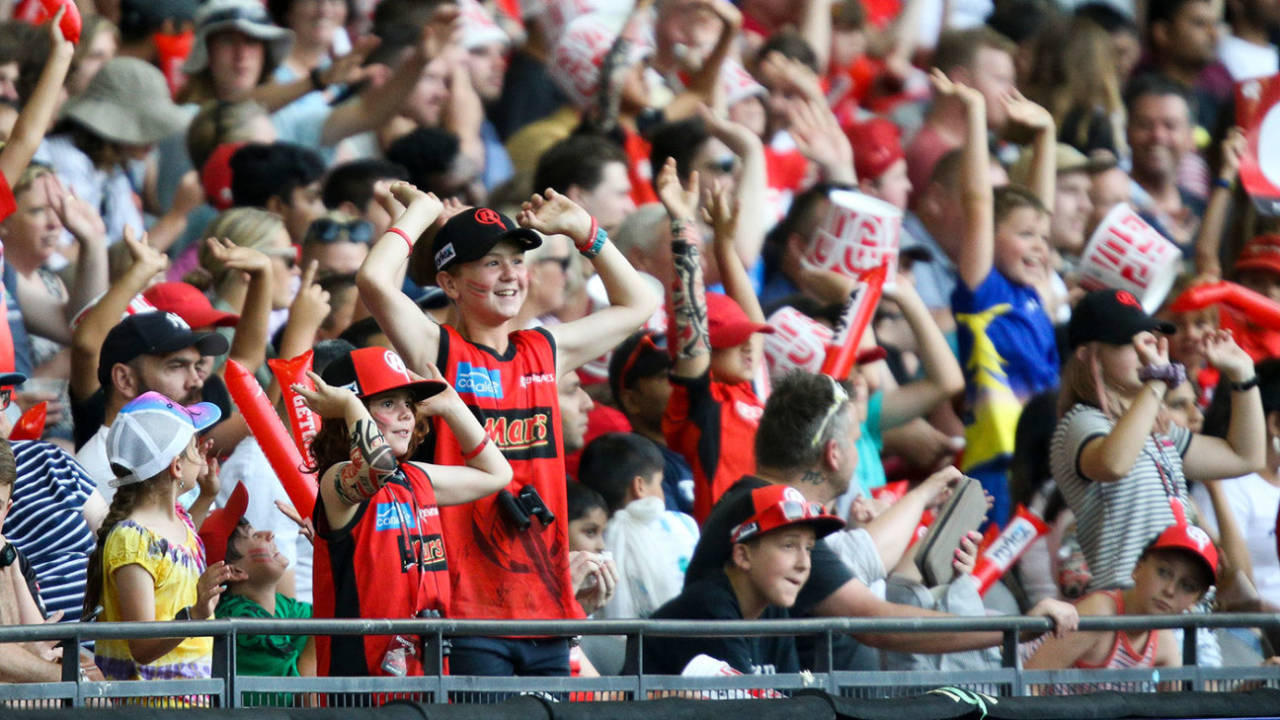
The BBL has recovered in recent years but operates at a congested time of the year • Getty Images
The Big Bash League (BBL) is about to celebrate its 15th season. There are current BBL players not old enough to remember the Australian cricket summer without the T20 franchise competition, which grew rapidly after its inception in 2011.
The BBL memorably peaked in the middle of last decade, marked by a still record tournament crowd of 80,000 for the Melbourne Derby. But an expanded length of competition in 2018, followed by the Covid-19 pandemic, saw its crowds and value decline before a truncated tournament helped engineer a bounce back in recent seasons.
"I'm seeing a lot of indicators that are showing it's back at this sort of BBL 5-6 level," Cricket Victoria chief Nick Cummins told ESPNcricinfo. "For Stars and Renegades, ticket sales are up year on year since Covid, growing at about 20-30%."

The BBL clearly remains an integral part of the cricket summer, well nestled in the school holiday period of December-January, but winds of change are in the air.
While fans will be focused on the whirl of on-field action, Australian cricket power brokers will be deeply pondering whether to privatise the eight BBL clubs, a model favoured by most overseas domestic T20 leagues and other sports, and expand the tournament into neighbouring countries.
Any of those changes would radically alter Australian cricket and if they happen then the BBL could soon look very different to its first 15 seasons. Amid the speculation there is a widespread belief that something will happen although nobody quite knows for sure.
"Nothing is inevitable. Nothing has been ruled in or out. There is a lot of water to go under the bridge," an administrator aware of discussions said.
Privatisation has been mooted from the beginning
Privatisation has long been contemplated, even before the franchise-based BBL started in 2011 as it pivoted from the previous domestic T20 competition contested by the six traditional state teams.
"There was a delegation from Australia, including reps from Cricket Australia and the Melbourne and Sydney franchises, that visited India before the start of the BBL," a senior administrator from an IPL franchise told ESPNcricinfo.
"We were made an offer for one of those teams, but I don't think they had really thought it through in terms of the structure and how they would bring in private investment.
"That was the closest we came to considering something there. There has always been interest seeing how it has all unfolded and some of the challenges it has had."
With then CA chief executive James Sutherland sceptical, privatisation talk fizzled away but resurfaced when the game's coffers took a hit during the Covid-19 pandemic.
The advent of cashed-up leagues in South Africa and the UAE, overlapping with the BBL season, also provided serious competition in attracting big-name players.
The BBL's standing as the second biggest T20 competition in the world after the IPL came under question, accelerating calls for private equity which have gathered steam since chair Mike Baird and chief executive Todd Greenberg have taken CA's leadership reins in recent times.
The sale of Hundred franchises in England earlier this year, with the teams valued at £975 million (AUD$2 billion), was also an eye-opening moment for Australian administrators.
Financial distribution model awaits
An independent report from Boston Consulting Group (BCG) was commissioned by CA to assess the current model and future structure of the BBL. BCG in July recommended CA sell minority stakes in the eight BBL clubs.
There had been some hope that a final decision could be made by the end of this year, but much still needs to be thrashed out with every state having its own set of needs amid varying financial issues.
The financial model for privatisation had been based around the concept of selling 49% stakes in the clubs, but it has emerged that one franchise each in Melbourne and Sydney could be entirely sold off. Selling an entire franchise would likely add major value and be particularly alluring for prospective investors.
I'm always a value buyer. So I always believe in taking something and building, that's my goalSanjay Govil, owner of Washington Freedom
Estimates of the value of a sale have ranged between AUD$400 and AUD$800 million, according to industry sources. A potential sticking point, however, is how exactly will the money from a sale be carved out.
States are waiting on the distribution model which could create an impasse. If the proceeds are divided equally, Victoria and New South Wales, who combine for half the teams in the competition, won't be enthused.
Privatisation does provide a huge opportunity for CA to repair its budget and potentially around AUD$400 million could be invested in the game - from the grassroots to ensuring the three formats of international cricket are financially sustainable.
Who are the potential investors
Potential owners are likely to mostly come from India and the US, some of whom already own T20 franchises and might want to further spread their footprint. Some IPL franchises, like the Knight Riders, have built global brands and boast satellites in various leagues.
It is safe to assume that IPL owners, some of whom have been courted by CA, would be keen to rebrand BBL franchises they bought into. Perhaps foreshadowing what's ahead, there have been prominent changes in the Hundred such as the Oval Invincibles transforming into MI London after Reliance Industries (Mumbai Indians) secured a 49 per cent stake.
"If it doesn't make business sense, we're not going to do it but it'll be interesting to explore if privatisation happens," an administrator from an IPL franchise said about the BBL.
American tech entrepreneurs have also started to get seriously involved in cricket, spurred by the development of Major League Cricket (MLC) in the US. Having had a taste of ownership, some are keen to build a portfolio of teams.
Sanjay Govil, owner of Washington Freedom which has a strategic partnership with Cricket New South Wales, secured a 50% stake in Welsh Fire as part of the Hundred sale.
"Absolutely interested if there was an opportunity in the BBL. I think it would be a great opportunity, but we need to wait," said Montreal-born Govil who grew up in India before making his fortune in the U.S.
"I'm always a value buyer. So I always believe in taking something and building, that's my goal. Like with Welsh Fire, I think retaining the local character is very important. So I'm not coming from a perspective where I would come in and want to change everything."
Overseas expansion
Expansion of the BBL was put forward by the BCG report as an avenue worth further consideration. There has not been as much public focus on the concept, suggesting perhaps that expanding the tournament abroad might be a longer-term goal.
But under a privatised BBL, an initial expansion of two further teams - one domestic and one international - is a possible route. Canberra, the nation's capital, appears the frontrunner to build within and has the backing of Cricket ACT.
We are very interested in the BBLSingapore Cricket Association president Mahmood Gaznavi
New Zealand, which boasts teams in many Australian sports leagues, is an obvious first foray abroad. Its proximity to the east coast of Australia makes it easier from a logistical sense while being attractive to broadcasters.
With New Zealand being two hours ahead of Sydney and Melbourne, and five in front of Perth, having triple headers on game days could create a television bonanza.
New Zealand Cricket currently runs the Super Smash, a six-team competition played by the local cricket associations.
"Very supportive of expansion, New Zealand in particular," Cummins said. "I think it's bold and could be a game changer. Whether it stacks up and makes sense, I don't know, but it's interesting and expands the market.
"I think New Zealand is an important part of the cricket ecosystem in this part of the world. Time zone, the market and the strong players they have are reasons why a New Zealand side would really be an asset to the BBL."
But the idea has had a lukewarm reception in New Zealand, where plans are afoot to start NZ20, a tournament comprising six privately owned franchises in January 2027.
Singapore has also been mooted but discussions so far have been extremely informal. Greenberg and Baird were able to get a glimpse of Singapore's potential during the ICC's AGM in July, with the city-state playing host to the sport's most powerful administrators.
With financial might and a strategic location, around four hours from Chennai by plane and in the same time zone as Western Australia, Singapore is an appealing market. Prominently, it boasts a 55,000-seat national stadium, the showpiece of the Singapore Sports Hub in Kallang on the south coast of the island.
The ground has the capacity to insert drop-in wickets and over the years there have been plans for the IPL, T20I and Test cricket - as a home base for Pakistan - to be played there. But no cricket games have ever been held at the stadium much to the disappointment of the many South Asian expats who live in Singapore.
"We are very interested in the BBL. We can use all our links with the sports authorities, such as the national sports association, to push for cricket facilities to be available," Singapore Cricket Association president Mahmood Gaznavi said.
Having hosted many tournaments, becoming a hub for Associate cricket in South-East Asia, ESPNcricinfo has learnt that neighbouring Malaysia have pushed its case through a 30-page document to CA. But Malaysia does not boast the type of showy cricket stadia like in Singapore.
Another option that could be considered is playing BBL games in some of these countries as a sort of trial before launching overseas expansion teams. It could work well with Melbourne Stars and Sydney Sixers having to perennially look elsewhere to play home matches during the MCG and SCG Tests.
Australia's congested peak summer calendar
What separates the BBL from other major T20 franchise leagues is that it doesn't have a clear window, but rather complements Test cricket at the height of summer. That means that Australia's best players are not available for much of the BBL season.
Owners of a privatised BBL would surely want the best Australian players in action and for the tournament to take centre stage in the peak Christmas-New Year holiday period.
But the marquee Boxing Day and New Year Tests in Melbourne and Sydney mean that's increasingly unlikely - a public uproar would erupt if those traditions were upended - creating major logistical challenges.
What's next?
Chiefs and stakeholders are set to hold meetings through the summer. But final decisions are not expected until at least the middle of next year. There is some belief that even if privatisation does go ahead that actual changes to the competition may not happen until after the current broadcast agreement, which expires in 2030-31.
Much more should be known over the next few months.
Tristan Lavalette is a journalist based in Perth