
Australia vs India in 2024-25
A review of Australia vs India in 2024-25
Gideon Haigh
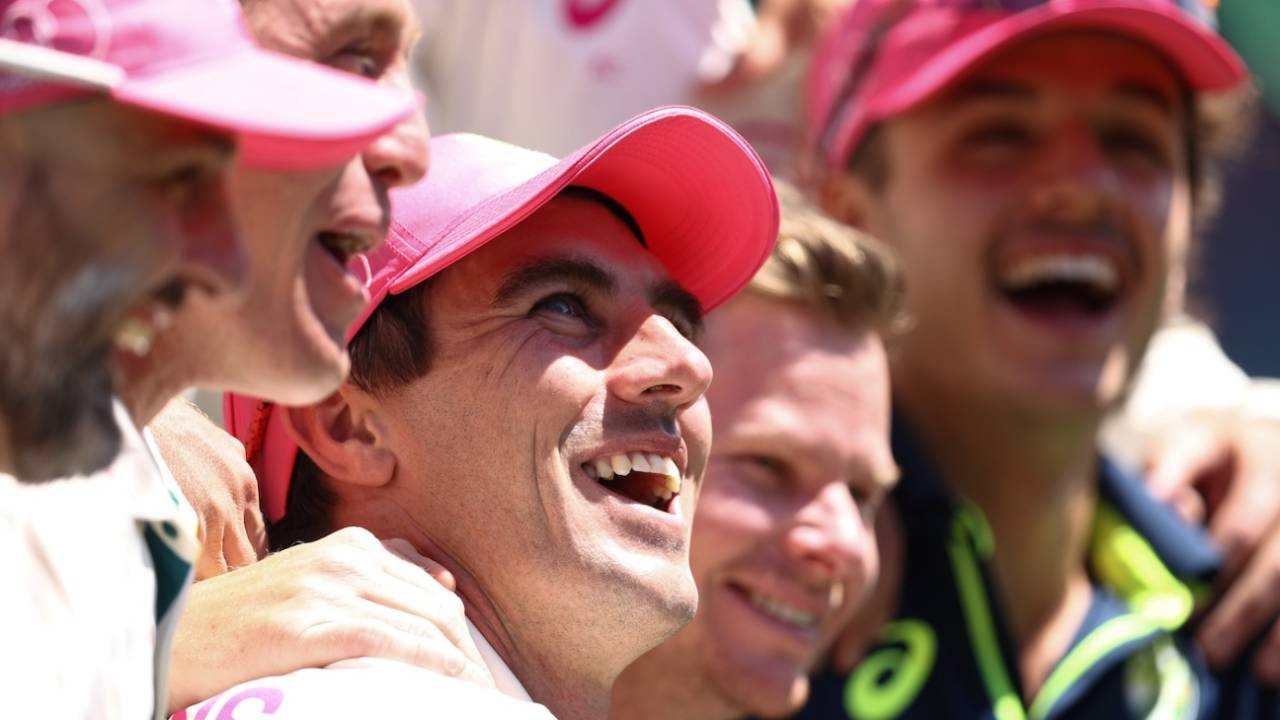
Pat Cummins celebrates with his team after winning the Border-Gavaskar Trophy • Jason McCawley/AFP
Test matches (5): Australia 3 (40pts), India 1 (16pts)
On the last morning of this epic Test series, India still had a chance of retaining the Border-Gavaskar Trophy, and Australia were not assured of a place in the
World Test Championship final. In the event, the home team prevailed 3-1, their task greatly eased by the absence with back spasms of Jasprit Bumrah, the summer's greatest single influence on either side, with 32 wickets at 13. But it was indicative of the tightness of the competition, with Australia winning a home series from 1-0 down for the first time since 1968-69, when Garry Sobers was captaining West Indies.
Ultimately, justice was done. Having surrendered the trophy in 2016-17, then lost twice to India at home, Australia were this time better prepared, better selected, better coached and better led. The series was a triumph above all for Pat Cummins, who averaged 21 with the ball and 20 with the bat, seldom missed a trick in the field, and totally eclipsed his rival Rohit Sharma, dismissing him four times for 11 runs. Rohit arrived late, having missed the First Test for the birth of his second child, and left early, supposedly resting himself from the Fifth Test.
His decline formed part of a trend. Extra grass and a twice-lacquered Kookaburra envenomed pace bowlers on both sides, making for the lowest scoring Test series in Australia in nearly 30 years. There were only 14 partnerships of more than 50 for the first five wickets, partly compensated for by the record number of balls - 3,191 - soaked up by wickets six to ten. Spin played virtually no part, despite two Tests lasting the full five days. Ravichandran Ashwin perhaps saw the writing on the wall when, after the Third at Brisbane, he announced his retirement, effective immediately. Nathan Lyon's greatest contribution was the 60 he added with Scott Boland for the last wicket in Australia's second innings at Melbourne.
It is misleading to call Bumrah a revelation, as he was a known quantity, but he attained heights of mastery that made it seem like there were two series in progress: one where we watched him bowling, the other where we waited for him to bowl. In the first series, for instance, Usman Khawaja averaged five; in
the second, 50. Bumrah reduced one nervous debutant, Nathan McSweeney, to a sitting target; it was a source of widespread astonishment when a second
debutant, teenager Sam Konstas, came out in the Melbourne Test and ramped Bumrah serially through the most expensive spell of his career. Bumrah
delivered 28% of India's overs, taking 40% of their wickets, at a third of the cost of the other bowlers.
Cummins was reinforced by the remarkable Boland, who joined the ranks only when Josh Hazlewood was injured, and in three Tests further reduced his bowling average on home soil to 12. Tireless and accurate, he was chiefly responsible for the struggles of Virat Kohli, who made a second-innings hundred in Perth, only to slip away abjectly: Boland dismissed him four times in the series at an average of seven. Deprived of impact with the bat, Kohli could make impact only with his shoulder, brushing arrogantly against Konstas as they passed in mid-pitch in Melbourne - the pettiest act of a great career, and for which the ineffectual ICC imposed only a token fine. Nothing became Kohli so little as the manner of his departure from Australia.
Coming after India's failures against New Zealand at home, their performance at Perth Stadium was a shock to the system. Yashasvi Jaiswal and K. L. Rahul denied Australia a wicket for two entire sessions; Australia's bowlers, wrapped in cotton wool for months, seemed underdone. The false dawn lasted as long as it took Mitchell Starc, armed with the pink ball, to dismiss Jaiswal with his first delivery at Adelaide Oval. "We've spent a lot of time together as a group over the years, so we knew we weren't at our best at Perth, but it was never as bad as it seems," said Cummins. "So you stick tight and double down on what makes us a really good side."
One of those things was Travis Head, whose capacity to stay leg side of the ball, freeing his arms to play through the off, made him difficult to stop once set: he made 415 runs in four innings, 33 in six others. Two further hundreds, his first since Lord's in 2023, also accrued to Steve Smith, who finished the series a single short of 10,000 Test runs. His 101 at Brisbane was a careworn effort with three boundaries, his 140 at Melbourne a celebration of future potential. It was his 11th hundred against India, to go with 12 in the Ashes.
India's selection, meanwhile, seemed confused. They conservatively lengthened their batting, slotting in the promising Nitish Kumar Reddy at No. 8 when he should have been higher, and excluding Ashwin to fit in Washington Sundar, a superior batter. Reddy and Sundar had a good partnership at Melbourne, but the strain that caught up with Bumrah was an indication of India's over-dependence on him.
Fans were almost as much the stars as players. The aggregate of 837,879 was the fourth-highest in Australian history. Melbourne's attendance of 373,691 was a record for any Test in Australia, surpassing the 350,534 who watched Don Bradman's side defeat England over six days in 1936-37. The final-day attendance of 74,362 was a record fifth-day crowd for a Test in Australia. Non-Ashes attendance records were broken at every venue. Ratings were the highest since Channel Seven and Fox Sports acquired the broadcast rights in 2018, and video engagements were unprecedented. It's little wonder that soon afterwards were bruited ICC plans to split Test cricket into two divisions, mainly to enable Australia and India to meet more often: in the great economic Test match, self-interest wins by an innings every time.