
Vandals stopped play
The last day's play at Headingley in August 1975 promised to be a thriller ... until it was discovered the pitch had been vandalised

Martin Williamson
Aug 19, 2005, 3:32 PM
PA Photos
The fourth day's play of the third Test at Headingley in August 1975 ended with the match balanced on a knife-edge. Australia, chasing a record 445 to beat England, and so retain the Ashes, had reached 220 for 3, with their opener Rick McCosker still there, within one hit of a maiden Test hundred. England still had their noses in front, however, with only Doug Walters, never happy on English pitches, and the incapacitated Ross Edwards of the mainline batsmen remaining. But the pitch was benign, and any one of three results were still possible.
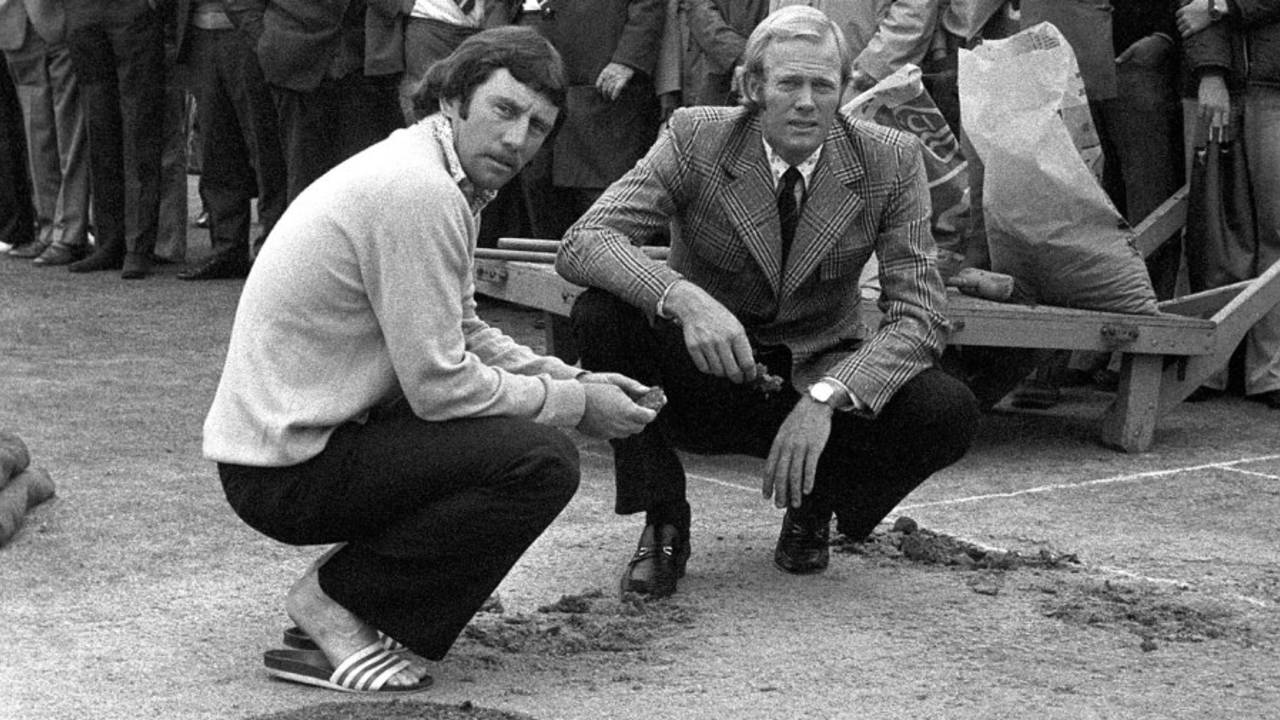
The last day - a Tuesday, in those days of rest days on a Sunday - dawned cloudy, but when George Cawthray, the groundsman, pushed back the covers, he was greeted with the sight of a pitch which had been vandalised. Several lumps of soil had been gouged out of the surface just short of a length at the Rugby Ground End. While Cawthray later admitted that he could have repaired those sufficiently to allow play to recommence, what sent a chill down his spine was that the holes had been filled with about a gallon of oil. Cawthray found the solitary nightwatchman, who had not heard anything unusual, and then summoned the police.
As the players, officials, and keen early spectators arrived, the first signs that all was not well came when they were greeted by the sight of slogans daubed on Headingley's perimeter walls: "George Davis is innocent." Inside, the number of policemen and officials clustered round the pitch soon brought home the reality.
Tony Greig and Ian Chappell, the two captains, inspected the pitch and agreed that it couldn't be used. The umpires briefly considered a suggestion that the adjacent strip could be mown, but with no guarantee that it would play as the one used for the first four days had - slow, low and with little turn - that idea was quickly dismissed.
Television viewers tuning in for the start were greeted by a sombre-looking Peter West. The reason for the lack of his usual genial grin immediately became obvious as he announced that the match had been abandoned. The details given were sketchy and brief. And whereas today endless replays would be shown, and petro-chemical experts dragged in to explain exactly what kind of oil had been used, in those more genteel times of 1975, the BBC reverted to transmitting a picture of a cricket ball with a two-line explanation as a caption.
By lunchtime, the grey clouds had given way to a more persistent drizzle: the match would have been abandoned by tea-time anyway.
A rumour began to circulate that there would be an extra Test - a fifth - slotted in after the Oval finale. But although the idea was discussed by the two boards, it was soon dismissed. The only spare date was for a match starting on September 11, and the Australians, who all had fulltime jobs back home, were committed to return before then.
 |
|
And what of the George Davis, the man in whose name the pitch had been dug up? Largely unknown until then, he was a 34-year-old London minicab driver who had been sentenced in 1974 to a 20-year sentence for armed robbery. Protestors had been campaigning for his release for about a year, and in 1976 he was freed after Merlyn Rees, the home secretary, decided that his conviction was unsound. But two years later he was found guilty of
attempting to rob a bank and sent to prison for 15 years. Released in 1984, he again returned to prison in 1987 when caught trying to steal mailbags.
Interviewed on the evening of the incident, Colin Dean, Davis's brother-in-law, who was later convicted of being involved, told the BBC that the act had been carried out to bring the subject to the public's attention. "We can get the Ashes back anytime," he argued. "What have we done? Dug a little bit of ground up. Is it sacred?"
Dean and three others - two men and a woman - were eventually taken to court and charged with vandalism. Three received suspended sentences and one, Peter Chappell, was jailed for 18 months.
The fourth Test at The Oval ended in a draw, even though it was extended to six days, and so Australia, led by Ian Chappell for the last time, retained the Ashes. McCosker, stranded on 95 at Headingley, did manage to score a Test century at last.
In the aftermath of the incident, security at major matches was reviewed. But just in case anyone thinks that this kind of thing couldn't happen today, it's worth noting that in May 2004 vandals scaled the walls at The Oval and dug holes just behind the crease at the Vauxhall End, delaying the start.
Footnote
Picking on innocent pitches appears to have been all the rage in the hot summer of 1975. In the same issue of The Cricketer which reported on the Headingley vandalism, there was a story about police in Staffordshire being summoned to deal with a man who had repeatedly driven his car across the square at Silverdale CC. He was thought to have been protesting at balls being hit into his garden, which adjoined the ground.
Picking on innocent pitches appears to have been all the rage in the hot summer of 1975. In the same issue of The Cricketer which reported on the Headingley vandalism, there was a story about police in Staffordshire being summoned to deal with a man who had repeatedly driven his car across the square at Silverdale CC. He was thought to have been protesting at balls being hit into his garden, which adjoined the ground.
Martin Williamson is managing editor of Cricinfo