
Under-19 World Cup 2026: Everything you wanted to know but didn't know whom to ask
The 16th edition of the Under-19 World Cup starts later this week. You can get started with this primer
Abhijato Sensarma
12-Jan-2026 • 5 hrs ago
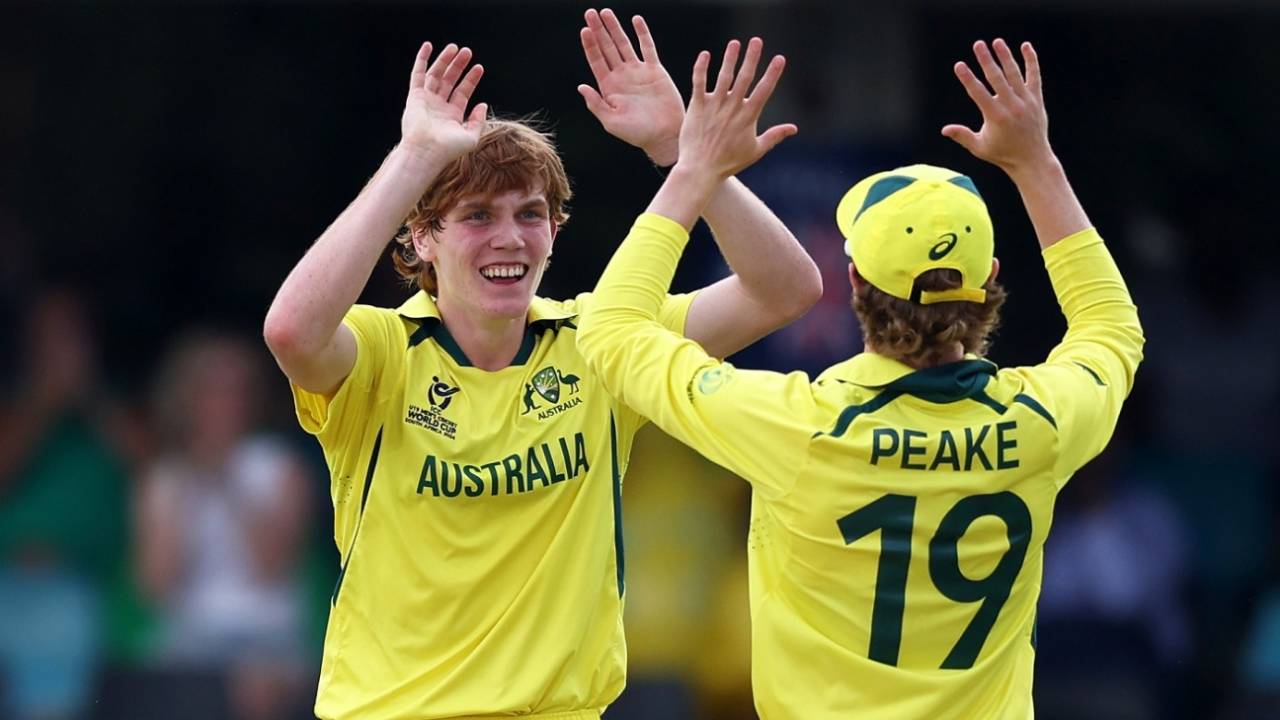
Australia are the defending Under-19 World Cup champions • ICC/Getty Images
The 16th edition of the men's Under-19 World Cup begins later this week. It will, as always, pit young cricketers from the top cricket nations alongside those from up-and-coming teams, against each other over three weeks. Here's all you need to know about the tournament.
First, the basic details: when and where?
Zimbabwe and Namibia are splitting hosting duties for this edition of the U-19 World Cup, which will be played in the 50-over format as usual. India and USA start off the tournament on January 15 at Queens Sports Club in Bulawayo. The group stage will have 24 matches, played across ten days. All the matches, including the knockouts, begin at 9.30am local time (1pm IST).
The action in Zimbabwe will move between Queens Sports Club, Harare Sports Club and Takashinga Sports Club, also in Harare. And in Namibia, the matches will be played at the new Namibia Cricket Ground as well as the HP Oval, both in Windhoek. Both Zimbabwe and Namibia will host 12 group-stage matches each.
The next stage, the Super Sixes and the playoffs between the teams that don't make the Super Sixes, will also be divided between Zimbabwe and Namibia, before the knockouts, which will all be played in Zimbabwe. Queens Sports Club and Harare Sports Club will host the semi-finals, on February 3 and 4 respectively, and the final will be in Harare on February 6.
Which teams are playing in the tournament? Any surprises?
The surprise first: Tanzania.
That aside, the top ten teams from the previous edition - Australia, India, Bangladesh, England, Ireland, Pakistan, New Zealand, Sri Lanka, South Africa and West Indies - qualified directly for the tournament. Zimbabwe are there, but Namibia, despite being co-hosts, couldn't qualify. That aside, you have Afghanistan, Japan, USA and Scotland.
Tanzania! How did that happen?
Tanzania are the biggest story to come out of the qualifiers. They won all five of their matches at the Africa qualifiers to secure their spot at the U-19 World Cup. Impressively, they got there ahead of teams like Namibia and Kenya, who have played senior World Cups in one format or the other, as well as Nigeria, rated higher than them at the senior level. This will be Tanzania's first appearance at a global tournament.
What else happened at the qualifiers?
Tanzania are joined by Japan, a rising team that won the East Asia-Pacific qualifiers. This is their second U-19 World Cup - you might remember that they qualified in 2020 too. Afghanistan won the Asia qualifier, pipping hosts Nepal, while Scotland and USA won the Europe and Americas qualifiers, respectively.
You mentioned 24 games in the first stage. What is the structure?
Ever since its second edition, the tournament has involved 16 teams. They will be split into four groups of four teams each. So six games in each group, where they all play each other once. The top three from each group then progress to the Super Sixes. Those from groups A and D will be placed in one Super Sixes group, and the top three from B and C in another. The teams that finish bottom in each of the four groups will contest in the playoffs for final placements.
At the Super Sixes, each team will carry forward the points, number of wins and net run rate gained against the fellow Super Sixes teams. Each team will play two more matches in the Super Sixes. The Super Sixes matches will be against the teams whose ranking in the group stage was different from their own: A1 will not play D1, for example, but only D2 and D3.
The top two teams from each Super Sixes group will move on to the semi-finals.
And is it like the seniors' World Cup in terms of, say, DRS, etc?
Like last time, there will be a TV umpire for each game, but DRS will not be available in the tournament.
Right. Simple enough. Now give me a bit of history.
The U-19 World Cup was hosted for the first time in 1988, as part of Australia's bicentenary celebrations. Seven Test-playing nations, as well as an ICC Associates' XI, participated in a tournament that looked quite different from what it is now. Australia beat Pakistan by five wickets in the final to become the first champions.
It was then shelved for a decade before making its return in 1998. It came back remodelled as a 16-team tournament played every two years - a format that has stayed. India and Australia have dominated in recent years, and they squared off in the latest final too, in 2024. Australia won that by 79 runs.
India, though, have been the most dominant side overall. They have won the title five times, while the win in 2024 was Australia's fourth. Pakistan are the only other team to win it more than once - they won in 2004 and 2006. England, South Africa, West Indies and Bangladesh are the only other teams to win it.
Have many of the players to play the U-19 World Cup gone on to make a name for themselves?
We'll need a lot of space to give you the full list, but let's give you an idea.
From the inaugural edition in 1988, we got Brian Lara, Sanath Jayasuriya, Inzamam-ul-Haq, Mike Atherton, Nasser Hussain, Stuart Law, Mark Ramprakash, Nayan Mongia, Chris Cairns, Aaqib Javed... Every edition has had a similar list. More recently, we have had Virat Kohli, Steven Smith, Kane Williamson, Graeme Smith, Michael Clarke, Rohit Sharma, Hashim Amla, Alastair Cook, Joe Root, David Warner, Brendon McCullum… the list is really long.
So who are the players to look out for this time?
The biggest is India opener Vaibhav Sooryavanshi. As just a 14-year-old, he cracked a 38-ball 101 in the IPL, and has been smashing records for fun since then, at a level or two below top-drawer cricket.
Pakistan opener Sameer Minhas turned heads at the recent U-19 Asia Cup, smashing 172 against India in the final, and 177 against Malaysia.
Australia's Oliver Peake returns after having lifted the U-19 trophy in the last edition. He will be the team's captain, with plenty of exposure under his belt in both domestic cricket and the BBL, where he recently smashed a last-ball six to win a thriller for Melbourne Renegades.
Another Pakistan player - Ali Raza - is highly regarded by those who have watched him, with his height and pace setting him apart from a crowded field of young seamers. He played in the PSL last year, taking 12 wickets in nine matches for Peshawar Zalmi, and also derailed India's chase in the U-19 Asia Cup final with a fiery four-for.
Someone you might not have heard of is Japan's spin-bowling allrounder Charlie Hara-Hinze - a member of the national set-up as well - who will be crucial to their chances of a first win for his country at the tournament. His acumen was on display at a Brisbane Under-17 match, where he scored 99 and took 6 for 4.
Tanzania Under-19sUnited States of America Under-19sSri Lanka Under-19s (Young Cricketers)Scotland Under-19s (Young Cricketers)Japan Under-19sAfghanistan Under-19sZimbabwe Under-19sWest Indies Under-19s (Young Cricketers)South Africa Under-19sPakistan Under-19s (Young Cricketers)New Zealand Under-19s (Young Cricketers)Ireland Under-19sIndia Under-19s (Young Cricketers)England Under-19s (Young Cricketers)Bangladesh Under-19sAustralia Under-19sICC Men's Under-19 World Cup
Abhijato Sensarma is a sub-editor at ESPNcricinfo