
Sammy's West Indies return to Kolkata looking to reclaim lost glory
It was here in 2016 that West Indies defied odds to become champions. Now back in Kolkata with not many giving them a chance, can they prove people wrong again?

Sreshth Shah
Feb 6, 2026, 6:22 AM • 6 hrs ago
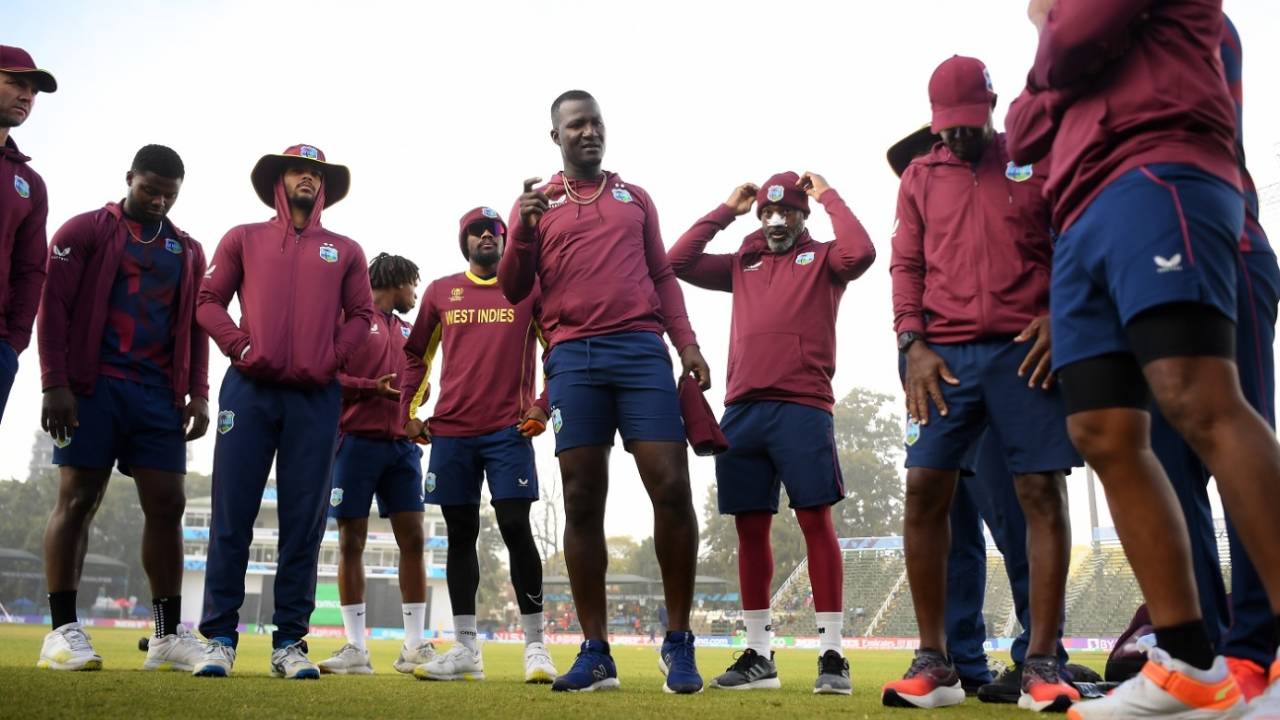
Daren Sammy was West Indies captain when they last won the T20 World Cup in 2016 • Getty Images
Ten years after they last won a world title, West Indies return to Kolkata, the site of their 2016 T20 World Cup final triumph. Their style helped pioneer the T20 approach of those years, but in the decade since, the format has evolved and West Indies' stature has steadily diminished.
The poignancy is hard to miss, arriving in Kolkata and lagging in the modern game, where once in this very city, they were shaping it. What remains, though is Daren Sammy. Captain then, head coach now.
Any mention of Kolkata, where West Indies open their 2026 T20 World Cup campaign against Scotland on Saturday and are scheduled to play three matches - including a potential Super Eight fixture against India - and Sammy still lights up. "Kolkata is always a good place to go to," he says. "Anytime I'm feeling down, I go straight to Eden Gardens."
Sammy is not riding only on nostalgia. He sees parallels between the two campaigns - a similar blend of experience and youth, a comparable energy in the squad, and a familiar sense of needing to prove naysayers wrong.
"It feels the same," Sammy says. "We are going to India and I'm pretty sure nobody is giving us a chance. Same as 2016."
Immediately after their win in 2016, you'd remember Sammy saying the "disrespect shown by journalists, media and their own cricket board" pushed the West Indian players to go the extra mile amid a chaotic collapse in communication between players and administration. They took down tournament hosts India in Mumbai in magnificent fashion in the semi-final. And then, Carlos Brathwaite's heroics in the final at Eden Gardens acquired instant legendary status.
That dynamic has changed. In the decade since, the board has gradually acknowledged that the players hold the aces at the negotiation table, and their stance on player participation is less rigid, if not totally laissez faire. The head coach now finds himself as the bridge between the board and players. Sammy is still, players say, the elder brother in the squad, the anchor in moments of drift, but his authority now comes from responsibility to the health of cricket in the Caribbean rather than individuals.
West Indian players are still among the most sought-after T20 players in the world, and individually they have thrived. But collectively, the national side has been inconsistent with ten different captains - five of them full-time - since Sammy, and only one semi-final appearance since. Selection has often been shaped by availability as much as form, and continuity has rarely extended beyond a couple of series. It comes across as though the maroon shirt has become just one of many commitments, with national contracts and match fees nowhere close to the pay-checks distributed by top leagues. Take Nicholas Pooran, as one example of many, who retired from internationals during the prime of his game at the age of 29, to ensure better financial security for his days after retirement.
But to zero in entirely on off-field issues as the reason behind West Indies' T20 decline over the last decade would be an easy out. The truth? Their batting hasn't evolved with the times even as their bowling has held its own with exciting incoming talent.
Let's go back to the period between the 2012 and 2016 T20 World Cups, and West Indies operated on an extreme trade-off. Nearly 43% of all their balls faced were dots, but they made it up with a ball-per-boundary ratio of 6.8 and a ball-per-six ratio of 16.98. Dots barely mattered because no team in the world converted deliveries into big shots as frequently as they did. One clean strike could undo an entire over of inertia.
However, the modern game no longer allows for that kind of play. Since the 2024 T20 World Cup, West Indies still hit boundaries and sixes at a healthy rate, but no longer at a level that separates them from elite teams. India, England and Australia have matched that power while their dot-ball percentages are way lower. West Indies, by contrast, sit at the bottom for dot-ball percentage. What was once an acceptable risk has become a structural disadvantage in a format where power is now normalised and efficiency during non-boundary deliveries can make a difference over 20 overs.
The assessment is not lost on the West Indies captain Shai Hope. His batting transformation is an example for his team-mates.
"From a batting standpoint, dot balls have been our Achilles heel for quite some time," Hope says. "We have power-hitters who find boundaries freely, so if we limit those dot balls then we can maximise our runs and score big totals, or chase what we need to."
What Hope - who has promised to be the team's floater this T20 World Cup - is really articulating is not to limit power, but to not let the game drift against good bowling. That has shaped how the squad looks. For every big-hitter like Sherfane Rutherford, Rovman Powell, Romario Shepherd, Quentin Sampson and Johnson Charles - who also has a winners medal from 2016 - there's Brandon King, Roston Chase and Hope interspersed in the line-up.
That is also why the buzz around this batting group is quieter than usual. There are fewer promises of whirlwind hitting - which they remain capable of - and instead there is an acknowledgement that the challenge now lies in finding ways to keep the scoreboard moving. The bowling, with Shamar Joseph, Jayden Seales, Akeal Hosein, Gudakesh Motie, Matthew Forde can challenge the best, and Holder - who was a non-playing member of the 2016 winning squad - has just had the best bowling year of his life, and for any T20 bowler in history.
"The realistic point is we can win the World Cup," Sammy says. "The challenge, though, will be for us to put all this talent together."
And so West Indies return to Kolkata and India, not to recreate who they once were but to test what they have become. Sammy remains the constant, but this time the outcome will rest on how his team handles the moments he can no longer influence.
Sreshth Shah is a sub-editor at ESPNcricinfo. @sreshthx