
NZ Confidential: How Brook's tangled timeline leaves ECB in a bind
By covering up the off-field antics of England's white-ball captain, the board has exacerbated its post-Ashes fallout
Cameron Ponsonby
Jan 22, 2026, 7:10 PM
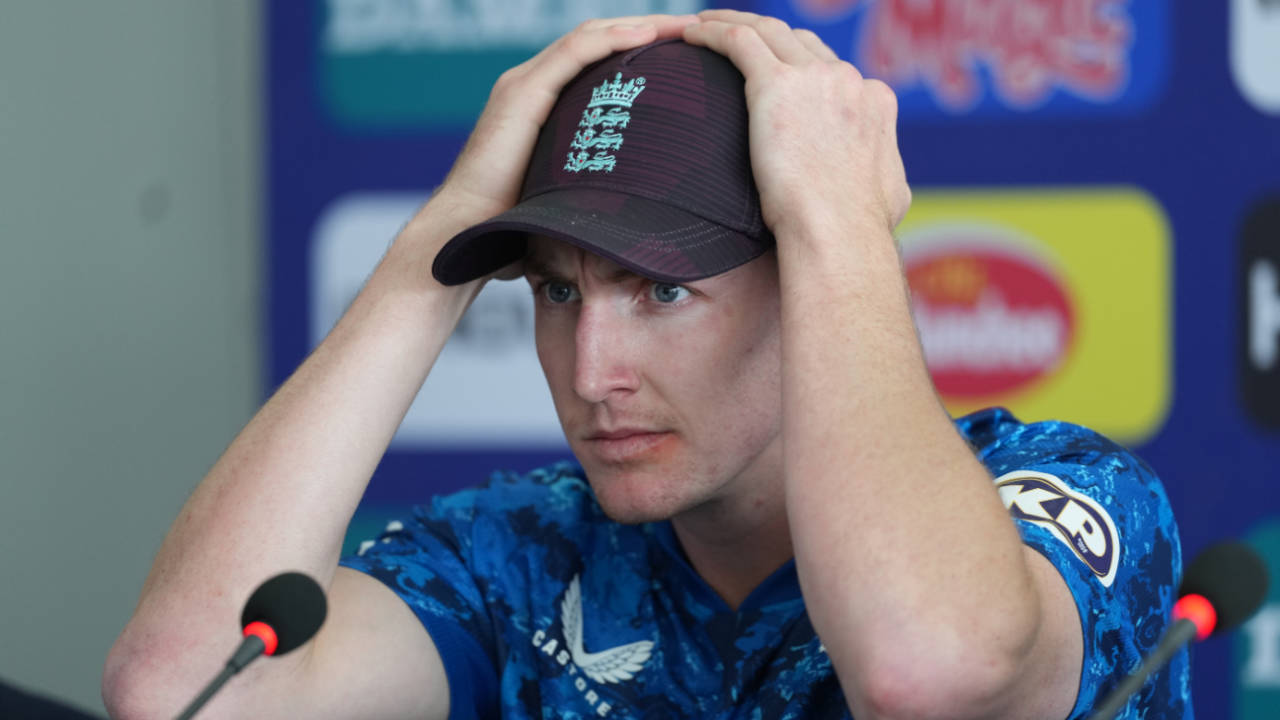
Harry Brook faces the media ahead of the first ODI in Colombo • Getty Images
When does lying by omission become a deliberate lie?
The entire Harry Brook timeline has been a mess. To catch you up, the night before the third and final ODI against New Zealand, Brook - along with Jacob Bethell and a number of other squad-mates - went out for a drink. The following day, a social-media video emerged of the group at a bar. Upon discovering this, Brook went to the management, mid-game, and confessed what had happened. Except he had an extra detail for them. He'd been out late, and when attempting to get into a nightclub, a bouncer had refused him entry and punched him. England lost the subsequent match by two wickets. And the series 3-0. It was their final competitive fixture before the Ashes.
England addressed the matter immediately, though only the aspects that social media had already put in the public domain. The line given was that the players had had one drink after dinner and then gone home. This was not true. Over the following days, behind closed doors, Brook came close to being sacked, but was instead spared and fined the maximum amount possible of £30,000, while being placed on a final warning for his off-field behaviour.
"I didn't think it would ever come out," Brook said to the press in Colombo. Addressing the story that had, ultimately, come out.
Perhaps that would have been true had England won back the Ashes, having gone out of their way to protect their famously laid-back team culture. Instead, they placed themselves in a bind: when that disastrous tour went off the rails, all conversations around drinking and off-field behaviour had to be conducted with the elephant not in the room.
In Melbourne, ahead of the Boxing Day Test, Rob Key was asked about England's alleged drinking culture, with the focus on that evening in Wellington in particular. He said that "no formal action" had been taken, and that England had had "four years where we've had none of these issues really with any of the players". But this was not true either. England's Test vice-captain had been punched outside a nightclub a mere eight weeks earlier. Which Key knew, but the public didn't.
Key and England's defence here is that these are two separate issues. First, the social-media video, and then what happened with Brook. By that logic, they were not lying, they had simply been asked questions about the social-media video, and so they answered questions about the social-media video ... Your Honour. However, had the details of Brook's night out been known, the context of any and all discussions would have changed. England being out and about in Australia would no longer have been an "allegation of a drinking culture", but a confirmation.
The cloak-and-daggers continued with Brook's mea culpa in Colombo on Wednesday. In his first public comments since the big reveal on the final evening of the Ashes, Brook insisted that he had gone alone to the nightclub. Yes, he had been out drinking with his friends, such as Gus Atkinson, Josh Tongue, Tom Banton and Jacob Bethell. All of whom were on their penultimate night in New Zealand, and most of whom, bar Bethell, didn't have work the following day.
And yet, from his version of events, we are led to believe that a group of men in their twenties, who were out in Wellington, on a Friday night, on Halloween, and who didn't have work the following day, said: 'Well, that's plenty enough for us tonight. We're going home'. To which Brook, the one man in that group who did have work the following day, said: 'Well, I'll just crack on by myself then'.
All such questions remain unanswered. At your most generous, you can ask how aghast anyone should really be with the muddled comms. What, exactly, are England duty-bound to tell the public? There's no legal requirement for them to bare all. In the case of the social-media video, the full picture might have remained unclear even with full disclosure. In Brook's specific case, Key could have cited confidentiality. And as for who was where and when ... well, England want Brook to prove himself as a leader, and here he is on the public stage (allegedly) not dobbing in his mates.
But what is relevant is the mess that this has created. England's management are under the microscope for the decisions they have made and the on-field consequences that they have led to. And in this, the most glaring example of where the team's relaxed environment went too far, they hid it from public view.
The upshot is that England are now on their best behaviour, but two months too late. Had the situation been acknowledged publicly ahead of the Ashes, the drinking and behavioural problems that the ECB CEO Richard Gould cited in his post-series statement would have already been addressed, and wouldn't require post-hoc investigation.
That is not to say that England would have won the Ashes. In fact, it's a fair bet that the team management believed full disclosure would actively undermine their chances, and given the unrelenting media scrutiny that accompanied them from Perth Arrivals onwards, they arguably had a point.
But the excesses that they are now having to answer for - such as when an unnamed player was out after the third Test against captain's orders, or when Ben Duckett was out on his own in Noosa and had a camera shoved in his face, or when multiple England players were turned away from a casino in Perth because it was too late - all these could have been avoided.
It would have been difficult for England. Firstly, because the New Zealand tour had been billed as a chance for the players to bond and let their hair down before the big event. And many of us, this writer included, extolled the benefits of a relaxed environment. But it's surely not hypocritical to suggest you should be able to have your cake and still not get p***ed the night before a match.
The timing of Brook's admission was a further problem for the management. He only owned up to the incident midway through the following day's match, by which stage he was already captaining England in their final outing before the Ashes. Had he divulged it beforehand, he could have been suspended for that fixture and the crime would have been addressed and punishment administered in one fell swoop. The message could also have been sent to the wider group: "This is too far. Heads screwed back on for the Ashes, please."
Related

McCullum: Media scrutiny of Brook incident is 'annoying'
Brook lied 'to protect team-mates' after nightclub bouncer incident
Road turns minefield as England fail familiar trial by mid-innings spin
Ashes fallout: Key to investigate whether England's drinking went too far in Noosa
ECB investigating Ben Duckett video amid drinking allegations
But as it transpired, the news was released not simply after the fact, but after the Ashes, and now a performative midnight curfew has been introduced for the Sri Lanka tour.
But if, as Brook put it, a curfew is "the best thing going forward, for the time being, to be able to put us in situations where we can win games of cricket", then wouldn't it have been best introduced for the Ashes, the series that head coach Brendon McCullum described as "the biggest of our lives"? The answer is no. Because the only difference between now and then is that the public also know of the Brook incident. It is an infantilising punishment, brought in to play to a crowd that England have repeatedly insisted they ignore.
The whole thing smells off at the moment. Not just the curfew, but the accompanying news agenda: the re-hiring of fielding coach Carl Hopkinson, the re-hiring of Troy Cooley as national pace-bowling lead, ... it all speaks to an executive that is changing the temperature of the room to the point where McCullum will want to leave.
McCullum doesn't do curfews. And nor does he do bigger backroom staffs. But nor is McCullum dumb. The ECB have given him a massive contract until the end of 2027, so he won't want to quit, as then he won't get paid. And the ECB won't want to fire him, as then they will have to pay him. McCullum vs Gould. Is this the great staring contest of 2026?
It was reported in the Telegraph that Key looks set to keep his job. Okay. But the decision to keep Brook's misdemeanour under wraps is another example of a wrong turn made. Add it to the self-confessed list that includes the preparation for the Ashes being wrong, the selection being wrong, and the performance being wrong. At some point, something has to matter again.
Cameron Ponsonby is a freelance cricket writer in London. @cameronponsonby