
Pakistan vs England in 2024-25
A review of Pakistan vs England in 2024-25
Lawrence Booth
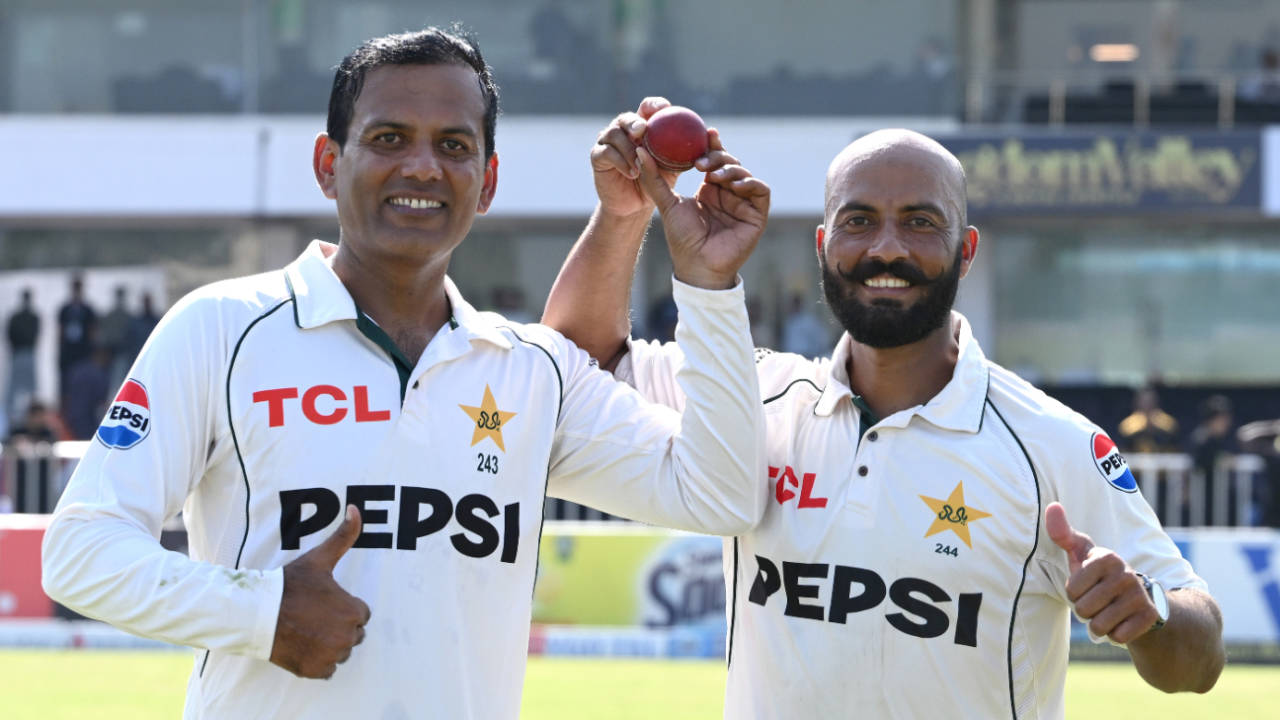
Noman Ali and Sajid Khan pose with the match ball after the third Test • Getty Images
Test matches (3): Pakistan 2 (24pts), England 1 (12pts)
Before the First Test at Multan, England head coach Brendon McCullum said his side's 3-0 whitewash in Pakistan two years earlier had been an "outlier". When they racked up 823 for seven a few days later, setting up a victory as astounding as any in the Bazball era, his words sounded like false modesty. Yet in the very scale of Pakistan's defeat lay the seeds of their recovery. In a manoeuvre that only they could have contrived, let alone conceived, they tore up their strategy and embarked on one of Test cricket's most memorable fightbacks.
England had never lost a three-match series from 1-0 up; perhaps, too, they had never been so clinically ambushed. At the heart of Pakistan's resurrection were two thirtysomething slow bowlers, left-armer Noman Ali and off-spinner Sajid Khan, who had been unwanted for the First Test, when Abrar Ahmed was the lone frontline spinner. But he was hospitalised by dengue fever midway through the game, and did not feature again. Upheaval ensued. The Pakistan Cricket Board installed a new selection committee, including the former Test seamer Aqib Javed and the former international umpire Aleem Dar. Head coach Jason Gillespie, to his publicly stated irritation, and captain Shan Masood no longer had a vote. Nor did they have a say in what happened next.
Preparations and refurbishments for the Champions Trophy, scheduled for February and March 2025, had temporarily ruled out Lahore and Karachi as Test venues. It was decided - late on - that Multan would stage the Second Test too, while Rawalpindi would keep the Third, though ongoing protests there in support of the incarcerated Imran Khan, Pakistan's former captain and prime minister, briefly raised the prospect of Multan hosting the whole series. Yet the events of the First Test had persuaded Aqib and Aleem that England could not be beaten on a flat track. They ordered spinning surfaces - and how.
With the Second Test played on the same pitch as the First, and into its ninth day by the time England resumed their second innings on 36 for two in pursuit of 297, Noman and Sajid became the first pair of spinners to share all 20 wickets in a Test since Jim Laker (19) and Tony Lock (one) against Australia at Old Trafford in 1956. ICC referee Richie Richardson was uneasy about the decision to ignore three fresh surfaces on offer at Multan, but settled for a quiet mention in his post-match report.
Pakistan's job was only half-complete. Almost the minute they had squared the series, the think tank flew north to oversee the build-up to the decider. There, they were equally inventive. In an attempt to dry out Rawalpindi's famously unyielding pitch, giant heaters were employed alongside the industrial-sized fans used for the previous game; liberal use of a rake added the finishing touches. Noman and Sajid this time shared 19, and Pakistan had won a home Test series for the first time since 2020-21. The sight of Sajid twirling his vaudeville moustache and celebrating wickets with a dance derived from the South Asian sport of kabaddi added to the sense that England had become the punchline in a joke beyond their control.
Richardson later ruled the pitches for all three Tests "satisfactory". Previous English teams might have grumbled, but this one - save for a couple of knowing references to rakes - accepted they had been outplayed. In both Tests they lost, they had established a platform: in the Second, they were 211 for two on the second evening in reply to Pakistan's 366, before losing four quick wickets; in the Third, they reduced their hosts to 177 for seven in reply to 267, and had the advantage of bowling last. But Pakistan showed more resolve and skill, not least when Agha Salman exploited dropped catches to give them a crucial lead in
the Second, and Saud Shakeel manipulated singles at will during a superb century in the Third, with Noman and Sajid helping him add 167 for the last three wickets. Barely 24 hours after England were eyeing a series win, they had slumped to defeat - only their second out of nine under McCullum and Ben Stokes.
The contrast with the First Test could not have been greater. In response to Pakistan's imposing 556, England had raced at five and a half an over to their third-largest total. Central to it was a partnership of historic proportions: the 454 between Joe Root, who made a career-best 262, and Harry Brook, whose 317 was England's first triple-century for 34 years, was their highest for any wicket, and a Test record for the fourth. At one stage, the scoreboard read 703 for three, like some nightmarish throwback to the era of timeless Tests. Overwhelmed, Pakistan collapsed on the fourth evening, before Jack Leach cleaned up next morning.
But the arrival of Noman, who had won the last of his 15 caps in July 2023, and Sajid, who had played only one Test since March 2022 (and later that year managed just five Championship wickets at 71 for Somerset), were not Pakistan's only changes. Babar Azam was dropped - a revolutionary move in a country that reveres its few sporting stars. Fast bowlers Shaheen Shah Afridi and Naseem Shah were left out too, after a combined three for 277 in the First Test. Babar's replacement was Kamran Ghulam, a 29-year-old who had emerged from a labyrinthine domestic system, and now marked his debut with a pristine century. Aamer Jamal, meanwhile, was their only seamer for the last two games, in which he bowled just six overs. Indeed, while the deceptively languid Noman and the more combative Sajid finished with 39 wickets at 17, the other eight Pakistanis who bowled in the series took eight at 116. Had legspinner Zahid Mahmood not removed Jamie Smith in the first innings at Rawalpindi, the two main spinners would probably have shared all 40.
England's numbers were similarly lopsided. After their 823 for seven (a wicket every 21 overs), they lost 814 for 40 (a wicket every five).Meanwhile,
the partnership between Root and Brook was higher than each of the team's subsequent match aggregates: 435 and 379. But, mirroring England's decline,
the Yorkshiremen spiralled as the pitches spun: Root managed just 90 more in four innings, Brook 56. Among the rest of the batters, only Ben Duckett had
any discernible gameplan, passing 50 three times in all. And not until Smith hit straight and powerfully for 89 on the first day of the Third Test did the tourists stop relying on the sweep. For Ollie Pope, who averaged 11, and Zak Crawley, unpicked by Noman after a brisk 78 against the seamers in the First Test, it proved a chastening tour. Stokes was left to insist that his top six were the best the country had.
Nor could the spinners match Pakistan's. Leach, in his first series since injuring his knee in India in January, was the steadiest, becoming England's leading spinner in Tests in Asia while collecting 14 wickets in the first two games. Shoaib Bashir had his moments, but was still learning on the job, not least against the right-handers, and managed only nine wickets at nearly 50. A first-innings four-for from Rehan Ahmed at Rawalpindi was a reminder of his talents.
England's seamers pulled their weight in merciless conditions, with temperatures touching 40°C for the first of the Multan games. Winning his first two caps, Brydon Carse was fast and hostile; with better support from fielders, he would have picked up more than nine wickets, before England rested him for the decider. Gus Atkinson confirmed the impression he had made during the summer, while the indefatigable Matthew Potts was unlucky to play only once. Chris Woakes bowled Abdullah Shafiq with the first ball of Pakistan's second innings in the series opener, but an average of 55 was par for his overseas course.
For England, the greatest disappointment was Stokes, who returned from the hamstring injury that had ruled him out of the home series against Sri Lanka and the First Test here. He looked all at sea against spin, and bowled only ten overs, despite assurances he was fully fit. His dismissal on the third (and final) morning of the Third Test - leg-before offering no shot to Noman - summed up his side's all-or-nothing approach. Just as worryingly, he was off the pace as captain, prompting McCullum to suggest that his "messaging" had been less clear than normal. He added: "It's our job to make sure we wrap our arms around him and help him along the way." It later emerged that masked burglars had broken into the Stokes family home on the third evening of the Second Test, while his wife and children were in bed. Stokes opted to stay in Pakistan, but was not his ebullient self.
For Masood, despite his loss of influence, the series was a triumph. A fan of Bazball, he had pledged brighter cricket, and was true to his word, cracking 151 on the opening day, and sealing the series with an unbeaten 23 off six balls. He then pointedly observed how glad he was to have won the Third Test after batting last: Pakistan's victory in the Second had been partly explained away by winning the toss. But England could have no excuses after Stokes's habitual call of "tails" had finally paid off at Rawalpindi. While Pakistan celebrated their first series win over England since 2015-16, he and McCullum were left to reflect on the worst result of their reign.