| Series | Countries | Live Scores | Fixtures | Results | News |
Features
|
Photos | Video & Audio | Blogs | Statistics | Archive | Games | Mobile | ||||||||||||||||||||
|
Every South African fielder has had a role model to look up to: Jonty Rhodes, Peter Kirsten and Sybrand Engelbrecht explain why the country has never lacked fielding talent

April 5, 2010
|
|
![]() |
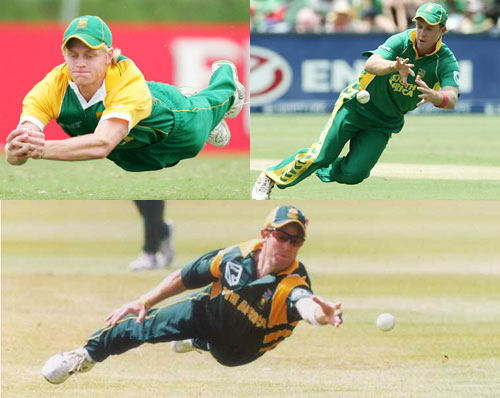
When AB de Villiers soared into the Bangalore night to snuff out Praveen Kumar's innings for the Royal Challengers 10 days ago, he wasn't only making a seemingly impossible catch spectacularly possible. He was also continuing a tradition of South Africans daring to go where no other fielders, except those from Australia, have regularly gone before.
By any standard, de Villiers' effort shimmered with brilliance. Praveen pulled lustily at the first ball he faced, a short delivery from the Delhi Daredevils' Umesh Yadav, and sent it arcing towards the long-off boundary. De Villiers scrambled backward and launched his leap with perfect timing. He snared the wannabe six high above his head in his right hand and hung onto the ball as he crashed to earth a foot inside the rope.
"Awesome," was Jonty Rhodes' description of de Villiers' catch, and he should know. From 1992 to 2003, Rhodes dazzled opponents and delighted crowds with the kind of catching and fielding that would have won him star billing in PT Barnum's Big Top. Rhodes was the epitome of the gritty middle-order batsman, and a more treasured team man will never exist. But he will forever be remembered for diving headlong into the stumps to run out Inzamam-ul-Haq at the 1992 World Cup.
Click on the first mention of Rhodes' name in this story, and you will be taken to a profile page illustrated not with a photograph of him playing a fine stroke, but of him flying through the air with the greatest of ease to take another of those impossible catches.
This thread can be traced back more than 50 years, at least, in South Africa's cricket history. Before Rhodes, Peter Kirsten was South Africa's angel of death in the field. Before Kirsten, Colin Bland, "the Golden Eagle", preyed on hapless batsmen.
"Youngsters tend to look up to their cricketing idols, and in my case that was Colin Bland," Kirsten said. "Hopefully that means that Jonty was watching me!" Indeed, he was. "Peter Kirsten was my hero," Rhodes said, unprompted.
The modern mantle might just belong to Sybrand Engelbrecht, a 21-year-old blond ghost who haunted backward point with enthusiasm as memorable as his athleticism at the 2008 Under-19 World Cup. He took five catches, some of them positively Rhodesian, in the three matches he played, and added to his value by hurrying and harrying batsmen into and out of singles. If the ball was being hit somewhere he wasn't, he was in the captain's ear, nagging to be moved to the hot spot.
And Engelbrecht's hero? "Without a doubt, definitely Jonty. He's been my role model," he said.
But, according to Rhodes, South Africa's fielding prowess is more than the preserve of a few shining individuals. "We were untested as an international team when we went to the 1992 World Cup," Rhodes said. "But [former South Africa captain] Kepler [Wessels] told us there were two areas in which we could dominate: fitness and fielding.
"We had Fanie de Villiers out on the boundary and Brian McMillan and Kepler in the slips. They were all excellent fielders. Fielding was something we could compete at even without international experience." Eighteen years of international experience later that remains true: "You can judge a good fielding side by the fact that they don't have to hide anyone. That's the case with South Africa."
Rhodes thinks the reason for that goes down to grassroots level, and he says he has the evidence to back up his claim. "Our fields are just so good and so well-maintained. I wish I could show you the video clip of my son playing in his first outdoor cricket match. There he was, diving and sliding all over the place. And he was five years old!
"Fields in Australia are pretty much the same as they are in South Africa, and I think it's fair to say that those two countries have been at the forefront of fielding over the years."
In other countries, cricket and cricketers could be considered less fortunate. For instance, in India, where Rhodes is part of the Mumbai Indians' coaching staff in the IPL. "You just don't get much grass in this part of the world. I was talking to Mark Boucher and he said he can feel the strain on his knees even through his wicketkeeping pads. That's an indication of how hard the fields are here."
For Engelbrecht, practice makes perfect. "Fielding is about hard work and confidence, and catching hundreds of balls in training," he said. "People look at someone like Richard Branson and how he makes building a business empire look so easy. What they don't see is how much time and effort he has put in behind the scenes to make it look so easy."
Rhodes and Engelbrecht belong to a generation of cricketers who don't need to be convinced of the advantages to be had from superior conditioning and a more intense focus on skills training. Not so Kirsten, who began to make his way in the game when cricket was still something of an amateur pursuit in South Africa. However, early in his career he encountered the forward-thinking Eddie Barlow, who was among the earliest believers in fitness and better training methods for cricketers.
| "You can judge a good fielding side by the fact that they don't have to hide anyone. That's the case with South Africa" Jonty Rhodes | |||
Kirsten also suffered a serious knee injury that required long, lonely hours of rehabilitation. "I used to train hard individually in the 70s and 80s. That made the difference for me," Kirsten said.
"South Africans are naturally athletic people, and since the 90s fitness levels have improved. These days there is also plenty of sports science around for us to make use of."
But certain aspects of fielding would seem to remain in the realm of instinct. "Anticipation is very important, as is peripheral vision," Kirsten said. "It's vital to be able to read the batsman. I suppose there are some things you just can't coach." Kirsten held more than his share of unforgettable catches, but his trademark as a fielder was the fluid pick-up-and-throw from the covers that cut down many batsmen short of their ground. He was mercury in motion, and just as deadly. Who knows how many run-outs he would have effected had his career fallen more squarely into the age of electronic umpiring?
Bland bestrode the covers from the 1950s to the 70s, a lean, grim reaper. He threw down the stumps almost at will, his reward for endless hours spent in solitary practice sessions, and intimidated batsmen with his sheer presence. "He was brilliant in certain positions," remembered Trevor Goddard, Bland's captain in 12 of the 21 Tests he played in the 1960s. "We also fielded him at mid-on a lot of the time, and he was so accurate when throwing at the stumps. When he was patrolling the boundary, he would send these underarm throws whistling in. The batsmen wouldn't dare take two to him."
Goddard recalled the bleak observation made by former England captain Peter May after a 1956-57 rubber in which he was caught seven times in 10 innings and recorded his lowest Test series average, 15.30. "He said that if you hit the ball in the air when you were playing against South Africa, you should expect to be caught."
Praveen Kumar won't argue with that.
| ||||||
| Comments have now been closed for this article |
||||||
Telford Vice, crash-boom-out left-hand bat, sort-of legspinner, was never
sure whether he was a cricket person. He thought he might be when he
sidestepped a broken laptop and an utter dearth of experience to cover South
Africa's first Test match in 22 years in Barbados in 1992. When he managed
to complete Peter Kirsten's biography as well as retain what he calls his
sanity, he pondered the question again. Similarly, when he made it through the 2007 World Cup - all of it, including the warm-up matches - his case for belonging to cricket's family felt stronger. But it was only when the World Twenty20 exploded gloriously
into his life in 2007 that he knew he actually wanted to be a cricket
person. Sort of ...
'You can't taint the whole IPL'
Bowl at Boycs: Geoff Boycott on spot-fixing, Adil Rashid's future, and yorkers in Test matches
Harsha Bhogle: The spot-fixing controversy teaches us about the pitfalls of insecurity and of the desire to keep up with the Joneses
The new Harmison? Or is it the new Caddick?
Numbers Game: Stuart Broad is destructive at his best, but at other times his bowling average is unusually high
Aakash Chopra: Apart from luck, you need to pick your team wisely, get to bat at the top, and have your captain's support
Less cricket on TV? Hallelujah
Matt Cleary: Why Channel Nine should be applauded for not broadcasting domestic cricket in Australia
Even at the height of his success with the national side, Sreesanth was a lonely cricketer who felt hard done by
A talent that didn't know its own worth
Sreesanth wasn't the most likeable team-mate or opponent, but he had skill beyond doubt, which we might have seen the last of
Mumbai Indians still have a better head-to-head record against Chennai Super Kings, but once again on the big occasion, they came second
A time for anger, a time for action
Out of the shattered lives of three young men caught up in allegations of fraud, newer and stronger players must emerge
Vijay slips, Ashwin does a Sahara
Plays of the day from the IPL qualifier between Chennai Super Kings and Mumbai Indians in Delhi
Spirited Sunrisers exceed expectations (83)
Sunrisers began this tournament as one of the underdogs, but fought impressively to reach as far as the Eliminator
Even at the height of his success with the national side, Sreesanth was a lonely cricketer who felt hard done by
Mumbai Indians still have a better head-to-head record against Chennai Super Kings, but once again on the big occasion, they came second
Anderson's magic not to be missed (50)
None of the other three England bowlers with 300 Test wickets - or many other of the game's finest swing merchants - could have bowled better than James Anderson at Lord's
A case of peaking too early (42)
Royal Challengers began the season in full steam, but failed to replicate their consistency away from home
ICICI Bank M2I. Register Now and Get A Gift Offer.
Safe & simple online money transfer. Apply Now!
Buy Wisden 2013 & get a FREE Playfair
Available now at Cricshop
Jonty Rhodes...YOU were AWESOME...the demigod of fielding! The greatest fielder (non-slip) in the modern game by far!
Posted by Shunya on (April 6, 2010, 2:34 GMT)true, the yawning gap in fielding standards between subcontinent teams and the rest can be put down to the ground conditions to an extent. This can be seen from the improving fielding standards displayed by some of the younger generation cricketers in india as the grounds across the country have started to look greener lately. But then, diving and sliding are only a means to an end. A nimble footed fielder at point or a swift player manning the cover region or a thirdman with a strong arm can be as effective in turning the game on its head. Likewise, good conversion rates in effecting run outs and pouching high catches can be game changers as well, which do not require any ground assistance. Failure by the subcontinent teams (barring SL perhaps) to lift this side of their game for such a long time only highlights the apathy they carry towards fielding.
Posted by BillyCC on (April 6, 2010, 2:25 GMT)I agree with sudzz71 that fielding requires a work ethic and an attitude just like batting and bowling. The current crop of sub-continental players, West Indian players and English players are on average much worse than their counterparts in Australia, South Africa and New Zealand. The sub-continental players have an attitude problem when it comes to fielding, the West Indians have a work ethic problem and English players have an overall skill problem, since I actually think their work ethic and attitude as cricketers are quite good.
Posted by jonesy2 on (April 6, 2010, 0:52 GMT)aussies are head and shoulders above anybody when it comes to all aspects of fielding. as with most things really
Posted by knowledge_eater on (April 5, 2010, 21:30 GMT)When ppl. ask you what batsman you want to be like ? there many names in many country, when they ask you what kind of bowler you want to be ? there are again many names. BUT when they ask what fielder you want be ? "The Jaunty" It was great when in young years, we use to call names. "Hey you bat like such and such" I had honor once, when ppl. gave me nick name of "Jaunty", but over years I have been tagged differently. However, it is great when gully friends tag you with such a caliber name. I reckon if that calling names in gully cricket still exist. I am sure when someone dives and field better than everyone in neighborhood, they must have been calling them "Jaunty". I think he is superman in disguise. I still remember the catches I use to take in slip fielding in blink of an eye. I don't have so called gene of athletics but as Kirsten said "Anticipation is very important, as is peripheral vision,It's vital to be able to read the batsman." MI and Indian team are lucky with these two
Posted by sudzz71 on (April 5, 2010, 13:57 GMT)Fielding among all others aspects of the game relies more on fitness and muscle memory as compared to batting and bowling.
One cannot become a top fielder very easily if one is not physically tuned to it and coached properly as well. The key to good fielding is willingness to get hurt and ability to practice for endless hours each day probably for not much glory as compared to mainline skills of batting and bowling.
Especially in India there is a potent combination of very hard grounds, inherent inability/lack of fitness levels coupled with fielding being a distant third as compared to batting and bowling.
Lets look at a different corollary when most Indian's are batting they prefer hitting boundaries to running singles and twos, when most Indian's are bowling they prefer bowling medium fast or spin bowling fast or running between the wickets depend on how good an athlete you are.
Posted by Hamayoun on (April 5, 2010, 13:07 GMT)Come on, how can you forget Derek 'Arkle' Randall?
Posted by Godof86 on (April 5, 2010, 12:03 GMT)I remember a few one-dayers where the SA off-side lined up as Boucher, Kallis at slips, Rhodes, Gibbs, Crookes and Cronje (with Donald and his flat throws at third man). Now that was impossible to pass !
Posted by jonkerr7 on (April 5, 2010, 10:52 GMT)Fielding is an exciting art of the game isn't it? From someone who saw the West Indies regulary in Australia in their heyday, Clive Lloyd, Viv Richards, Gus Logie, Richie Richardson and Roger Harper were all the equal if not better than Rhodes, Herschelle Gibbs, AB DeVillers (didn't see much of Peter Kirsten). Of the Australians, Allan Border was fantastic, Dean Jones, Ricky Ponting, Michael Clarke and Andrew Symonds all spectacular. I'd like to see the subcontinent guys really pick this part of the game up - they have the athleticism and certainly the hand eye coordination. I think playing in the IPL where it is so important will probably force this to happen.
Posted by kdcricket on (April 5, 2010, 9:19 GMT)A very valuable learning from this article would be for the non test playing nations. As Kepeler Wessels had said, fielding is the aspect in which they can catch many teams off guard and unprepared, because initially they are going to struggle in batting and bowling relative to established nations. I agree with _NEUTRAL_Fan_ about the fielding prowess of Aussies, NZ and Proteas. Jonty has got a valid point, when he says that in the dry, arid regions of subcontinent, it is difficult to have naturally athletic fielders, due to their upbringing on hard coarse grounds. The players mentioned here are truly fielding "greats" and they have made fielding to an art form with their dazzling displays. Still remember the Inzamam run out....It made me a cricket fanatic back in 1992, when I was just beginning to watch cricket.