
Perception, not reality, Anil
Kumble has to assess himself not by the reality of what he actually does but by the possibility, in the eyes of the public, of what he might

Harsha Bhogle
14-Oct-2011
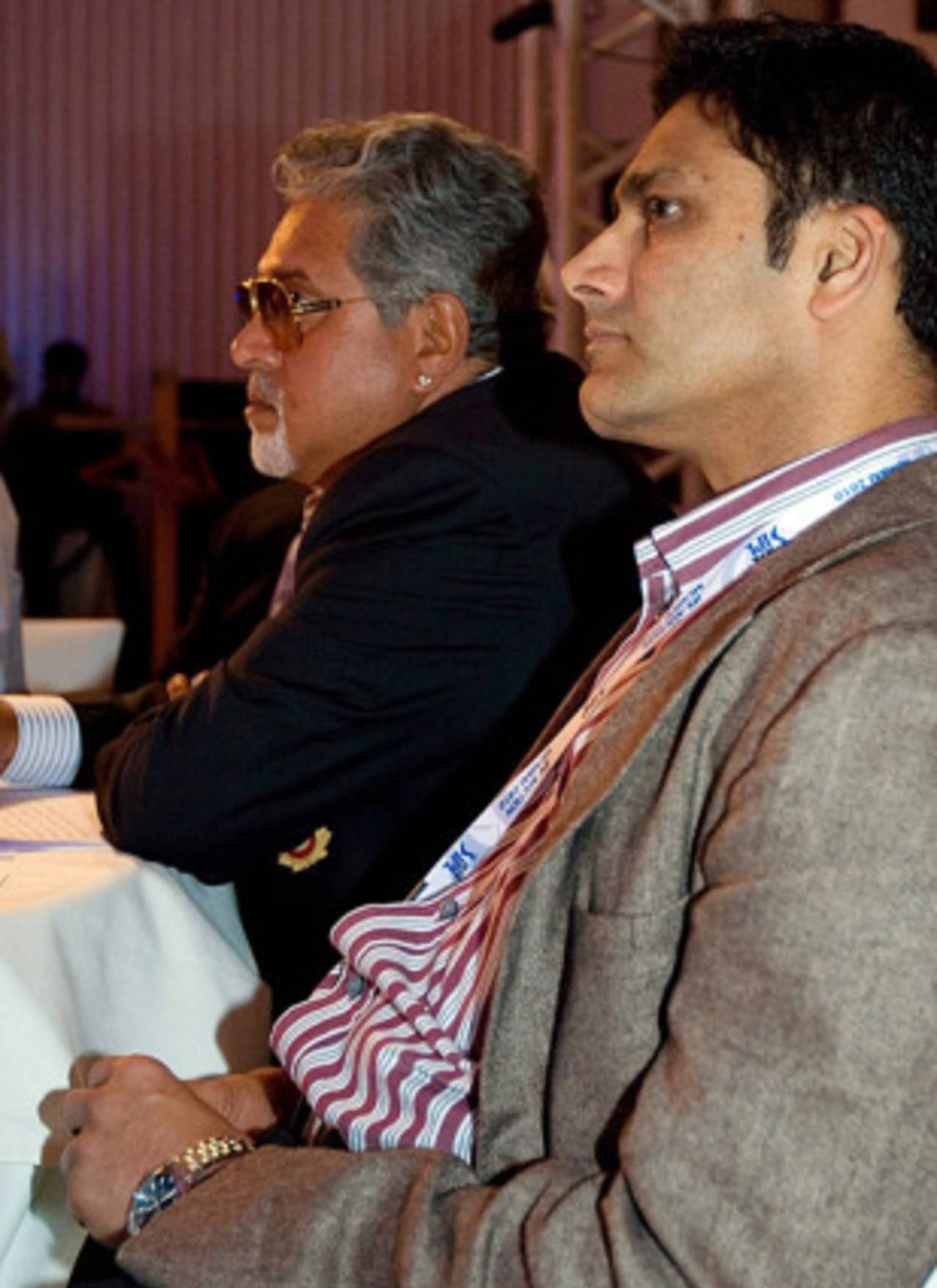
As mentor at Royal Challengers Bangalore, among other things, Kumble lays himself open to the charge of influencing decision-making for personal gain • Getty Images
I won't be surprised if Anil Kumble is perplexed, even hurt, at the accusations of conflict of interest raging around him. He is a man of some standing in world cricket, his integrity has rarely been questioned; he now seeks to establish a legitimate business activity with a company that mentors and manages players. He seeks to independently influence the way Indian cricket is run by joining the administration rather than criticising from the sidelines - which is the easier, and more convenient, thing to do. He must believe that we should encourage him at what he is doing rather than paint him with a brush used for lesser men.
It might well be true that Kumble has never influenced the selection of cricketers from his state, even though he is in a position to do so, and will perceive the suggestion that he has as an attack on his integrity. However, what Kumble is fighting is not the truth but the perception of it, and the possibilities that emerge from it. However honestly he thinks he separates the roles of player representation, mentor at the Royal Challengers, and head of the Karnataka State Cricket Association, he lays himself open to the charge of influencing decision-making for personal gain. And establishes a precedent for someone who might possess a different set of values.
He must wonder, too, what the fuss is all about, because conflict of interest is everywhere in our cricket. But as someone recently told me: if you want to be seen to be different then you must be willing to live with a different set of rules. Kumble has to assess himself not by the reality of what he actually does but by the possibility, in the eyes of the public, of what he might.
I strongly believe that, revenue considerations apart, cricket boards should not be in production; that broadcasters must have complete freedom, since that is what audiences are entitled to
And so he has two options: He shuts down his company and works for Indian cricket for nothing. Or he quits the KSCA and Indian cricket loses a valuable asset. And so the conflict-of-interest situation has to be addressed at its roots. As long as you have power without remuneration and this fascination with honorary office-bearers, it will continue to exist.
Having said that, I suspect I can understand Kumble a bit better than some because I have been in a reality-versus-perception situation myself. In 2008 I worked with the Mumbai Indians, travelled with them, was in meetings and sat in the dugout watching things unfold. My understanding of cricketers and their response to situations was greatly strengthened as a result, but by the time IPL 2009 began, I no longer had a financial or decision-making commitment with the team. When I sat in the commentary box that year, I knew I was completely unbiased, as I have been every single time in a commentary box. Yet respected voices suggested I might have an interest in MI doing well, and it hurt hugely because it was so contrary to what I believe a commentator should be. It hurt, too, that people didn't seem concerned that a former coach or cricket captain could be biased when broadcasting on a match involving a team he had been an intrinsic part of.
But when I took a step back I realised I was dealing with perceptions and not reality; that those whose opinions I respected did, in fact, have a point. It is a similar situation to that of commentators contracted by a cricket board to broadcast on matches it organises. The reasons the BCCI seeks to own the telecast have more to do with overall revenues and profits, but as a sub-plot it means that as the producer, production contracts have to be with them. Now if you want to do cricket in your own country, as anyone would, you necessarily have to have a contract with the BCCI. Cricket Australia and Channel 9, and the England Cricket Board and Sky Sports, do things differently. I strongly believe that, revenue considerations apart, cricket boards should not be in production; that broadcasters must have complete freedom, since that is what audiences are entitled to. Now, as with the Kumble case, a commentator may or may not toe the official line, may or may not even be asked to, but by virtue of a contract, that perception is established. And as I said, we live with perceptions not reality.
So too the case with N Srinivasan of India Cements and the Chennai Super Kings. First, an admission. I hardly know Srinivasan. I have spoken to him twice, each time for no more than a couple of minutes, so it is different from Kumble, whom I have had the pleasure of knowing for about 20 years. Srinivasan can seek to create a difference between himself and India Cements, between corporate ownership and individual ownership, but perceptions may not change. As managing director he would have had to sanction funds for the purchase of CSK; the expansion of India Cements into northern markets using stars from CSK will necessarily, in public perception, be put alongside the desire to retain players after three seasons of the IPL.
All over the world, definitions of conflict of interest are fuzzy. Did the war on Iraq and the imaginary weapons of mass destruction there benefit Dick Cheney and Halliburton, for example? We live in an atmosphere where conflicts of interest abound and till such time as employer-employee contracts aren't clearly defined, we will continue to have a Kumble-like situation, where the answer is not easy to find.
Harsha Bhogle is a commentator, television presenter and writer. His Twitter feed is here