| Series | Countries | Live Scores | Fixtures | Results | News |
Features
|
Photos | Video & Audio | Blogs | Statistics | Archive | Games | Mobile | ||||||||||||||||||||
|
Over the last three years, Australia's No. 3 batsmen have averaged 27.13 in Tests, which is worse than all teams except New Zealand and Zimbabwe

March 8, 2013
![]()
|
|||
|
Related Links
Numbers Game : Last week's column: The best and worst teams to debut against
Series/Tournaments:
Australia tour of India
Teams:
Australia
|
|||
During the days of Ricky Ponting in his pomp, the fall of the first Australian wicket would be a moment of high alert for the opposition team, for the next man walking in would be the best of the Australian line-up, and arguably the best of any line-up during that period. More often than not, the one-hour passage of play immediately after his arrival would be one in which Australia would regain control after an early wicket, or consolidate the gains of a productive first-wicket partnership.
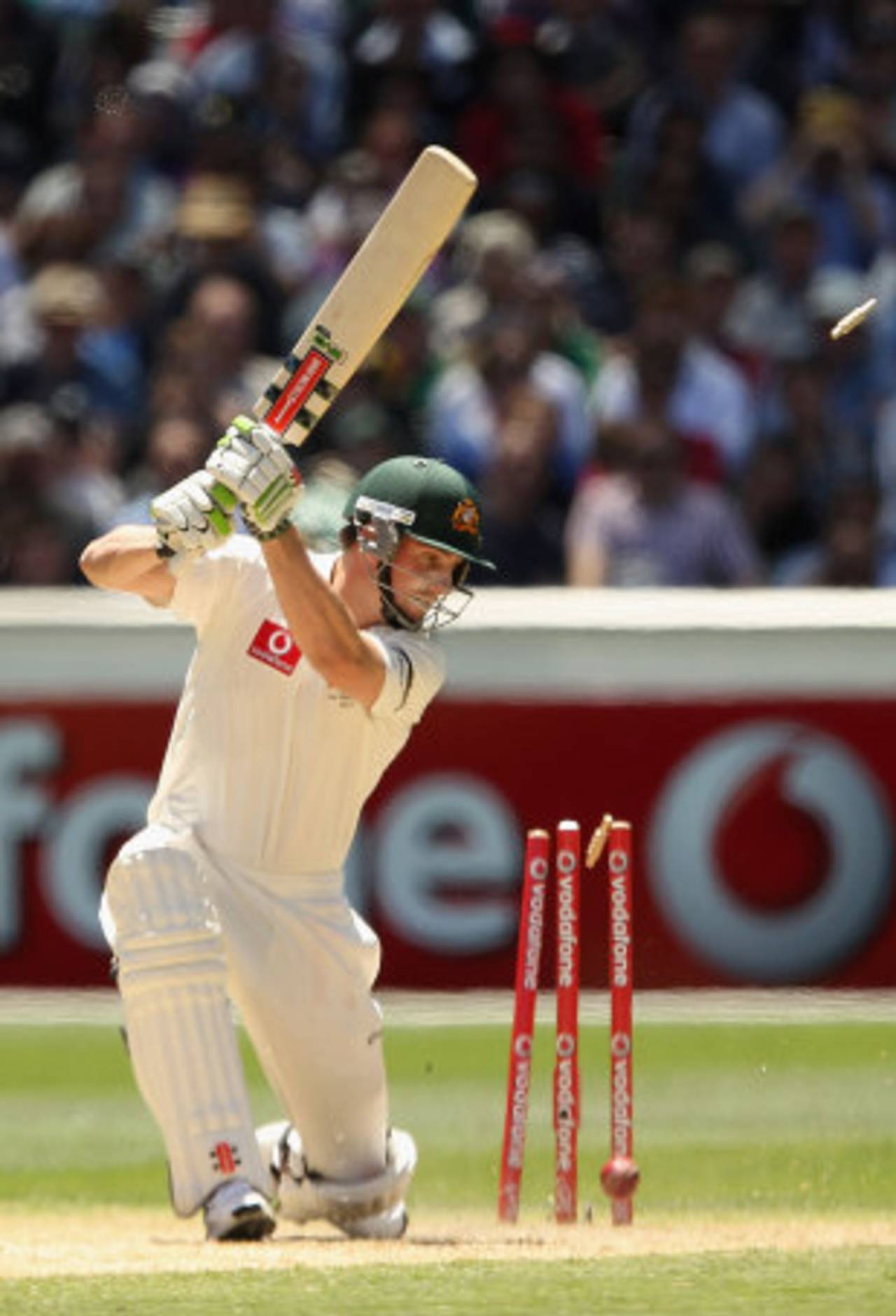
Fast forward to the present, and the fall of the first Australian wicket is now a signal for the No. 4 batsman to be on guard, for the second wicket usually follows the first pretty quickly. Phil Hughes' recent struggles in India - 25 runs in four innings, three of them at No. 3 - only brings further attention to a batting position that used to be an undoubted strength for Australia not so long ago but is now their biggest liability in their top-order batting line-up.
Over the last three years, beginning March 2010, Australia's No. 3 has been among the weakest of all sides in Test cricket - even Bangladesh have done significantly better at that position during this period, a stat which won't please a country that has historically produced some of the best batsmen who've ever batted at that position in Test cricket: over the history of Test cricket, West Indies and Australia are the only two sides whose collective No. 3 batting average is more than 45.
In these three years, though, that average has slipped alarmingly to 27.13 over 60 Test innings, which is lower than all other teams except New Zealand and Zimbabwe. Bangladesh have done 20% better, averaging 32.59. Australia's average second-wicket partnership during this period is 26.67, worse than all other teams except Zimbabwe.
Australia's problems at this position began when Ponting was still around. Between March 2010 and November 2011, he batted 22 times at that slot and averaged a mere 26.28, with a highest of 77. It wasn't good enough by any standards, let alone his own lofty ones, and the logical step was for him to make way for a player who initially looked tailor-made for that position. Shaun Marsh scored plenty from that position in Sri Lanka, but then suffered a severe case of the batting yips in the home series against India, making a pedestrian attack look ultra-threatening, as he gathered 17 runs from six completed innings. (His average of 2.83 remains the lowest in a series for an Australian top-four batsman who's played at least four innings.)
Since Marsh's debacle, Shane Watson and Phil Hughes have done the bulk of the batting at No. 3, without doing justice to the slot. A couple of stats indicate further how steep the fall has been: in 60 innings at this position, there has been only one century - Marsh's 141 against Sri Lanka in Pallekele. On the other hand, there have been ten ducks in these 60 innings, with Ponting and Marsh each contributing three. Twenty-two times the No. 3 batsman has got out for a single-digit score, and a further 15 times for less than 25. All these failures have put additional pressure on the rest of the Australian batsmen, and offered early encouragement to the opposition bowlers, in contrast to how it was during Ponting's pomp, when opposition bowlers were usually deflated early in the innings, and the rest of the Australian batting order benefited.
| Team | Players | Tests | Runs | Average | Strike rate | 100s/ 50s | Ducks |
| Sri Lanka | 5 | 28 | 2659 | 59.08 | 49.71 | 9/ 11 | 5 |
| South Africa | 4 | 27 | 2523 | 58.67 | 59.51 | 9/ 11 | 2 |
| England | 5 | 35 | 2844 | 53.66 | 50.94 | 8/ 12 | 2 |
| India | 4 | 33 | 2649 | 49.05 | 45.45 | 9/ 8 | 0 |
| Pakistan | 5 | 27 | 1967 | 40.97 | 40.02 | 4/ 13 | 5 |
| West Indies | 8 | 26 | 1606 | 37.34 | 44.58 | 3/ 11 | 3 |
| Bangladesh | 2 | 11 | 717 | 32.59 | 48.18 | 1/ 5 | 2 |
| Australia | 7 | 33 | 1574 | 27.13 | 46.66 | 1/ 11 | 10 |
| New Zealand | 11 | 22 | 1078 | 26.29 | 41.94 | 1/ 7 | 4 |
| Zimbabwe | 2 | 4 | 193 | 24.12 | 36.21 | 1/ 0 | 0 |
| Batsman | Tests | Runs | Average | 100s/ 50s | Ducks |
| Ricky Ponting | 12 | 552 | 26.28 | 0/ 5 | 3 |
| Shaun Marsh | 7 | 301 | 30.10 | 1/ 1 | 3 |
| Phil Hughes | 5 | 258 | 32.25 | 0/ 2 | 1 |
| Shane Watson | 4 | 228 | 28.50 | 0/ 2 | 1 |
| Usman Khawaja | 4 | 203 | 29.00 | 0/ 1 | 0 |
The fall in standards over the last three years becomes even starker when compared with the numbers for the two previous three-year periods. In the period between March 2007 and February 2010, Australia's No. 3 batsmen averaged 45.70, which was the third-best in the world, after Sri Lanka (64.23, aided by the ever-consistent Kumar Sangakkara) and South Africa (58.13, thanks largely to Hashim Amla). During that period Ponting wasn't at his best, but his stats were still very acceptable - six centuries in 56 innings at No. 3, and an average of 46.09.
In the previous three-year period, from March 2004 to February 2007, Australia's No. 3 stats were far and away the best of the lot - they averaged 68.23, with the next-best being Sri Lanka's 55.66. Of the 72 innings for the team at one-drop, Ponting played the role 60 times, scored 13 hundreds, and averaged 68.16. The team that struggled during that period was South Africa, who averaged 34.11 - Amla hadn't yet made his mark, and the others who occupied that slot had limited success.
Combining the stats over the entire six-year period from March 2004 to February 2010, Australia's No. 3 batsmen scored 21 hundreds in 129 innings, and averaged 57.46, next only to Sri Lanka's 59.37. Nineteen of those 21 hundreds belonged to Ponting. The other noteworthy stat is that there were only seven ducks in those 129 innings, compared to ten in 60 innings since March 2010.
In fact, working backwards from February 2010, ten ducks by Australia's No. 3 batsmen spanned 12 years, and 221 Test innings. The current lot has achieved the mark in only 60 innings.
| Team | 2007-2010* - Tests | Average | 100s/50s/0s | 2004-2007^ - Tests | Average | 100s/50s/0s |
| Sri Lanka | 25 | 64.23 | 8/11/1 | 31 | 55.66 | 8/11/2 |
| South Africa | 30 | 58.13 | 8/13/3 | 35 | 34.11 | 3/14/7 |
| Australia | 32 | 45.70 | 6/15/4 | 39 | 68.23 | 15/15/3 |
| India | 34 | 44.69 | 7/13/2 | 32 | 50.68 | 6/13/4 |
| Pakistan | 16 | 44.24 | 3/5/3 | 31 | 49.34 | 7/9/5 |
| West Indies | 26 | 40.32 | 6/6/2 | 31 | 46.34 | 8/6/8 |
| England | 38 | 31.92 | 6/5/4 | 41 | 40.39 | 5/19/5 |
| New Zealand | 25 | 29.88 | 0/10/5 | 25 | 48.64 | 5/7/4 |
| Bangladesh | 20 | 21.43 | 0/5/3 | 16 | 30.31 | 1/7/0 |
| Zimbabwe | - | - | - | 10 | 9.95 | 0/1/3 |
Australia's No. 3 is their weakest batting position in the last three years (though the No. 4 batsmen haven't done a whole lot better). Their overall top seven average of 38.96 owes much to Michael Clarke, who has been by far the best of the lot, averaging 57.10 when none of the others, barring Michael Hussey, have played a significant number of matches and averaged over 45. That Australia have had more Test centuries from their No. 7 batsmen than their No. 3s in the last three years is another unusual stat, and one that says much about the failures at one-down. Over the last three years, Australia's Nos. 3 and 4 have been problem areas, and unless they fix these holes at the top of the order, there could be more problems down the road, especially with the Ashes coming up later this year.
| Position | Innings | Runs | Average | 100s/ 50s | Ducks |
| Openers | 122 | 4284 | 36.61 | 7/ 26 | 6 |
| No.3 | 60 | 1574 | 27.13 | 1/ 11 | 10 |
| No.4 | 58 | 1785 | 31.31 | 2/ 12 | 3 |
| No.5 | 58 | 3592 | 66.51 | 13/ 9 | 4 |
| No.6 | 58 | 2080 | 40.00 | 8/ 6 | 6 |
| No.7 | 57 | 1649 | 35.84 | 2/ 12 | 3 |
| Overall top 7 | 413 | 14,964 | 38.96 | 33/ 76 | 32 |
| ||||||
| Comments have now been closed for this article |
||||||
Stats editor Every week the Numbers Game takes a look at the story behind the stats, with an original slant on facts and figures. The column is edited by S Rajesh, ESPNcricinfo's stats editor in Bangalore. He did an MBA in marketing, and then worked for a year in advertising, before deciding to chuck it in favour of a job which would combine the pleasures of watching cricket and writing about it. The intense office cricket matches were an added bonus.

Aakash Chopra: Apart from luck, you need to pick your team wisely, get to bat at the top, and have your captain's support
Fixing? It's people like us doing it
Ed Hawkins: It's convenient to blame the underworld for every instance of fixing, but it's ordinary punters behind many of them
The perils of scoffing at failure
Rob Steen: Excessive success can destroy inhibition, and hence the capacity for shame
New Zealand shaken and stirred
Andrew Alderson: The second-innings collapse at Lord's has revived concerns about New Zealand's top order
'Being an NZ fan is like being in an abusive relationship'
Beige Brigade: Taylor Swift's songs would speak to any Kiwi cricket fan right now
A talent that didn't know its own worth
Sreesanth wasn't the most likeable team-mate or opponent, but he had skill beyond doubt, which we might have seen the last of
Even at the height of his success with the national side, Sreesanth was a lonely cricketer who felt hard done by
Pollard sledges Watson, Dravid is angry
Plays of the day from the IPL match between Mumbai Indians and Rajasthan Royals in Mumbai
A time for anger, a time for action
Out of the shattered lives of three young men caught up in allegations of fraud, newer and stronger players must emerge
Mumbai Indians still have a better head-to-head record against Chennai Super Kings, but once again on the big occasion, they came second
Even at the height of his success with the national side, Sreesanth was a lonely cricketer who felt hard done by
Anderson's magic not to be missed (50)
None of the other three England bowlers with 300 Test wickets - or many other of the game's finest swing merchants - could have bowled better than James Anderson at Lord's
A case of peaking too early (41)
Royal Challengers began the season in full steam, but failed to replicate their consistency away from home
"Minimise sixes" - Two words sum up farcical contest (40)
The eight-over dash between Bangalore and Chennai was as close as cricket played on the field can get to cricket played on smartphone apps
ICICI Bank M2I. Register Now and Get A Gift Offer.
Safe & simple online money transfer. Apply Now!
Buy Wisden 2013 & get a FREE Playfair
Available now at Cricshop
Clarke's tears during Ponting's retirement announcement were not just for the press, they were very real & conveyed his worst fears of the days to come with a gaping hole at no.3 in the batting line up, even considering Ponting's form slump over his last few games. In a way it can be said that Australian team is currently a victim of its own success over recent years. The high standards of world class players like Ponting, Hussey, Hayden, Gilchrist and such set a benchmark, it is unattainable by the Marshes, Hugheses and Wades amongst the current crop. Its surely a rebuilding phase which is not likely to stabilise in near future. Opening partnership is shaky & inconsistent, Watson struggling, newcomers like Khwaja lucky to get two games in a row, lead spinner loosing confidence. Add to this the whimsical selection and rotation policy, no wonder Clarke's burden is way too much. If Australia can get away with draws in remaining games at least that would do their confidence some good.
Gaping hole at no.3 ?... More likely a poorly selected no.1-4... Cowan needs a right-hander to open with him (helps upset bowlers rhythm), Warner moves to no.3, Clarke no.4 - Watto's very poor average since being VC doesn't make him an opener (not even top 6)... That probably leaves Rogers or Cosgrove as leading candidates - no one else is standing out this season atm...
@Khawaja_troll... Even the great Ponting started his Test career at the bottom of the middle order... Hussey spent most of his FC career as an Opener but he batted no.5-6 for Oz...
Posted by Paul_Rampley on (March 9, 2013, 23:09 GMT)@Bertjie agree completely with you bud, Khawaja would be my number 3 as well and just needs a similar trod at it similar to what the other blokes before have got. I still think we can come back in this series, it wont' be easy but one thing we Aussies don't do is give up so expect a fightback.
Posted by Front-Foot-Lunge on (March 9, 2013, 21:50 GMT)@HowdyRowdy "Clarke's inability to move up to this spot has really hurt." :
Spot on 100%.
Clarke's refusal to take responsibility for the chaos that is the Australian batting orders' top 4 is one of the most controversial episodes in modern aussie cricket, as it has harmed the development of the team. Every position in the four places above him has been unstable for a longg time, and occupied by players who do not possess the skill levels required to take on the top 4 or 5 countries in the world. Time and again, like the whitewash and Ashes defeats to England, losing against South Africa and now in India, Clarke cannot take the risk and move up. Put simply, this is decision making unbecoming from a captain.
Posted by Beertjie on (March 9, 2013, 21:05 GMT)I too would favour Khawaja at 3 but with so many "openers" and so few middle order batters it's perhaps worthwhile considering Warner there. He's hit and miss but averages over 40. By having him there Clarke at 4 and Khawaja at 5 you have a good mix provided you have decent openers. Cowan and Hughes are worth considering, but for me Rogers and Watson would be better for England. To get stability though keep 3 thru 5 as I suggested since over the next 3 years they'll be the backbone of the team.
Posted by Front-Foot-Lunge on (March 9, 2013, 20:52 GMT)No wonder Australia have a gaping hole at no.3, they're currently one of the worst sides in international cricket.
Posted by Soso_killer on (March 9, 2013, 17:27 GMT)@Master_mihil when did i suggest that Sangakara cant play spin or pace? Lets be honest here, he handeles spin better than pace. He averages 35 and 30 in South Africa and England which are two of the toughest conditions to bat in, yes tougher than Australia. So he does have a weakness against a swinging ball. In that sense Amla is a complete batsman to Sangakara you cant tell me a guy averaging averaging 40 away from home is better than a guy averaging 56. Sangakara's overall average has been increased by the dust bowls of the subcontinent.
What is it about Amla and India? Amla was born in South Africa and both his parents were, also. You can click on his profile if you want.
Posted bynoticed one common factor in the article, Kumar Sangakkara has been by far the most prolific batsman in the world since 2004. Averages over 70 as a pure batsman. a Legend. Kallis and Dravid should have gotten a mention in this article as well as they have been magnificent no 03 batsman for SA and India
Posted by aruntheselector on (March 9, 2013, 14:52 GMT)Just shows how important that position is for any team and what was the impact of Punter.However greats are not produced that often and not easy to fill the shoes of the Punter leave alone Australian cricket but World cricket.Also the stats show that only those teams have been consistent where the No.3 was the best batsman in the team and among all time greats.No wonder Sri Lanka is at the top as it has been Sangakkara's position for almost a decade and once he goes,it is going to be bad days for Sri Lanka.For South Africa that position was occupied by Kallis for long and now its Amla who is also heading towards greatness.India was lucky to have rahul Dravid with VVS Laxman taking the position on a few occassion.India is as of now lucky that Pujara has not made the position felt void post Dravid's retirement.But once needs to see how he would perform overseas and will he be consistent for a decade.With a good start and his approach to the game,it looks like Pujara is here to stay.
Posted by HatsforBats on (March 9, 2013, 14:12 GMT)For all the doom & gloom statistics, prior to this poorly scheduled and under-prepared-for series, Australia have lost just 4 of their last 21 test matches. In the last 12 months they had the most productive opening partnership, the captain averaging near 70, a wk scoring 2 centuries, and some of the most promising young pace stocks I've seen in years. They are (rightfully) ranked 3rd. Just imagine if they manage to fix the leaks. Even without the bizarre selectorial events and administrative bungling then I imagine Aus would still be ranked 3rd behind SA and England.