
Sri Lanka batting collapses follow an all too familiar script
"I ask [the fans] to stick with us, we will do our best to make them proud in the World Cup," - Dushmantha Chameera
Madushka Balasuriya
Feb 3, 2026, 10:28 PM • 14 hrs ago
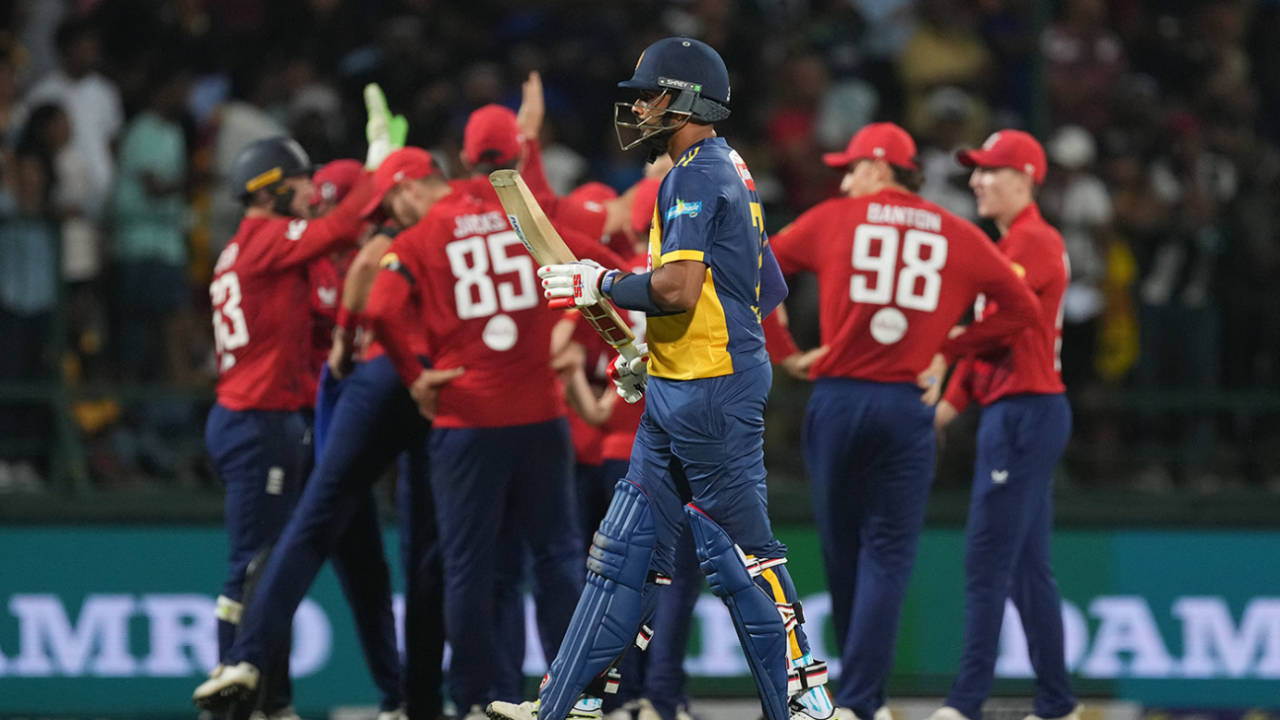
Dasun Shanaka trudges off • Sameera Peiris/Getty Images
Chasing a modest target of 129, Sri Lanka once again found themselves in the throws of a middle-order trough, but on a third-use wicket, one where turn was far from infrequent, their plan to employ seven specialist batters was seemingly on the verge of finally paying off.
On paper, this was the perfect use case. A batting collapse, but in a low-scoring thriller, so that the extra batter would not be burdened by scoreboard pressure, and therefore, presumably, able to shepherd home the chase in a measured fashion. Well, not quite.
Kamil Mishara fell off the third ball, but it allowed Pathum Nissanka and Kusal Mendis to rekindle their top-order chemistry - 1721 runs at an average of 32.47 and run rate of 8.4 they have opening together - as they sped to a 33-run stand off 23 deliveries. But, once Nissanka fell, it opened the door to Sri Lanka's fragile middle order and they did what they tend to do these days.
Related

McCullum: Media scrutiny of Brook incident is 'annoying'
Curran happy with his flexible role with the ball
Shanaka puts spotlight on Sri Lanka selections ahead of T20 World Cup
SL batting coach Rathour: We can overcome power-hitting woes by finding more fours
Curran, spinners star as England defend 129 to seal whitewash
There was a run-a-ball stand between Kusal and Pavan Rathnayake, but then both fell off consecutive deliveries. This was followed by another 28-run stand off a slightly quicker 24 deliveries between Kamindu Mendis and Janith Liyanage, but they too fell about two overs apart.
And so Sri Lanka had stumbled from 62 for 2 to 97 for 6. But still, with just 32 runs to get, the added security of that long batting order Sri Lanka have been so desperate to cling on to was ready to shine. Right?
Briefly Dunith Wellalage and skipper Dasun Shanaka - pushed down to No. 8 likely owing to the spin-friendly conditions and his perceived weakness against it - managed to inch along towards the goal in a stand worth 15 off 13, but another, definitive, collapse swung the game decisively in England's favour as they stormed to a series clean sweep.
It was an all too familiar script, and a worrying trend heading into a home World Cup for the Sri Lankans. The fans, usually a patient bunch - at least the ones in stadiums - made their voices heard during the post-match presentation, chiding the Lankan team. Not exactly an ideal send-off.
"It's always sad and disappointing to lose a match, especially in such a manner. We're all trying our best to win," Dushmantha Chameera said after the game, addressing those very same fans. "The fans kept coming to the ground right up until the end, and I understand they're upset we weren't able to get the win. But I ask them to stick with us, we will do our best to make them proud in the World Cup."
Those words might seem hollow given the context, but the pain in Chameera's voice told a story. While results might not be forthcoming, it's clear the players care - this has never been about that.
"I think we do tend to get exposed because we play on these sort of [slow] wickets. In the dressing room when wickets fall like that it's actually quite upsetting," added Chameera.
"When wickets fall close to each other, the coming batter finds it difficult to score runs at a similar rate. So the scoring rate slows down in those instances. We need to find a way not to lose wickets in clusters, and instead turn over the strike better."
Such sentiments are well worn, even if largely accurate. But at the highest level, the difference between possessing the skills and executing them is mostly about mentality. That mentality needs to flow down from the management - head coach Sanath Jayasuriya has in the past spoken about giving players the confidence and freedom to play attacking cricket - yet certain decisions belie the insecurity lurking under the surface.
This has revealed itself most prominently in the decision to go in with an extra batter at the expense of a frontline bowler. It's a decision management has openly stated is down to the vulnerability in the middle order - but doing so makes clear the lack of trust therein.
From a tactical standpoint, the decision to shore up the batting can more often than not end up as a net negative. If the top order clicks, the extra batter generally becomes superfluous - in fact since the end of the 2024 World Cup, any instance of Sri Lanka scoring more than 180 runs in T20Is has seen them lose not more than five wickets. Moreover, if the top order fails, runs will be needed by the middle order regardless - and at that point an extra bowler arguably becomes more useful, in order to defend a middling total.
On Tuesday each of Chameera, Matheesha Pathirana, Maheesh Theekshana and Wellalage went for no more than seven runs an over. However the fifth bowler combination of Shanaka and Kamindu went at nearly eight an over. It might not seem like much, but in a low-scoring game, it can be the difference.
Meanwhile in the second T20I, the same strategy left Sri Lanka a bowler short and with little recourse after Eshan Malinga's injury. Numerous times over the past year too opposition batters have purposefully targeted Sri Lanka's fifth bowlers.
Despite this, Sri Lanka perseveres with seven genuine batters. It is almost as if a narrow defeat has become preferable to a larger loss in pursuit of proactive cricket. It is an ingrained culture of fear-based decision making, when the very best sides approach the game with courage instead. For Sri Lanka, maybe it's a little too much to change days out from a World Cup, though the first step might just be in dropping that extra batter.