
Why do teams score slower in T20 World Cups than in leagues?
Teams often adopt a more measured approach at World Cups, and there are many reasons why this is so

Sruthi Ravindranath
Feb 6, 2026, 6:32 PM • 15 hrs ago
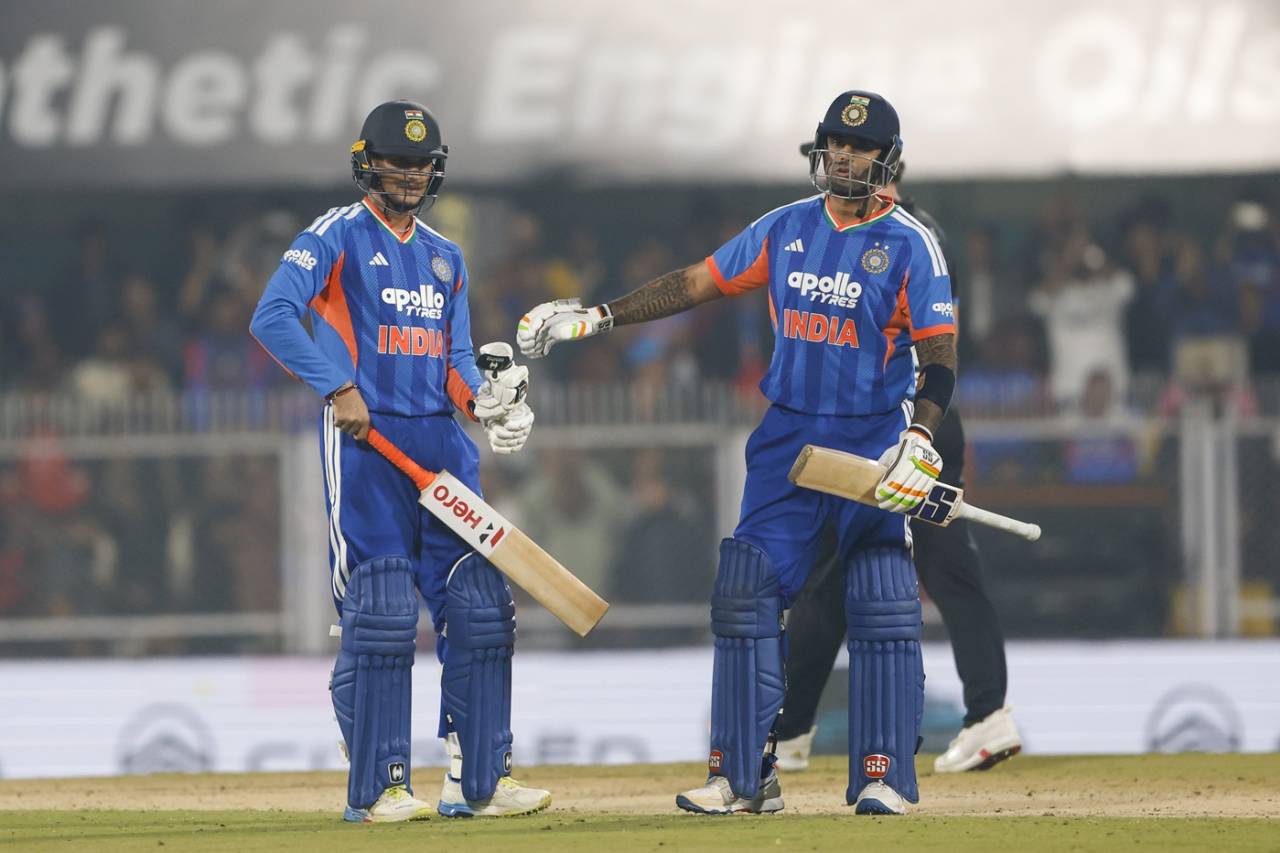
India have been pushing the envelope in international cricket • BCCI
In the history of Men's T20 World Cups, there have only been 18 scores of 200 or more in 317 matches. Compare that with the most recent season of the IPL alone, which had 52 such totals.
On most days in the major T20 leagues, any total less than 200 has stopped looking imposing. When the T20 World Cup comes around, however, the numbers tell a different story. Totals that would not hold up in the IPL or the BBL start looking competitive. Scoring rates slow down significantly, even when top-ranked teams play oppositions ranked well below them.
Only twice has a 200-plus total been chased down in the T20 World Cup. The last time it happened was in 2016 when South Africa posted 229 and England chased it down with two balls remaining at the Wankhede Stadium in Mumbai. The one before that happened in 2007, with South Africa chasing down West Indies' target of 206 with 14 balls to go.
Scoring rates in T20 leagues have continued to climb, but at T20 World Cups, they have remained largely unchanged, a difference that also shows up in boundary-hitting. For instance, in the CPL, a six has been hit roughly every 13 balls across the last three seasons, up from one every 19 balls in the league's first three seasons. Meanwhile, in the last three Men's T20 World Cups, a six has been hit only once every 24.30 balls, which has barely budged from one every 25.28 balls in the first three editions.
In the last three T20 World Cups, at least one in five innings ended with a total below 130. The 2024 event recorded the highest percentage (36.54) of such scores, with 38 out of 104 innings ending with teams failing to reach 130, with the number only dropping to 32.50% in matches involving the top ten teams (according to the latest ICC rankings). That tournament, however, can be viewed as something of an anomaly, given that it took place in the USA and the Caribbean, where slower pitches and weather interruptions affected run-scoring.
One of the main reasons for the scoring gap could be shaped by caution. At the World Cup, teams play fewer games and margins are thin. One collapse can damage net run rate and derail qualification, while one loss can leave teams hoping for other results to go their way. In such circumstances, batters are inclined to protect their wicket and rein in their attacking impulses, as compared to T20 leagues where lengthier seasons give teams more chances despite losses.
Tom Moody, who has coached extensively in both international and franchise cricket, believes that difference is fundamental.
"There's no question in franchise cricket, you've got a second chance," Moody says. "You can lose the first two games or even lose the first three games of an IPL season and end up winning the final. But if you do that in a World Cup format, you're packing your bags and potentially not even playing in the group stage, let alone the semi-finals. So, I think that is definitely an aspect where teams can be a little bit more cautious and conservative around winning games against going out there all guns blazing and trying to blow a team away."
Moody also feels the introduction of an Impact Sub or Super Sub in leagues (currently in use in the IPL and the ILT20) has played a major role in inflating scores. "The Impact Sub in itself does influence the actual outcome of totals and the ability for teams to chase down totals. You're playing basically with the extra asset in your batting line-up or in your bowling resources."
Then there are obvious reasons like conditions and venues, which widen the divide. Moody believes the challenge of adapting quickly to varied venues is often underestimated in international tournaments.
"I think around the world, realistically, that 200 mark in T20 cricket is always hard to achieve purely because of the conditions that you face in various different countries, and the size of venues," he says. "For instance, Australia versus India. Two completely different venues, from Wankhede Stadium to the MCG.
"One ball goes for six at Wankhede square of the wicket. That same ball is caught 20 metres inside the boundary at the MCG. So I think if you look back on, for example, you look back on the [2022] T20 World Cup that was in Australia, that was really the undoing of a lot of players where they're finding themselves caught on the boundary or well inside the boundary purely because they thought they had enough legs on the shot and the ball was going to disappear 10, 15 rows back."
In leagues, each team typically has a home venue. World Cups strip away the familiarity factor. Franchise-based teams build squads around their home conditions and benefit from detailed data on conditions, match-ups and scoring zones, which can be limited when teams move across countries and conditions for a world tournament.
"You're suddenly facing a high-quality international attack on a surface that's a little bit unpredictable, whether it be a little bit up and down, which we saw in New York [at the 2024 T20 World Cup], or is taking a bit more turn than you wouldn't expect, or slower than you expect," Moody says.
The quality and depth of bowling attacks when international teams go full-strength is something leagues can't always guarantee. "In T20 cricket globally, I think if you compare the supply and demand of top-order dynamic players versus top-line impact bowlers, I think the supply of the batters is healthy, where on the other hand, I don't think you're going to have the balance of high-class bowlers that can influence the game.
"I think that's one of the reasons - generally countries draw on their best resources from a bowling perspective and they comfortably have five specialist bowlers with a sixth bowler or a seventh bowler that is part of the batting unit that can lend a hand with a few overs."
All these factors also explain why success in T20 World Cups, specifically knockouts, has tended to belong to low-risk batters rather than all-out power-hitters. For instance, in four of the last five T20 World Cup finals, the top run-scorer from the winning side struck at less than 135. The same approach can look conservative across a league season, but in a World Cup, managing tempo and curbing instincts, along with an understanding of the conditions, seems to be the currency.
Slow, long innings (30 or more balls at a strike rate under 100) have been more prevalent in the T20 World Cups. To compare, in the IPL, one in every 29 long innings has come at a strike rate of 100 or lower, and in the PSL, one in 20 such innings. But in T20 World Cups, it's one in every five.
"I think in a World Cup, because, you know, it's generally a tougher challenge to navigate totals or to chase totals down, you do rely on your architects that combat through the innings to provide that foundation, and then you have your impact players around that player," Moody says. "I think the value of that style of player is probably more important in international World Cups than it is in franchise cricket, particularly if you're comparing it, you know, at the venue that the 2026 World Cup is at, where in places like Sri Lanka you can potentially have 16 overs of spin."
Ahead of the 2026 T20 World Cup, team captains were asked whether the 300-run mark could be breached at the tournament, with England's Harry Brook suggesting it was a real possibility. Moody, however, anticipates a more measured approach from batters.
"I think most teams will go into this World Cup with their eyes wide open to playing a very, very bullish brand of cricket, but with the mindset that we need to be able to adjust very quickly if we see things happening slightly differently than what we expect.
"I think what we've seen over the last couple of years is the teams that have just the one-stop shop approach to batting, and that is all guns blazing. Yes, they have spectacularly entertained us from time to time, but they've fallen into very big holes on other occasions. And in a World Cup, you can't afford too many of those up-and-down moments. So yes, they will play that aggressive brand, but I think they'll be very mindful that they need to find another gear if it's necessary."
All the venues in India this time also regularly host the IPL, where scoring rates have surged in recent seasons. Could these grounds, with small, fast outfields and dew potentially coming into play, push a shift in T20 World Cup scoring trends?
Stats inputs from Shiva Jayaraman
Sruthi Ravindranath is a sub-editor at ESPNcricinfo