| Series | Countries | Live Scores | Fixtures | Results | News |
Features
|
Photos | Video & Audio | Blogs | Statistics | Archive | Games | Mobile | ||||||||||||||||||||
|
Michael Clarke being let off in Chennai could cost India in the series. The administrators must reach a consensus on the review system

February 24, 2013
![]()
|
|||
|
Related Links
Players/Officials:
Michael Clarke
Matches:
India v Australia at Chennai
Series/Tournaments:
Australia tour of India
|
|||
Cricket administrators obviously don't mind embarrassing themselves. How else do you explain two Test matches running concurrently being played under different sets of laws? South Africa and Pakistan are trying to win the same world championship title as India and Australia, but one series is using the DRS and the other isn't. How do you justify that and retain credibility?
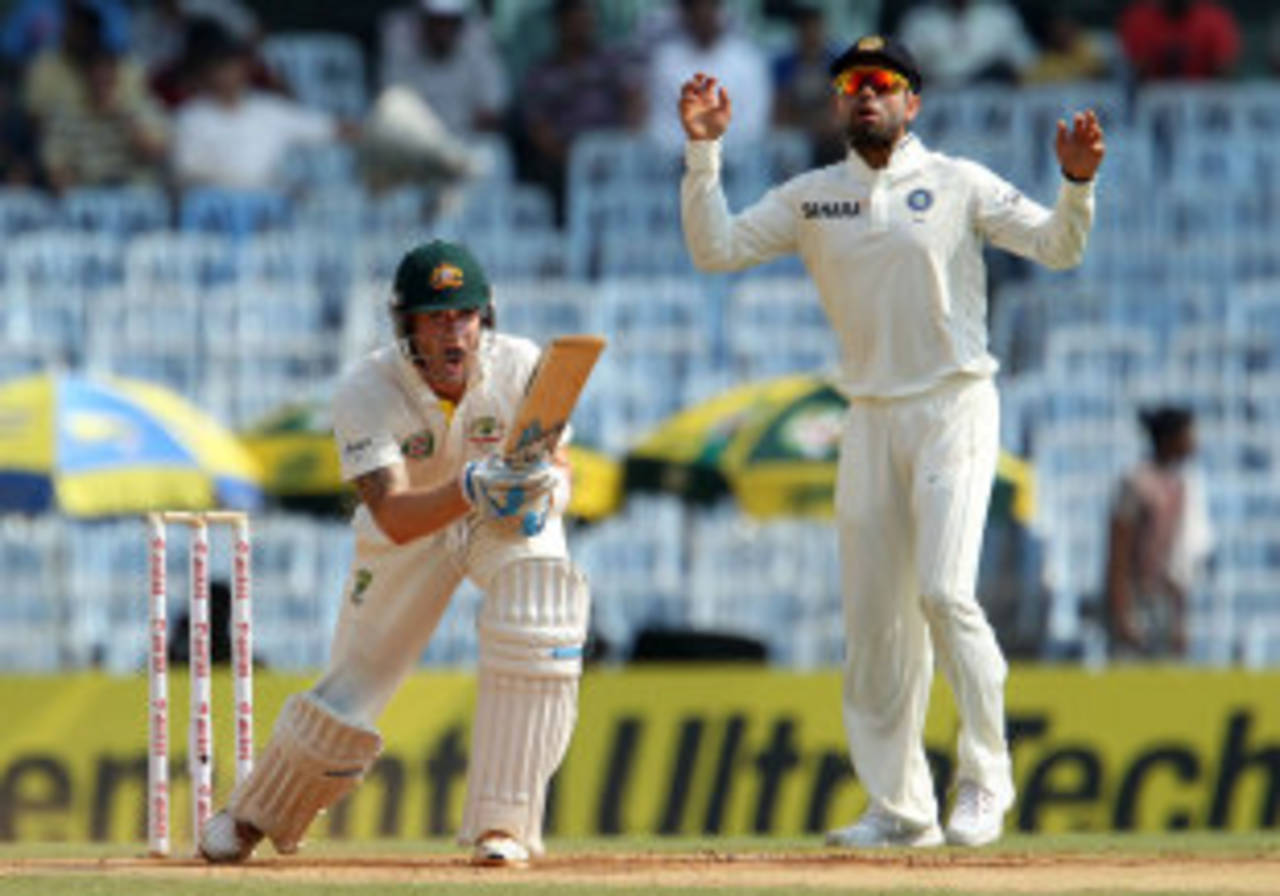
There'll be plenty of people eager to wag their finger at the BCCI and say: "Be careful what you wish for." After all, it was their refusal to use the DRS that cost the team dearly in the first innings, when Michael Clarke was erroneously adjudged not out on 39, and he went on to amass a century.
I'm no great fan of the DRS for a number of reasons but isn't the Clarke case what the ICC told us it was there to eradicate - the howler? The Clarke non-decision was a howler if ever I've seen one. A workable DRS would have achieved another stated aim of the ICC in implementing the technology - to get the right decision.
The big problem with the DRS is an unstated desire to get the right decision all the time. Cricket isn't that sort of game; there will always be 50-50 decisions as long as there's an lbw law, and that's part of the charm of the sport.
Stop aiming to produce a 100% record and concentrate on getting rid of the howler and then the DRS will be a useful tool in the game. This can only happen when the players have no part in the DRS and it's left in the hands of the third umpire to overrule on-field decisions that are palpably wrong.
It's easy to blame the BCCI entirely for the current mess but that's letting the other ICC Test nations off the hook. They are equally to blame for not standing up to the BCCI and presenting a case for all sitting down around the table and reaching a common-sense agreement, instead of the current situation, which is an embarrassment to the game.
Clarke is a good enough batsman - as he showed in the first innings - to capitalise on an umpiring error. The concern for India is, he's also an aggressive captain who can take advantage of any opposition weakness, just as he did in completing a whitewash win over MS Dhoni's hapless charges in Australia.
Indian selectors tend to be ultra-sentimental, and on the evidence of Harbhajan Singh's lacklustre performance, it was the lure of his 100th Test match that earned him a place in the side. And the sight of Ishant Sharma's inconsistent bowling rarely troubling batsmen only served to confirm what a wise decision it was to produce a pitch to help the spinners. If the Indian selectors maintain that form throughout the series, they'll more than likely play into Clarke's hands.
While Australia's ploy of playing a strong pace attack was based on a genuine belief they are their best bowlers and therefore present the most likely chance of victory, India look to have over-theorised. Relying heavily on offspin because there is a preponderance of left-handers in the opposition line-up is fine as long as they all bowl like the much-improved R Ashwin. Surely Pragyan Ohja is one of India's three best tweakers? Not playing him seemed to be a mistake. Anyway, isn't the left-armer spinning into the left-hander out of the rough? And doesn't that increase the likelihood of bowled and lbw dismissals, one of which doesn't require the umpire's intervention?
Clarke has established a solid base camp for Australia - they desperately needed a good first innings against the Indian spinners - thanks to two bits of good fortune, winning the toss and getting a favourable decision. Let's hope that if he does conjure up a victory it's because of shrewd captaincy rather than maladministration.
Former Australia captain Ian Chappell is now a cricket commentator for Channel 9, and a columnist
© ESPN EMEA Ltd.
| ||||||
| Comments have now been closed for this article |
||||||
Widely regarded as the best Australian captain of the last 50 years, Ian
Chappell moulded a team in his image: tough, positive, and fearless. Even
though Chappell sometimes risked defeat playing for a win, Australia did not lose a Test series under him between 1971 and 1975. He was an aggressive batsman himself, always ready to hook a bouncer and unafraid to use his feet against the spinners. In 1977 he played a lead role in the defection of a number of Australian players to Kerry Packer's World Series Cricket, which did not endear him to the administrators, who he regarded with contempt in any case. After retirement, he made an easy switch to television, where he has come to be known as a trenchant and fiercely independent voice.
'The most complete fast bowler I've seen'
Allan Donald on one of the bowlers he found intimidating: the relentless Wasim Akram
Monty's haul, and keeper-captains
Ask Steven: Also, most Tests at Lord's, the Don's drop, Olympic gold stadium, and Mandela the cricketer
'Would you want to face Finn?'
Switch Hit: Jonathan Harris-Bass and team talk about England's win at Lord's, 4am Twitter antics, and the week in county cricket
'We've got a good bowling attack for English conditions'
Mohammad Hafeez's resurgence, after three years in the international wilderness, symbolises that of his team
Cricket Sadist Hour: Mark Butcher, Iain O'Brien and Jarrod Kimber discuss why Broad can be great or garbage, and, how Root looks worse topless than Compton
Pollard sledges Watson, Dravid is angry
Plays of the day from the IPL match between Mumbai Indians and Rajasthan Royals in Mumbai
A talent that didn't know its own worth
Sreesanth wasn't the most likeable team-mate or opponent, but he had skill beyond doubt, which we might have seen the last of
Even at the height of his success with the national side, Sreesanth was a lonely cricketer who felt hard done by
Unfortunate Sunrisers let match slip away
For 36 overs, Sunrisers painstakingly built a position of strength only for one terrible over to spoil it for them
A time for anger, a time for action
Out of the shattered lives of three young men caught up in allegations of fraud, newer and stronger players must emerge
Even at the height of his success with the national side, Sreesanth was a lonely cricketer who felt hard done by
Dravid and the art of T20 captaincy (56)
Despite a small squad bereft of big names, Rajasthan Royals' captain has churned out win after win
Anderson's magic not to be missed (45)
None of the other three England bowlers with 300 Test wickets - or many other of the game's finest swing merchants - could have bowled better than James Anderson at Lord's
Pollard sledges Watson, Dravid is angry (43)
Plays of the day from the IPL match between Mumbai Indians and Rajasthan Royals in Mumbai
"Minimise sixes" - Two words sum up farcical contest (40)
The eight-over dash between Bangalore and Chennai was as close as cricket played on the field can get to cricket played on smartphone apps
ICICI Bank M2I. Register Now and Get A Gift Offer.
Safe & simple online money transfer. Apply Now!
Buy Wisden 2013 & get a FREE Playfair
Available now at Cricshop
I agree with Chappell's sentiment that the DRS should concentrate on getting rid of the howler. Being an optimist, I don't think any cricket fan would have a problem with that, were it able to be implemented consistently without interrupting play.
I have an idea: the technologies in Google's "Glass" augmented reality goggles could in theory allow the on-field umpire to see DRS overlays to "re-wind" the action and even see real-time Hawkeye tracking, for example. The advantages of this would be to reduce the time needed to consult the third umpire, and allow the on-field umpire to make more informed decisions in the first place.
The ICC's Elite Umpiring Panel are already almost inhumanly good, but under the pressure of constant TV replays and the sheer volume of cricket played, they are going to make mistakes. That's why we have the DRS, it's also why we should give them the best tools to succeed.
srriaj317 has the best description that I have seen on the situation - the umpires are using the brain's Hawkeye system. At 80 mph, the ball travels approximately 130 feet per sec. The human eye - brain combination takes frames at 10 - 12 per sec i.e about 13 feet between frames which the brain's Hawkeye makes into a moving picture. Cpmpare that with the DRS system that can take pictures at about 400 frames per sec depending on the cameras used ie about 3 inches between shots. Which set of pictures are more likely to give a better predictive path? Definitely the technological Hawkeye.
Whilst the introduction of DRS was to address the issue of the howler, it begs the questions of how you define a howler. For example, in India with a full house an edge is inaudible in real time so will affect lbws, bat pad, caught behinds etc. But with replays in slo-mo and snickometer, of which I'm no fan, can assist the 3rd umpire to reach the correct decision. The howler, IMO, is a decision given by the umpire that you would expect to be correct in real time and given the conditions at the time. But the use of DRS has moved on and should be there for teams to appeal against decisions that are wrong and limiting appeals to the current levels is fine with me. I completely disagree with IC in that the BCCI should agree to DRS even with limited use eg without ball tracking but have the pitch maps. There will always be marginal calls and that's the nature and beauty of cricket - it's happens in life so why not in sport?
Chappelli maintains that it'd be a good idea to let the 3rd umpires decide when to use DRS. But that will lead to many practical problems as was evident when this was experimented in domestic cricket somewhere. The players wasted a lot of time between deliveries in the hope that the 3rd umpire might review a LBW shout. Also, it is often not easy to decide what is a blatant howler. Very often, somebody's blatant howler is somebody else's marginal decision. Sometimes a 'howler' is 'exposed' after long multiple views of DRS after looking from multiple angles and using multiple technology. Players can use DRS more effectively since they are more likely to know a howler when it happens. If players choose to waste their reviews with 50-50 decisions and suffer bad decisions later, it's their problem and it's something everybody can live with (maybe except lower-order batsmen/tailenders.). 3rd umpire using DRS would lead to a very invasive DRS with a jarring viewing experience for the audience
I guess Chappel is marketing the DRS. When he mentions test match series using two different set of laws, he forgot to mention that both these series have its own DRS howlers. While it was Clarke's incident in India, it was Kallis incident is SA. Why does Chappel not mention the Kallis howler, where DRS failed miserably. If he says DRS is also a 50 - 50 chance, they why waste so much time and money on it by keeping away from it ? Technology should just be an aid, not replace decision making. Errors are there in DRS and umpires as well. Afterall, DRS is a product of humans, and umpires are human too.
Posted byIts pathetic to read what Ian Chappel writes, because he contradicts himself by saying that DRS need not be right all the time and still wants to use DRS ? If 50-50 is good with DRS what is wrong about 50-50 without DRS ? I bet he does not have an answer. It seems he is trying to force India into using DRS siting Clarke's instance, but we have seen ghastlier mistakes than that of Clarke's with DRS and the 3rd. umpire rulings together! So sometimes its the 3rd Umpire making the mistake or the DRS making the mistake, which compounds the complicity of the result and proves that DRS is not the solution unless and until it is 100 % accurate and till such time BCCI is absolutely right not favoring the Faulty Technology.
Posted by Meety on (February 26, 2013, 3:50 GMT)@ jmcilhinney on (February 25, 2013, 11:59 GMT) "The third umpire should be able to view slow motion replays at least to look for edges on bat/pad and LBW appeals" - the problem is slo-mo replays do not prove bat on ball in most cases. The reason why hot spot is compelling, is that in the moments after the ball makes contact, the Hotspot shows that something made contact. I certain that IF, the ICC could of, they would of just used slo-mo replays. The fact is though, that slo-mo cameras use high speed frames higher than most networks who cover cricket can provide. Also - in respect of the availability of the product, it is expensive currently, however, due to the failure to implement the technology, the usual economies of scale & technology investment has not taken place which retards the cost cycle. IF, Hotspot was mandatory, it would become rapidly more affordable within a couple of years.
Posted by WandererMatt on (February 26, 2013, 3:45 GMT)IMO I think that the DRS should stay with the players. However when a decision is referred to the 3rd umpire then the 3rd umpire has a set amount of time to decide on whether to over turn the decision or not. Not like has happened where they will scrounge for any evidence to prove that the player is out. If there is no decision able to be made within the first few replays then the benefit of the doubt must be given to the batsman - as is the old way. Unlike the recent series in Australia where there were multiple occasions where there was no obvious reason to give a batsman out, but they were given out nonetheless (even where it over turned the on field umpires decision).
Posted by Meety on (February 26, 2013, 3:43 GMT)@Harmony111 on (February 24, 2013, 18:03 GMT) - "I am surprised that the pro-DRS lobby fails to understand this simple point." - the problem is that slow motion replays do not always PROVE anything. This is due to the fact that the speed of the frames (whilst faster than previously), are not always in sync with WHEN the action occurred. IF, you follow cricket you would see that even simple run out reviews can often take numerous replays & still not be conclusive as one frame will show the bat outside the crease, the next over the crease but now the bails are off, at what point did the bails come off? The FACT is slo-mo does not offer anymore credible proof of snicks. The only time slo-mo would be close to HELPING an umpire is, whether the batsmens pad is struck in line with the stumps. I find it amazing that someone who can get on their high horse can so appallingly misunderstand the basics. It is very rare any type of replay (minus hot spot/snicko) proves a caught behind appeal!
Posted by GoelVipin on (February 26, 2013, 3:29 GMT)Chappell made a very good point here. Everyone who saw the match knew that Clarke was out. Only Dharmasena didn't know it. The original decision should have been overturned, especially knowing that it was a howler, no matter whether it was challenged or not. It's OK that the umpire made an error in judgment, good umpires don't do it quite often, but it was the duty of the third umpire to remind him that he wasn't right. There wouldn't have been any embarrassment for the umpire had he been told about his mistake. Anyway he would have come to know about it before the next over was bowled. That's even more embarrassing, watching the batsman standing his ground after you deemed him not out in the previous over and knowing that you made a flagrant error. Though unknowingly, Dharmasena robbed Ashwin to pay Clarke.