
England's drops, spinners' drought and Starc's Ashes
All the stats from an Ashes series notable for fast finishes and a lack of slow bowlers
Sampath Bandarupalli
10-Jan-2026
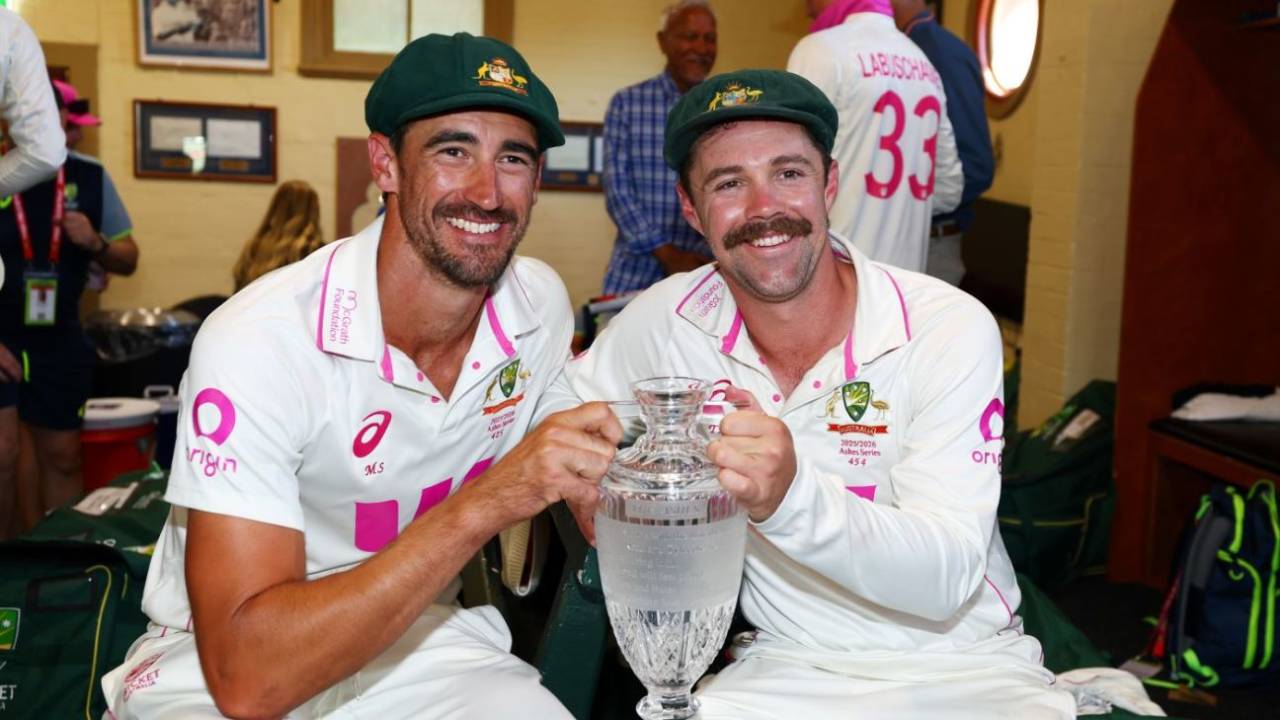
Mitchell Starc and Travis Head pose with the Ashes trophy after their stand-out displays • Getty Images
Shorter Tests galore
This Ashes series featured contrasting games: two finished on the last day, including one with an aggregate of over 1400 runs, while two were completed by the end of the second day. The first Test at Perth was the first two-day Ashes Test since 1921. As many as 19 wickets at Perth and 20 at MCG fell on the opening day, another Ashes high since 1909.
With MCG also being a two-day game, this Ashes series became only the fifth in Test history to feature multiple two-day matches. It is also the first such series since 1912 and the first bilateral series in nearly 130 years. Despite their brevity, both featured a substantial successful fourth-innings chase. Australia chased 205 at Perth, while England won chasing 175.
Before this Ashes, the highest fourth-innings total achieved by the end of day two was 105 for 7 by South Africa against England in Leeds in 1912, while chasing a target of 334. The previous highest successful chase for a two-day Test was 95 by England against Australia in 1890 at The Oval. Travis Head alone had scored more than that (123 runs) in a session at Perth.
The two Tests collectively lasted 1,699 balls, equivalent to ten sessions of a Test match. As a result, only a total of 7,677 balls were bowled across this series, the fewest for a Test series with five or more matches and featuring only completed games. Overall, only three Test series of five or more matches (including draws) had seen fewer balls; one of those was the 2024-25 Border-Gavaskar Trophy.
That series had 13 fewer balls than the 2025-26 Ashes, but one of the five matches ended in a draw due to the weather. The 1902 Ashes (6,545 balls) and South Africa's tour of England in 1924 (7,659 balls) ended with fewer balls, but both series featured multiple drawn matches, including one match apiece that was called off midway through the first innings.
England's missed chances
England lost four (or more) Tests for the fourth Australian tour in succession. But this time, they did get a moment to celebrate: their first Test win down under since January 2011 at MCG, a match they won despite conceding a first-innings lead. The result of this series was a combination of England not capitalising on their opportunities and the catches they missed.
England dropped as many as 17 catches across the five Tests, including three of a batter twice in an innings. On seven occasions, the batters went on to add 30-plus runs after the reprieve, including four from being under 20. The costliest miss was of Steven Smith at SCG, who scored 138 after being dropped on 12. He was responsible for handing Australia a big first-innings lead.
Not surprisingly, in the MCG Test, which they won, England dropped only one catch, off Travis Head in the second innings. Head scored only 20 further runs and got out for 46, which was the highest score of the game. It was the only match of the series in which they did not drop a chance in the first innings, as they spilt at least two in the remaining four.
As many as 547 runs were scored by the Australian batters from and after their reprieves, nearly twice that of England, who scored 298. Australia, as well, dropped 11 catches, but only one batter went on to add 40 or more runs after being reprieved.
Joe Root was on six when he edged to slip at Brisbane, where Smith nearly pulled off a stunner. Root ended up scoring 138 not out, which was his maiden Ashes hundred in Australia. In the same innings, Zak Crawley was dropped on 39 and eventually got out at 76. No other England batter managed to add 30 runs after being dropped in the series.
Ben Duckett was dropped three times in this series, the most among England batters, but failed to make at least one fifty in ten innings. On the other hand, among Australians, Head survived five dropped catches, including twice in the same innings. Another major contributor with the bat for Australia in this series, Alex Carey, was let off three times.
Starc's Ashes
Mitchell Starc's mission to retain the Ashes was on point straightaway. He struck in the very first over of the series and went on to bag a career-best seven-wicket haul and followed that with an opening-day six-for at Brisbane. Then with the bat, he top-scored for his side with 77 and followed it with 54 at Adelaide, the first time he has scored back-to-back fifties in his Test career.
By the time Australia retained the Ashes at Adelaide, just 11 days into the series, his wicket tally had soared to 22. Thereafter, he scored only six runs in three innings and took nine more wickets, although that included two in his first three overs at the MCG, and the key wicket of Ben Stokes for a duck at the SCG.
Only two men in the history of Test cricket before Starc had made two fifty-plus scores, taken two or more six-wicket hauls (including a seven-for) and also taken 20-plus wickets in a Test series.
Tony Greig managed it in the West Indies in 1974. Greig had only 24 wickets in that series, seven fewer than Starc's final tally, but excelled on the batting front with 430 runs and two hundreds. Kapil Dev was the other, against Pakistan in 1979-80, but in a six-match series.
Starc is also the first player to take 30-plus wickets and score two or more fifty-plus scores in a five-match Test series since Richie Benaud in the 1957-58 tour of South Africa. He is also the first to do this double in any Test series since Ian Botham in the 1985 Ashes.
Starc's bowling definitely made the England openers nervous facing him in the first over, having struck four times through the series. The only other bowler to strike four times in the first over of an innings in a Test series was Dhammika Prasad against India in 2015.
The left-arm pacer had dismissed Duckett and Stokes on five occasions each and claimed 14 of the 15 England players at least once through the series. Matthew Potts, the exception, faced only one ball from the player of the series.
Head, in a league of his own
Travis Head was expected to bat at No. 5 going into the Ashes series, but found himself opening after the tea break on the second day of the series at Perth. An injury-induced move was monumental in a series in which openers struggled. Not a single run had been scored for the first wicket across the three innings until that point, a first in Test history.
Head went on to slam a 69-ball hundred, reaching the milestone in the 22nd over of the innings, the second-earliest any batter had got to the mark in a Test innings (129 balls). He struck two more big hundreds in the series - 170 at Adelaide and 163 at SCG, where he was the player-of-the-match as well.
On a tricky MCG pitch, Head's 46 in the second innings was the highest individual score by any batter. Only at Brisbane did Head not record the match's highest individual score. Root's 138 not out was the top score in that game, while Starc's 77 was the highest for Australia.
Head became only the second batter in the history of Test cricket to record a match's top score four times in a series. That feat was first achieved by Don Bradman in the 1930 Ashes, with 131 at Nottingham, 254 at Lord's, 334 at Leeds and 232 at The Oval.
Head finished the series with 629 runs, of which 608 came while opening the batting. It is the highest aggregate for an opener in a Test series for Australia, since Michael Slater's 623 runs in the 1994-95 Ashes. Head's 608 runs accounted for nearly 47% of the runs scored by the openers in this series, as the others scored only 686 runs.
Smith and Carey ace behind and in front of the stumps
Steven Smith saved his best for last with the bat at the SCG, but his coin-flipping game remained off the mark. He lost all four tosses as the stand-in captain. His fielding, however, was exceptional throughout. Despite missing the Adelaide Test, he finished the series with 14 catches, one fewer than Jack Gregory's record of 15 catches in the 1920-21 Ashes.
Two other fielders also claimed 14 catches in a Test series - Greg Chappell in the 1974-75 Ashes and KL Rahul against England in 2018. All three with 14 or more catches before Smith had played five or more matches in the series.
Twelve of Smith's 14 catches came while standing in the slips. With the bat, Smith scored 286 runs across the eight innings in the series, averaging 57.2, the best behind Head's 62.9, while Beau Webster remained unbeaten on 71 in his only outing.
Smith's sidekick in the cordon, Alex Carey, also had a dream Ashes series. He had claimed 27 catches as wicketkeeper and also effected a stumping across the five matches. His tally of 28 dismissals is the same as Rod Marsh's in 1982-83, and one behind Brad Haddin's record 29 in the 2013 Ashes.
Only Carey and Head scored over 300 runs in this Ashes series, the former making 323 runs with a century and two fifties. His player-of-the-match effort at his home ground in Adelaide made him the first Australian wicketkeeper to score a century and a fifty in the same Test. He went on to bag seven dismissals in that game, a treble achieved only once previously, by Denis Lindsay of South Africa.
Spinless XIs and the return of mixture-type bowlers
England started the series with an all-pace bowling attack at Perth, while Nathan Lyon was needed to bowl only two overs in the whole Test for Australia. It was a rare instance of England going into an Ashes Test without a spinner, especially in Australia.
They had not picked a spinner in both day-night Tests during the previous tour in 2021-22, but the last time they didn't for a red-ball Test was for the Boxing Day Test at the MCG in 1998-99. They reverted to picking one spinner for the remaining four Tests, although their pick was Will Jacks, primarily a batting all-rounder.
However, with the conditions not conducive to spinners, Australia chose to leave out Lyon at Brisbane, then opted not to pick one at all for the MCG and SCG Tests, after Lyon picked up an injury at Adelaide. Before this Ashes, the last time Australia had not chosen a specialist spinner at home was in 2012, for the WACA Test against India.
Between those matches, Australia hadn't picked a spinner in a Test XI only twice away from home - at Manchester in 2023, when Lyon was injured, and during the West Indies tour in Kingston in July, which was also their final Test before the Ashes. Not picking a specialist spinner for the Sydney Test was a talking point, given it is traditionally the most favourable Test venue for spin bowlers in Australia.
Australia had picked a specialist spinner (or an allrounder well known for his credentials as a spinner) in all 103 men's Tests since February 1888. We have to go even further back to find the last time Australia didn't pick a spinner at the MCG. It was a Test in 1879 against England, after which they played 115 Tests until the 2025 Boxing Day Test. (This includes the 2010 Boxing Day Test, when Australia had Steven Smith in the XI. At that stage of his career, he was primarily considered a legspinner, but he hasn't bowled an extended spell since 2014).
Never before had Australia gone into a Test series as many as three times, home or away, without a spinner in their XI. Only twice before had they had two such playing XIs within a home season - in 1983-84 and 1989-90. Brisbane and WACA are the only home venues where Australia has gone into a Test match without a proper spin-bowling option between 1888 and 2025.
Australia didn't miss a spinner at MCG, given that the Test ended in two days. England did not turn to spin either, meaning it became the first men's Test match in Australia ever to be completed without any spin overs.
At SCG, however, Australia called on Beau Webster, primarily a medium-pace bowling all-rounder, to bowl off-spin. Webster started his career bowling off-spin, but switched to pace after the COVID pandemic, which improved his bowling credentials.
He, however, returns to his earlier bowling style occasionally, when required, and the SCG Test wasn't the first time he had bowled spin and struck for Australia. He, in fact, took two wickets during their tour of Sri Lanka earlier in 2025 on a surface that aided spinners. Now his wicket distribution in Test cricket reads: five with off-spin and six with medium-pace.
Marnus Labuschagne also claimed his first Test wicket as a medium-pacer, when he bounced out Jamie Smith. He had previously taken 13 Test wickets up until 2022, all with leg-spin. Since the start of 1980, only eight other men, who are known to be both pace and spin bowlers, have claimed wickets in both styles.
The likes of Shane Thomson and Mark Waugh changed from bowling pace to spin following injury issues. Colin Miller and Andrew Symonds alternated between the two methods more frequently. Miller even used to bowl both pace and spin within an innings, and at times, within an over, for specific batters.
Across both teams, only 191 overs of spin were bowled in this Ashes series. The 1,146 balls of spin in this series are the fewest in any Ashes series since 1910 and the third-fewest for any Test series of five or more matches.
Only 966 balls were bowled by spinners in the series between England and West Indies in 2000, while the series between them in 1980 had 929 balls from spinners, even after adding up the overs from mixture bowlers.
Lack of overs from spinners also meant both teams lacked bowlers who could slow down the game with tight overs. Only 155 maiden overs were bowled through the series, comfortably the fewest for any Test series of four or more matches.
Sampath Bandarupalli is a statistician at ESPNcricinfo