
Heaven at 37: Shadley van Schalkwyk is making hay while the sun shines
The USA bowler is currently the World Cup's leading wicket-taker; it's a far cry from 2024, when he finished on zero

Firdose Moonda
Feb 13, 2026, 3:29 AM • 1 hr ago
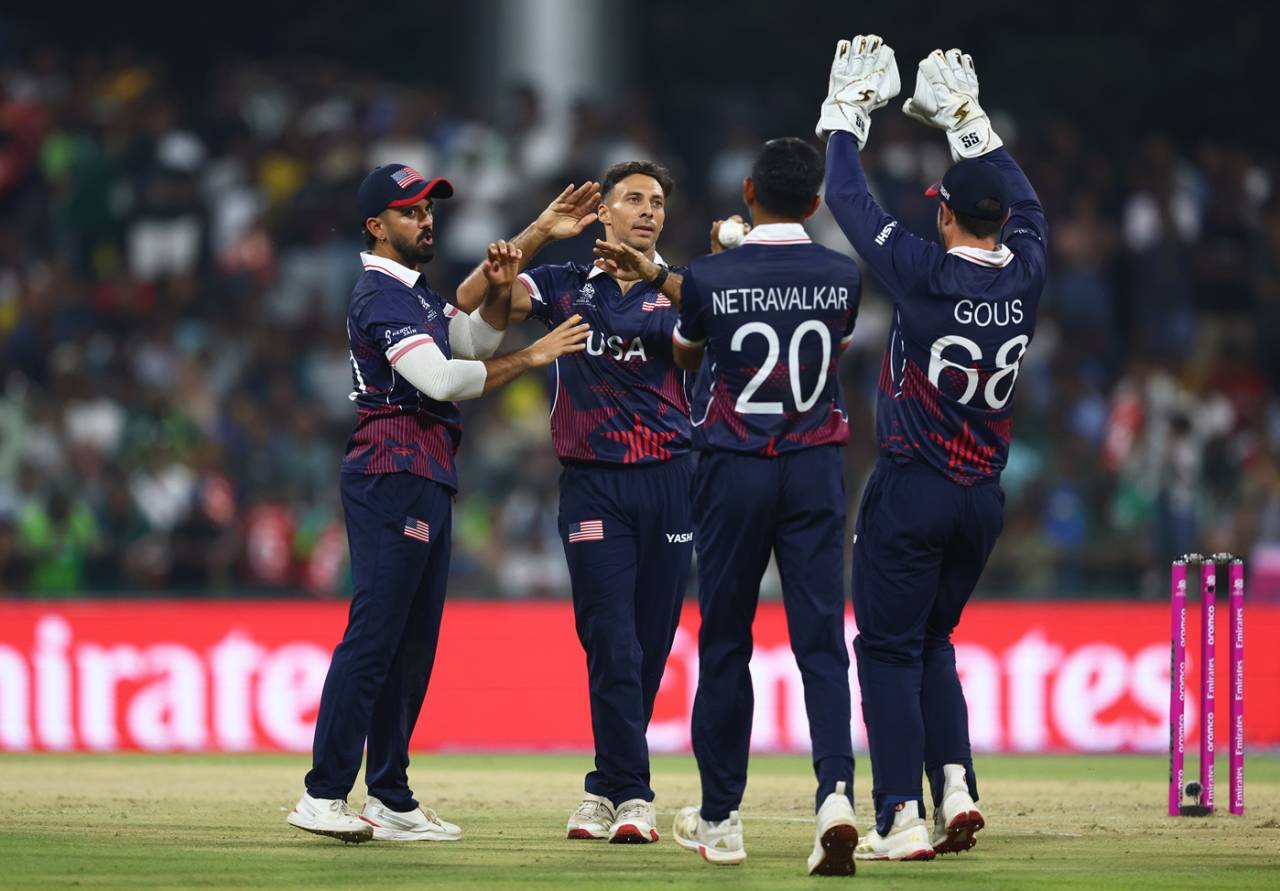
Shadley van Schalkwyk took two big wickets in one over against Pakistan, Saim Ayub and Salman Agha • Getty Images
Seamer Shadley van Schalkwyk, born in South Africa but playing for USA, went wicketless at his first World Cup, in 2024. That did not really bother him then, he says, and even less now that he has tasted success at the 2026 tournament. In two matches, he has eight wickets and leads the tournament's bowling chart with twin 4 for 25s against each of India and Pakistan.
"It doesn't feel like it's real," he says. "It just genuinely feels like a dream and probably one of the weirdest feelings I've ever had in my cricket life. I'd be lying if I say I am not chuffed.
"It hasn't kicked in. I wake up in the morning, and my wife will say, 'Can you believe it?' It's probably the most messages I've ever gotten in my life. I had about 340 WhatsApps and there must have been well over 100 Instagram messages, which unfortunately I haven't got to yet."
Several of those texts came from his old friend, South Africa top-order batter Reeza Hendricks, who is in a close-friends text group with van Schalkwyk. "I've got a few best friends and they always send me a message afterwards. I like that because there's a lot of banter with the messages. It's never the typical, 'Well done.' It's more like, 'Well done, but I can't believe you missed Usman Tariq by like a metre and a half.'"
Van Schalkwyk can take that joke, which refers to the time he swung and missed at a ball that spun away from him from Pakistan's maverick spinner, because by then he had already put his name in lights. USA bowled first against Pakistan and conceded 190 but he headlined their effort by dismissing Saim Ayub, Salman Agha, Shadab Khan and Faheem Ashraf. Add to those the names of Ishan Kishan, Tilak Verma and Shivam Dube and van Schalkwyk has some high-profile notches on his belt. But the names don't interest him as much as the results.
"My dad, he's old-school, and he taught me: Don't care about the name. You play the game, you watch the ball, and you hit the ball. That's basically it," he says. "It doesn't matter who you play against. You just have to do your job. It's me being hungry for wickets."
"It just genuinely feels like a dream and probably one of the weirdest feelings I've ever had in my cricket life"
That was how van Schalkwyk approached things when USA were drawn to play their opening game, against India at the Wankhede. Despite a partisan, expectant crowd and an India line-up that knew the conditions better than anyone, USA had the hosts on the ropes at 77 for 6, striking regularly as India tried to hit out. Van Schalkwyk took two of the first three and he did it by taking pace off and inviting the drive with a slightly wide line.
"I know my variations. It was about making the ball as slow as possible for them, because it looks like they quite enjoy it when it comes on, so technically, I wanted to take it away from their hitting zones," he says. "We set a slightly different field to what you'd usually see. Our deep square was a little bit in front of square, because we know some guys hit quite hard behind square, so preparation-wise, we went over what ball we should bowl, what angle we should bowl, and when we should take pace off. With the wicket being a little bit slow against India, it helped my game plan."
Against Pakistan, in different conditions and against an opposition who started well, van Schalkwyk had to change tack. "My approach was a little bit different with regards to how the game was going. I wasn't looking to strike. I was looking to try to finish the powerplay off and just trusting my planning with knowing where to bowl the batters," he says.
The first wicket came at the start of the sixth over, when van Schalkwyk had Ayub caught at short third, which was a field placing that was planned. "Being an Associate country, we do a lot more homework sometimes than other players, so we try to know exactly where we should be able to bowl dot balls or get the guys off strike. Also, one thing we do find is where the guys get caught," he says.
The meticulous attention to detail is part of USA's overall plan to develop the game widely in their country. Van Schalkwyk has seen it at work first-hand since he moved to the country in 2019. "There's a lot more cricket than people think in the USA," he says. "I mean, in our league alone in Seattle, there's five divisions, and each division has eight adult teams. There's five cricket academies within the Seattle area within a ten-mile radius, and each academy is averaging about 170 kids at this moment from all ages from five years old right through to 19. Skill-wise, there's a scary amount of talent coming through."
Van Schalkwyk left South Africa almost on a whim. USA left-arm spinner Nosthush Kenjige had gone to train in Bloemfontein, where van Schalkwyk spent the bulk of his professional career. The two got to talking and van Schalkwyk asked Kenjige about possibilities in the USA. "The cricket circle is big but small at the same time. I just randomly messaged him, and he was absolutely brilliant in helping me."
At around the same time USA Cricket was recruiting players for a minor league, with an eye on developing a major league, and several South Africans signed deals. Dane Piedt, Andries Gous, Obus Pienaar and Calvin Savage were among those who chose to chase the American dream.
Van Schalkwyk found himself in Seattle, which he likened a little to his original home town, Cape Town. "There's hiking. It's very green. There's mountains, there's rivers, there's lakes. I like my outdoor life and I know it rains quite a bit but I love Seattle. We've built up such a nice community around our family now that we call it home."
USA were due to co-host the 2024 World Cup and van Schalkwyk knew there would be an opportunity to make the squad. "I came over to try to play one World Cup for the USA and qualify in time to play the 2024 one," he says. "I was fortunate enough to have good trials leading up to that, which was quite nice. And then, to be fair, I don't think I always knew there was a possibility of a second World Cup, because I never thought that far ahead."
By virtue of their strong performances in the home tournament, where they reached the Super Eight, USA qualified automatically for this year's event, which gave van Schalkwyk an opportunity for another shot at the big time.
At 37 years old, and with 18 years in the game, he accepts that he is nearing the end of his career, but there are still reasons to keep going. "I'll be honest, I want to play forever, but I know I can't," he says. "I haven't decided yet because fortunately enough, the body's felt really good so far. I've pulled up quite nicely. I love my gym, I love my fitness, so if I can push for as long as my body allows me to, I still want to compete and play well at this level. I can't put a number on it or an age on it but I don't think [retirement] will be until I am 40."
That takes him to August 2028 and leaves open the possibility that, if USA qualify, he might play at the ODI World Cup in 2027 in South Africa and the LA Olympic Games in 2028. By then, he may have a few more World Cup wickets to his tally as well, and perhaps even the opportunity to watch them again on the highlights.
He hasn't seen any of his eight wickets on video because things have moved quickly. "It was a crazy rush-around. We finished the game [against Pakistan], our bags had to be out of the rooms at 1.30am, and then I tried to get some sleep because my daughter wakes up very early, and then we basically jumped on the bus and on the bus trip, I lose quite a bit of signal," he says.
That was on Wednesday, two days before USA's game against Netherlands. More than taking wickets against them, what van Schalkwyk wants is for the USA to register a win or two and leave Indian shores having shown what they are made of. For someone whose entire cricket education took place in South Africa, that means showing what being a professional in the USA is about. "In our team alone, the cultures are very different cricket-wise. We were brought up with different ways of playing the game. It's always good to pick each other's brains and see what we can do together."
Firdose Moonda is ESPNcricinfo's correspondent for South Africa and women's cricket