
Shadow-practise, dream, wait
The final nets are over, there are about 18 hours to the start of the Test. How do cricketers spend that time?

Aakash Chopra
24-Sep-2009
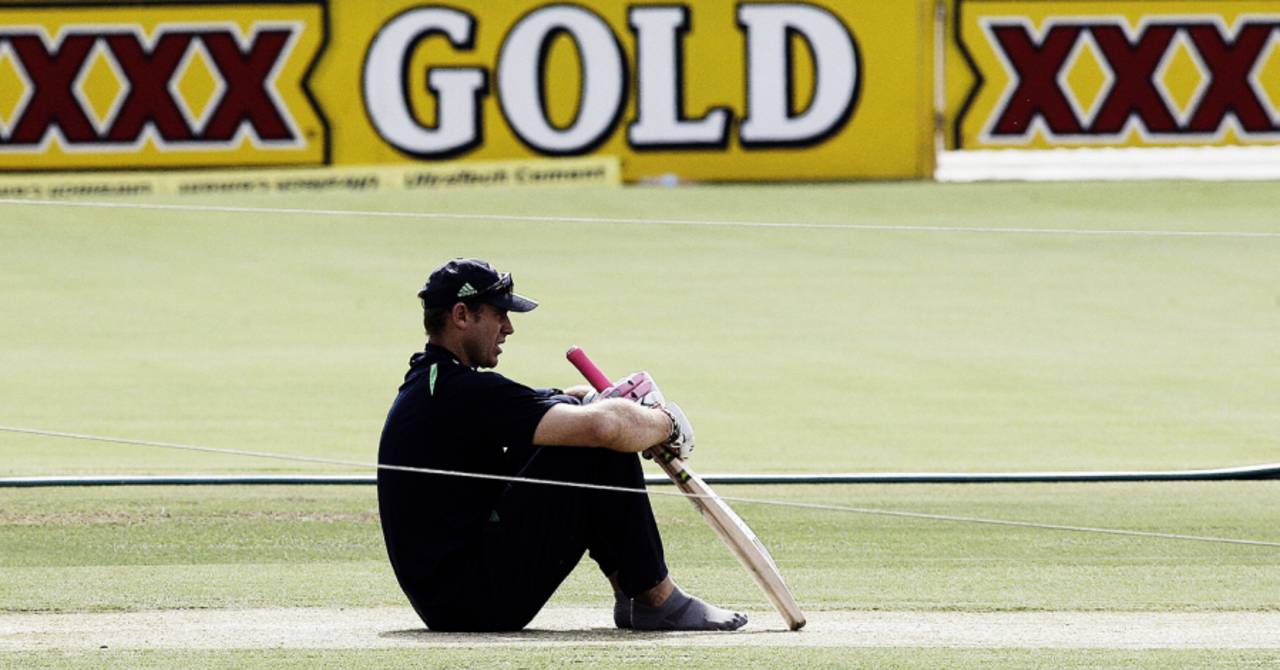
Matthew Hayden liked to be left alone with the pitch he had to play on the following day • AFP
You may have wondered why Matthew Hayden sits on the pitch on the eve of a match. Does he meditate sitting there? Or why Rahul Dravid shadow-practises shots at both ends? Hasn't he played enough in the nets? Chris Gayle also does the same thing, albeit in the middle of the pitch. What are these guys up to?
All of them use an extremely important tool for preparation, visualisation. Hayden visualised everything, good and bad, that could happen in a match, so as not to be surprised during the match. All of us, knowing or unknowingly, do it.
I had my formal introduction to this technique just before the first Test against Australia in Brisbane in 2003. John Bell, an Australian coach I had met in Holland, told me about its application and importance. He told me to walk out from the dressing room on the eve of the match assuming that I was walking out to bat on the first morning of the game.
I had to psyche myself into seeing the packed stadium, the Australian team waiting in the middle along with the two umpires. I also had to imagine my partner, Virender Sehwag, was walking alongside me. Then I did my ritual, running a couple of mock runs, before settling in to take strike. To avoid looking completely insane, I skipped the part where I asked the imaginary umpire for a leg-stump guard. Apart from that, I did everything I would in the real match. I mentally drew a line just outside the off stump, to use as a marker for letting balls go. Anything pitched outside that line would be allowed to go through to the keeper and the rest were to be played. Then I'd stand in my stance and visualise all the Australian bowlers running in and bowling in different areas. It is a routine I've followed ever since.
Ground reality
Every ground and track has a different feel and the earlier you get used to it the better. Batsmen identify certain shots for certain tracks. For example, on slow and low tracks you realise the need to get onto the front foot as much as possible and play with a straight bat. Similarly, on tracks with more bounce and pace, you prepare yourself to stay on the back foot and play horizontal bat shots. That's exactly why players shadow-practise while standing in the middle. Bowlers also identify the areas they'll be expected to bowl in, and do mock run-ups to get a feel of the approach to the stumps.
Every ground and track has a different feel and the earlier you get used to it the better. Batsmen identify certain shots for certain tracks. For example, on slow and low tracks you realise the need to get onto the front foot as much as possible and play with a straight bat. Similarly, on tracks with more bounce and pace, you prepare yourself to stay on the back foot and play horizontal bat shots. That's exactly why players shadow-practise while standing in the middle. Bowlers also identify the areas they'll be expected to bowl in, and do mock run-ups to get a feel of the approach to the stumps.
Individual approach
Batting and bowling in the nets on the eve of the match is strictly according to each individual's liking. No one tells you to bat in the nets if you aren't comfortable, and the support staff does everything to help you get into the groove. Rohan Gavaskar wouldn't play a single ball in the nets, while Viru likes a long hit. Similarly Gautam Gambhir needs his throw-downs before every match, while Sachin Tendulkar's batting in the nets depends purely on how he's feeling about his game at that point of time. While Sachin didn't bat too often in the nets during the 2003-04 series, when he did, he made someone bowl at him from 15 yards most of the time.
Batting and bowling in the nets on the eve of the match is strictly according to each individual's liking. No one tells you to bat in the nets if you aren't comfortable, and the support staff does everything to help you get into the groove. Rohan Gavaskar wouldn't play a single ball in the nets, while Viru likes a long hit. Similarly Gautam Gambhir needs his throw-downs before every match, while Sachin Tendulkar's batting in the nets depends purely on how he's feeling about his game at that point of time. While Sachin didn't bat too often in the nets during the 2003-04 series, when he did, he made someone bowl at him from 15 yards most of the time.
There was one extraordinary instance of Dravid and Viru missing the practice session and watching a movie instead. It was before the memorable Adelaide Test in 2003. Sometimes, simply unwinding is the need of the hour.
You often find cricketers sitting together till very late on the eve of a match. That's to ensure that the moment they walk into their rooms they fall asleep. There's also the tendency to get up a few times during the night to check if you have slept through the alarm, only to find that dawn is still a few hours away
At the end of the practice session, most batsmen take their match bats with them to the hotel. Some batsmen shadow-practise religiously in their rooms. Others just want the bat handy in case they feel like doing so.
Sleepless nights
Sachin didn't sleep well for 15 days leading up to the match against Pakistan in the 2003 World Cup. He would stay awake planning how to handle each bowler. He admits that he played the entire innings in his head way before it happened on the field. Gautam couldn't sleep the night before the 2007 Twenty20 World Cup final.
Sachin didn't sleep well for 15 days leading up to the match against Pakistan in the 2003 World Cup. He would stay awake planning how to handle each bowler. He admits that he played the entire innings in his head way before it happened on the field. Gautam couldn't sleep the night before the 2007 Twenty20 World Cup final.
You often find cricketers sitting together till very late on the eve of a match. That's to ensure that the moment they walk into their rooms they fall asleep. The anxiety doesn't let your mind rest, and that makes it very difficult to sleep. There's also the tendency to get up a few times during the night to check if you have slept through the alarm, only to find that dawn is still a few hours away.
A common dream for batsmen is that a wicket has fallen and you're slated to go in next. But you haven't put on the leg-guards and panic sets in. You try your best to get ready but something or the other always goes wrong. In reality, gearing up is a two-minute exercise that has been done a million times, but dreams seldom follow a logical pattern.
The morning of the match
Every player has his own routine on the morning of a game. Some, like Dravid, wake up well in advance, read newspapers and have breakfast before boarding the bus. Others sleep till the last possible minute and rush to the bus, grabbing a muffin on the way. Then there are those who indulge in incessant chatter all the way to the ground - and often occupy the last rows of the bus. Still others, like Sachin, listen to music. These routines depend a lot on temperament: some can't handle the anxiety and hence rush through everything, while others want everything in peace.
Every player has his own routine on the morning of a game. Some, like Dravid, wake up well in advance, read newspapers and have breakfast before boarding the bus. Others sleep till the last possible minute and rush to the bus, grabbing a muffin on the way. Then there are those who indulge in incessant chatter all the way to the ground - and often occupy the last rows of the bus. Still others, like Sachin, listen to music. These routines depend a lot on temperament: some can't handle the anxiety and hence rush through everything, while others want everything in peace.
After reaching the ground
Almost everyone rushes to the square immediately after getting to the field. Although nothing dramatic can happen, since you've seen the track the previous day, you need to be certain. It's like going through your notes one last time before an exam. You want to be 100% certain that you didn't misread the pitch.
Almost everyone rushes to the square immediately after getting to the field. Although nothing dramatic can happen, since you've seen the track the previous day, you need to be certain. It's like going through your notes one last time before an exam. You want to be 100% certain that you didn't misread the pitch.
Then there's the eternal wait for the toss. While one part of you wants it to be delayed for another couple of hours so you can hit a few more balls against throw-downs, the other part wants to be done with the suspense. Openers and fast bowlers watch the toss with great interest, and depending on the result of the toss, either prepare or relax.
Instead of warming up with cricket, most teams prefer playing a different, non-contact sport, like volleyball, just before the game. It lightens the atmosphere and helps you ease into the match day. Contact sports like football and touch rugby are generally avoided because the chances of getting injured are higher.
Batting first
The environment in the dressing room becomes a lot quieter if your team is batting. Even though the bowlers slip into a relaxing mode, they avoid making unnecessary noise. Both the openers and the batsman at No. 3 are left alone. Everyone wishes the openers luck as they go through their last little routines before stepping onto the field. But there are some batsmen who don't like to be wished before walking out to bat. One such was Sunil Gavaskar.
The environment in the dressing room becomes a lot quieter if your team is batting. Even though the bowlers slip into a relaxing mode, they avoid making unnecessary noise. Both the openers and the batsman at No. 3 are left alone. Everyone wishes the openers luck as they go through their last little routines before stepping onto the field. But there are some batsmen who don't like to be wished before walking out to bat. One such was Sunil Gavaskar.
Some batsmen will watch every single ball being bowled, as they wait their turn, either on TV or from the balcony, and then there are others who'd read newspapers and magazines (Mohammad Azharuddin) or sleep (Sir Vivian Richards) while waiting for their turn to bat. VVS Laxman likes to listen to music, while Yuvraj Singh prefers chatting.
I can't stop myself from watching. Thank god I'm an opener.
Bowling first
While batsmen relax, the bowlers are required to be on the field 10 minutes before the start of the game to warm up. But bowlers have the luxury of easing into the match, as they're not absolutely required to be at their very best right from the beginning. One mistake doesn't mean the end of the innings for them; an advantage that gets evened out with the heavy workload they have to bear. Their planning and plotting happens more on the field and during the match.
While batsmen relax, the bowlers are required to be on the field 10 minutes before the start of the game to warm up. But bowlers have the luxury of easing into the match, as they're not absolutely required to be at their very best right from the beginning. One mistake doesn't mean the end of the innings for them; an advantage that gets evened out with the heavy workload they have to bear. Their planning and plotting happens more on the field and during the match.
The opening batsmen start their preparation again when the opposition loses its eighth or ninth wicket. You see them standing in their stance and looking down the pitch every now and then. They also tend to go quieter in the field after the loss of the ninth wicket.
My endeavour through this three-part mini-series on preparation was to tell my readers what goes into the making of a good ball, a marvellous catch, an unsparing shot, a great cricketer. I hope that from now on every time you see a batsman fail or a bowler bowl a half volley, you remember that lack of performance is not necessarily because of lack of preparation. It's just that, in the game of cricket, like in any other walk of life, it's only human to err.
Former India opener Aakash Chopra is the author of Beyond the Blues, an account of the 2007-08 Ranji Trophy season. His website is here