
Swinging in the Jubilee rain
Thirty-five years ago, a weather-marred farce at The Oval

Martin Williamson
01-Jun-2012
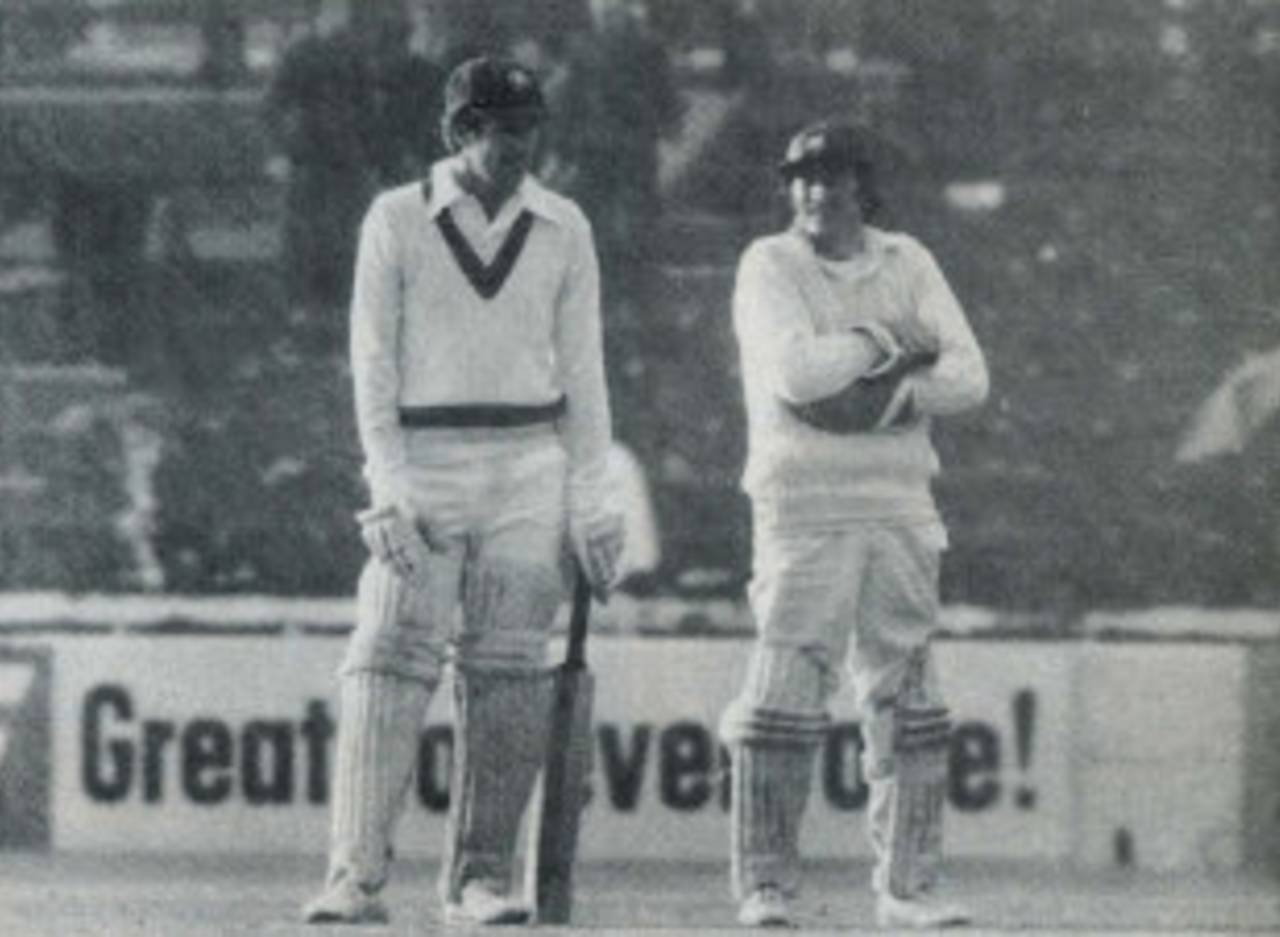
A drenched Greg Chappell and Alan Knott in the closing stages of what the Cricketer described as "an aquatic fiasco" • The Cricketer International
As the United Kingdom starts a four-day break to celebrate the Queen's Diamond Jubilee few are surprised at a poor weather forecast for the period. Rain and holidays are synonymous in this part of the world.
Thirty-five years ago to the week, the country was again preparing for a celebration. On that occasion it was to commemorate the Queen's Silver Jubilee. The backdrop was the same - bunting, street parties and fireworks - even if it was a very different world.
Jubilee day was a Tuesday, so recognising that there was money to be made from a holiday crowd on the Monday, the authorities slotted in the third Prudential Cup ODI between England and Australia at The Oval then.
The plan also ticked boxes with players and officials, who could stay in London after the match to join in with the celebrations the following day. The one problem was that under the competition rules if the match could not be completed on the scheduled day, play would spill over into a reserve day. Almost inevitably, although the match started under grey but unthreatening skies, by late afternoon the weather had turned.
Not even club cricketers would have put up with the conditions at the end. As Australia closed in on victory, rain lashed the ground and the few spectators who had lingered were huddled under what cover was available. "It would have rendered continuation of play in a football match almost grotesque," observed David Frith in the Cricketer. Five miles to the north, play at Lord's ended much earlier, which was just as well as all their supplies of beer had been rushed to cope with demand in Kennington.
The game itself, the third match in a series England had already won, started uneventfully in front of a capacity crowd. England made 242, but with Dennis Amiss (108) and Mike Brearley (71) adding 161 for the first wicket, it should have been so much better. In response, Australia had reached 88 for 1 when, at about 5pm, it started raining. As the downpour intensified most spectators headed home, but by 6pm the rain had stopped and the game resumed.
In normal circumstances there might have been no more play that night. But no one - players, officials or spectators - had any desire to return to The Oval the next day while the rest of the country was having a giant party. And furthermore, the sponsors knew that with all outside broadcast facilities tied up elsewhere, there would be no television coverage if the game spilt over to the Tuesday.
Australia restarted with attacking intent, Richie Robinson (70) and Greg Chappell taking the score to 181 before Robinson fell. After he walked off, things turned farcical. Dark clouds, which had been approaching from the west, arrived and very quickly the light deteriorated to such an extent spectators could not make out what was happening in the middle.
Chappell, realising that any newcomer to the crease would struggle to see the ball, let alone play it, tried to monopolise the strike, and did so to great effect. "I realised the best chance of winning was to get off and start again the next day," Chappell admitted. "But I played on for the sponsors' sake."
Only Doug Walters made any contribution at the other end, and his dismissal coincided with the start of a hailstorm. Still Chappell swished, water dripping off the peak of his baggy green - "the rain was driving straight into my face" - and the England bowlers waded in, not bothering to wipe the ball as the cloths handed to them for the purpose almost immediately became drenched. Chappell by now had also realised the bowlers and fielders were at a greater disadvantage than the batsmen.
As remarkable as Chappell's strokeplay was the diving catch by Derek Randall to dismiss Ray Bright, but it was a rare triumph for England as they slipped and slid their way round the outfield. The BBC cameramen struggled to follow the ball when hit into the outfield.
Umpire Dickie Bird, hunched as ever, as if the weight of the world was on his shoulders, cast a despondent figure, gazing bewilderedly as a game he knew should never be happening continued. Hands on hips, head shaking, drenched to the skin, he peered through the Stygian gloom, powerless to intervene.
As the match reached a conclusion, the weather had one last twist. While the hail continued to hammer down, loudly clanging on the tin roof of the old stand next to the pavilion, the sun came out low over the Harleyford Road. It cast an eerie light over an Oval deserted other than for 15 sodden figures shambling around on a puddle-dotted ground and some die-hards who had stayed on to watch.
"It was like looking through a dirty mirror," Chappell explained. "The conditions were worse than I had ever known on a baseball field, let alone a cricket field."
Kerry O'Keefe and Jeff Thomson (who was easily run out, not helping his own cause by wearing rubber-soled boots rather than spikes) came and quickly went in the scramble for victory - or more likely the dry sanctuary of the dressing room - but Chappell's unbeaten 125 guided Australia home with ten balls to spare. It was 8.15pm and, as Wisden noted, the game's final overs were played "in heavy rain against a blinding low sun at the Vauxhall End with pools of water in the middle".
Although the conditions had long rendered meaningful cricket impossible, Chappell recalled that both he and Brearley felt "morally entitled to see it through". He had batted, wrote Christopher Martin-Jenkins, "serenely on, as if indifferent to the extraordinary goings-on around him".
"As for the bemused spectators," Frith concluded, "they were left to reflect that in the days ahead, first-class cricketers, far from splashing about willingly, would not be prepared to emerge if there was the smallest spot of rain in the air."
Is there an incident from the past you would like to know more about? E-mail us with your comments and suggestions.
Bibliography
The Cricketer - Various
The Jubilee Tests Christopher Martin-Jenkins (Macdonald & Jane's, 1977)
The Ashes '77 - David Frith & Greg Chappell (Angus & Robertson, 1977)
The Cricketer - Various
The Jubilee Tests Christopher Martin-Jenkins (Macdonald & Jane's, 1977)
The Ashes '77 - David Frith & Greg Chappell (Angus & Robertson, 1977)
Martin Williamson is executive editor of ESPNcricinfo and managing editor of ESPN Digital Media in Europe, the Middle East and Africa