| Series | Countries | Live Scores | Fixtures | Results | News |
Features
|
Photos | Video & Audio | Blogs | Statistics | Archive | Games | Mobile | ||||||||||||||||||||
|
The way Indian cricket treats spectators is depressing and a travesty of the times

March 3, 2013
![]()
|
|||
|
Related Links
Blogs : Cricket between the ads
News : Arthur backs Lyon despite axe Series/Tournaments:
Australia tour of India
Teams:
India
|
|||
Watching cricket at Indian grounds has become less harrowing in the past few years, but the experience still tests your love for the game.
Since ESPNcricinfo is not considered worthy of media accreditation by the BCCI I have done a fair bit of cricket watching from the stands and, as a consequence, I have stayed acquainted with the reality. Press boxes provide the comfort and tools to do the job but, cordoned off from the noise and the colour, it is a relatively sterile experience. In the rest of the world, where we are welcome to report on cricket from the press box, I always make a point to catch a few sessions from the stands. It is invariably more enjoyable.
It's come a fair way since the days of cement benches and lone ticket counters. Most Indian Test grounds now have bucket seats and, in most cases, you can buy tickets online. During the IPL, the franchise owners - for whom attendance is a crucial component of the revenue - even court the fans. But that fundamental change of mindset is yet to filter down to most of the state associations that host India's international matches.
The ongoing Test between India and Australia is the second of the season in Hyderabad, a city that hasn't lost its grace and old-world charm despite the onslaught of consumerism. This Test was granted to Hyderabad because the facilities for the players at the Green Park ground in Kanpur were deemed unfit. But do facilities for spectators even count?
The new stadium is barely six years old. It is 40 minutes away from the city as opposed to the old Lal Bahadur Shastri Stadium, which was bang in the middle. Lack of space in the city is a genuine problem, but what accounts for the lack of thought? That the construction makes no allowances for aesthetics can be put down to a matter of taste but absence of consideration for spectators can only be put down callousness.
The word stakeholder is used in nauseating regularity by sports administrators around the world, eager to establish that sport is an enterprise and that they mean business. But how often does the definition of this term extend to include spectators?
I didn't buy my ticket. I couldn't have. I had left it till the last and, even though there were empty seats at the ground, the first day was officially sold out. This is true of many grounds in the world, and particularly so in India where the recipients of vast quantities of complimentary passes simply don't turn up.
Only last week, I had been forwarded a letter to the Tamil Nadu Cricket Association by Mina Anand, advocate by profession and cricket fan by identity. She stood in a queue at the ticket counter for nearly two hours on the second day of the Chennai Test only to return disappointed when the tickets were sold out in ten minutes. When she got home Tendulkar was batting on television but what caught her eye was the rows of empty seats in the stands. Hopes raised, she returned to the ground at lunch only to be told that those seats belonged to the sponsors.
She made sure she got in the next day: she left home at 4 am to make sure she was among the first ones in the queue. Which takes us to the first sentence of this piece: wanting to watch cricket from the stands in India does test your love for the game.
The night before the first day of the Hyderabad Test, I met a group of students from the Indian School of Business, among them a former colleague from ESPNcricinfo. They were fortunate to have secured tickets online in one of the better parts of the ground. But they still had to leave home before 7 am for play that started at 9.30 am - because the online tickets could only be picked up in the morning from the middle of the city, about 25 kilometers from their campus, before travelling 20 more to the ground. A ticket collection centre near the ground? That would make it too easy and that would be too much common sense.
I met the students again at the ground. They wore the same harried look as I did. Like me, they had encountered trouble at the first of many checkpoints: mobile phones had been banned. I was told that it was in the fine print on the ticket that I had picked up on the way to the ground, and the security guards, with utmost politeness and with folded hands, pointed to the signage at the gate.
It was part of the tightening of the security process after the recent bomb blasts in the city. But why mobile phones, I asked?
"Don't you know they can be used as a triggering device?"
"But how would a bomb get in to the ground?"
| India, we are breathlessly told, now boasts of 43 international grounds. Can a dozen not be found where spectators aren't subjected to melting under the sun? Or can money not be found to put roofs over every inch of the grounds where spectators are expected to spend 45 hours over five days? | |||
He smiled, pointing out that I also couldn't carry my pen. I didn't bother to ask what threat a pen posed.
Of course, there was no facility to deposit the cell phone at the ground. One of the security officers suggested I go back to my hotel and return later. "It's a Test match, you have a lot of time."
Quantity has superseded efficiency in the classical Indian approach to security. As Aakar Patel recently wrote in a no-nonsense piece, the layers of security at Indian airports seem to suggest a basic lack of trust in these very layers. There was no point in remonstrating with the security at the stadium. They were almost apologetic, and they were merely following instructions of someone who had got wise to the point of stupidity after the terrorists had done their job.
I was lucky that I knew people in the press box and that journalists were allowed to take their phones in. A friend came down and took custody of my phone and I merely had to pass through three more checks before taking my seat, almost behind the sightscreen.
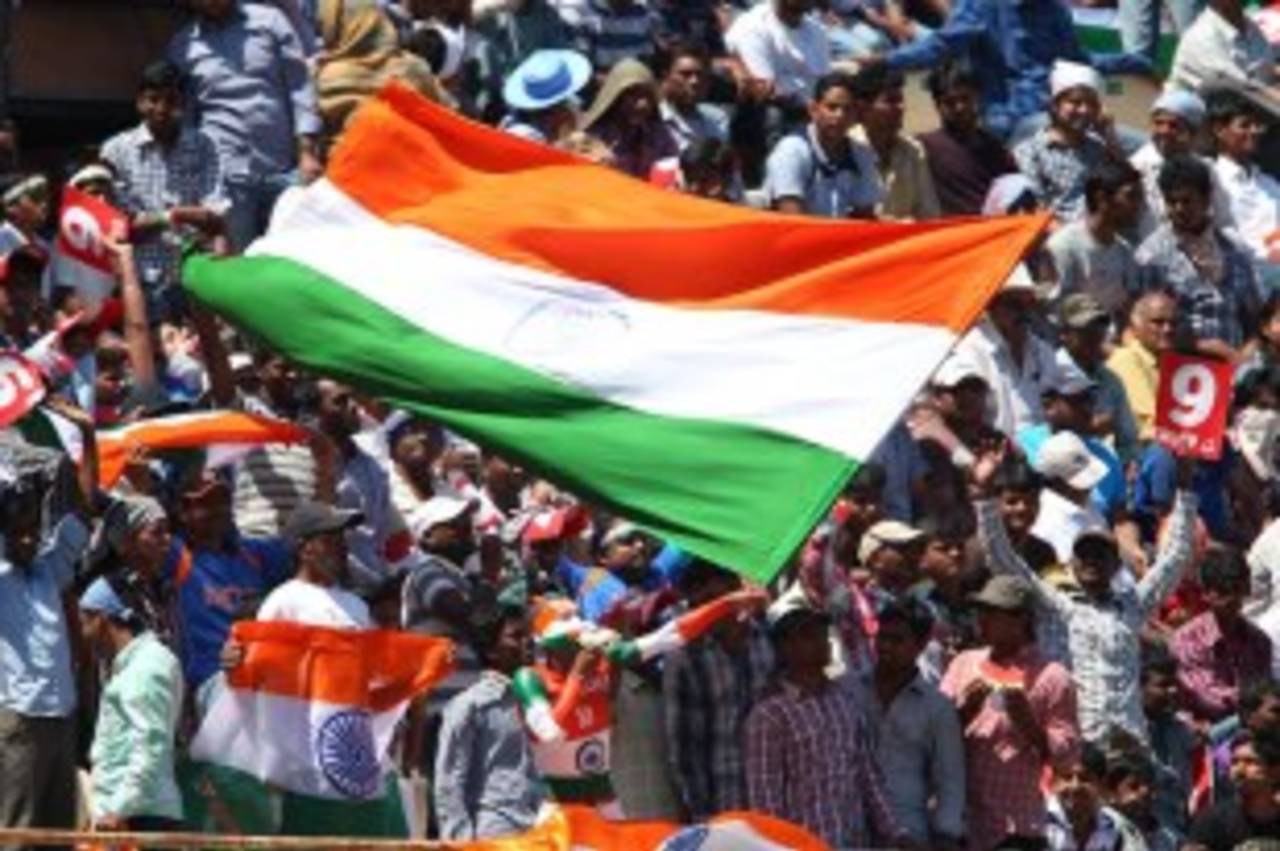
It was only when I looked around that I realised how fortunate I was. The biggest stands at the ground were to my left and my right. And they were open to the elements. Fans in some parts of the world welcome roofless stands because the sun feels nice in New Zealand and England. There are grass banks in South Africa and Australia that are open. But the only possible explanation for leaving fans under the sun in India could be to give them a taste of the conditions the players endure in the middle.
India, we are breathlessly told, now boasts of 43 international grounds. Indeed there are some excellent new stadiums in India. Facilities at Bangalore have got better, Chennai has become excellent as has the Wankhede. Care has been taken to get rid of the pillars that obstruct view and build adequate toilets. So can a dozen not be found where spectators aren't subjected to melting under the sun? Or can money not be found to put roofs over every inch of the grounds where spectators are expected spend 45 hours over five days. And can the non-negotiable terms for certifying a ground to be worthy of international cricket not include basic spectator comfort?
To watch fans stream in to watch Test cricket over the weekend lifted the spirits, but to watch them seek shelter from the sun with their handkerchiefs was depressing.
Why can't cricket take care of those who sustain it with their love?
In which other business is the consumer not the king?
| ||||||
| Comments have now been closed for this article |
||||||
Editor Sambit Bal took to journalism at the age of 19 after realising that he wasn't fit for anything else, and to cricket journalism 14 years later when it dawned on him that it provided the perfect excuse to watch cricket in the office. Among other things he has bowled legspin, occasionally landing the ball in front of the batsman; laid out the comics page of a newspaper; covered crime, urban development and politics; and edited Gentleman, a monthly features magazine. He joined Wisden in 2001 and edited Wisden Asia Cricket and Cricinfo Magazine. He still spends his spare time watching cricket.

Fixing? It's people like us doing it
Ed Hawkins: It's convenient to blame the underworld for every instance of fixing, but it's ordinary punters behind many of them
The perils of scoffing at failure
Rob Steen: Excessive success can destroy inhibition, and hence the capacity for shame
New Zealand shaken and stirred
Andrew Alderson: The second-innings collapse at Lord's has revived concerns about New Zealand's top order
'The most complete fast bowler I've seen'
Allan Donald on one of the bowlers he found intimidating: the relentless Wasim Akram
There'll always be takers for easy money
Mahesh Sethuraman: Conflicts of interest, disparity in earnings, and easy access to players enable underhand dealings
Pollard sledges Watson, Dravid is angry
Plays of the day from the IPL match between Mumbai Indians and Rajasthan Royals in Mumbai
A talent that didn't know its own worth
Sreesanth wasn't the most likeable team-mate or opponent, but he had skill beyond doubt, which we might have seen the last of
Even at the height of his success with the national side, Sreesanth was a lonely cricketer who felt hard done by
A time for anger, a time for action
Out of the shattered lives of three young men caught up in allegations of fraud, newer and stronger players must emerge
Another season in the bottom half
With some of their big names stumbling this season, Kings XI Punjab were rarely serious contenders for a playoff place
Even at the height of his success with the national side, Sreesanth was a lonely cricketer who felt hard done by
Dravid and the art of T20 captaincy (56)
Despite a small squad bereft of big names, Rajasthan Royals' captain has churned out win after win
Mumbai Indians still have a better head-to-head record against Chennai Super Kings, but once again on the big occasion, they came second
Anderson's magic not to be missed (49)
None of the other three England bowlers with 300 Test wickets - or many other of the game's finest swing merchants - could have bowled better than James Anderson at Lord's
Pollard sledges Watson, Dravid is angry (43)
Plays of the day from the IPL match between Mumbai Indians and Rajasthan Royals in Mumbai
ICICI Bank M2I. Register Now and Get A Gift Offer.
Safe & simple online money transfer. Apply Now!
Buy Wisden 2013 & get a FREE Playfair
Available now at Cricshop
Sambit, the stadium as you said is far away from the city, and if one chooses to drive a bike just to escape the city traffic, you are not allowed to take your helmet inside and you cannot keep it anywhere else. "Keep it at your own risk" this is the standard reply. There is no provision for paid parking for two wheelers. I was lucky to get the tickets for the covered stand on the 1st day but there was no drinking water except in the corporate boxes for most part of the day. The 2nd day was a little better but I couldn't get the desired seats. Food and drinks were sold well above the MRP or the rate chart. On the 2nd day a packet of buttermilk, which could protect someone from sun stroke was sold for 15/- as against the 10/- MRP being sold on the 1st day. Noone to monitor, the vendor fixes the prices depending on the demand and you have no choice but to oblige. I somehow felt, the vendor is the king. Poor spectator with poor facilities cab only be pitied in a few articles like these.
A wonderful piece. The apathy of the spectators are brought out by a very few and its nice to note that there is somebody who does notes all these things. Even the sale of tickets to better stands are not at all transparent and this aspect needs to be highlighted. The better stands are all sold either to the sponsors or the members who rarely turn up. Most of the members give away their tikcets to their near and dears who are seldom interested in the sport. often the members flaunt their tickets to show their status that they do get members tickets for an international cricket match. All sales should be on line and at least 70% of the capacity seats should be on sale for the general public and exchange of tickets for those who have booked online should be at the stadium and not at a place in the midst of the city. Seconldy the security harrassment being heaped on the public should come to a stop and there should be reasonable scouting and we need to take lessons on this.
Sambit .. you are bang on. I would love to watch matches on the ground & have travelled a few times to do so as my city (Bhopal) doesn't host matches. My last such experience in India was at a India-Pak. One-Day game at Gwalior around 4 yrs ago. We were seated in the Pavilion .. next to the VIP Pavilion which seated the CM, other state Politicians, Board Members etc. The ground is good, seating was comfortable but there was no provision for any amenities like Water or snacks in hot Gwalior summer where temp. could be around 40oC. We were not allowed to carry even water, forget cameras or mobiles. If they are not allowing us to carry basic things ... atleast provide them. All those with me swore never to watch a match at an Indian stadium again. I then went for 2 sessions of a Aus-SA test at the Wanderers in 2011 and must say the experience was amazing. The atmosphere was relaxed with excellent facilities for spectators & cost of the Pavilion day tkt. - princely R50/- (about Rs. 350/-)
Thank you Bahl for ur candid views on the facilities at the Cricket stadiums in INDIA . But the spectators are also equally responsible for creating chaos inside the stadiums like throwing bottles and other missiles in the ground. No doubt the genuine fans are really affected by this high authoritativeness of the Police. The shades in the stadiums are very much essential to avoid the heat from the scorching sun, especially during Feb/March onwards in South India. In the name of security, the genuine fans are denied the basic amenities like drinking water, food and even mobile phones. No doubt the State governments are responsible for the maintenance of law and order at the stadiums. But BCCI can step in and talk to the police authorities etc., and ask them to stop the non-sense like not allowing phones etc., When you cry from the rooftop saying spectator interest is waning, you have to take steps to allow genuine fans to watch cricket inside the stadiums.
Excellent article. I wanted to watch the 3rd day of the Ind-Aus test match. I went to Chepauk around 1:00 P.M. I seriously was not able to find as to where the tickets were being sold. There were no signboards, nobody to help the common public. I was told that all the tickets are sold out. I cam back home disappointed and started watching the match on TV. I was surprised to find that almost 40% of the seats was vacant. Was really disappointed. Lot of TV commentators complain about the lack of spectator presence in the ground for test matches. The issue is not to do with spectator's interest in test matches. The issue is with administrators interest to get the spectators onto the ground.
Bravo Sambit.This article reflects the agony and pain of an indian fan.i live here in the US but still follow the game ardently.i inherited the love for the game from my dad who had the opportunity to watch the game for the first 2 days.i was jealous first that i wasn't there but then i was happy that my dad will finally get to see the great Sachin. But how disappointed he was,when i called.he enjoyed the game, but he was furious at the facilities and the treatment.he wasn't allowed to carry a "chap stick and his comb.how dumb is that?? he is 65 and he cant carry his mobile.he was denied permission to use the bath room because they were locked and wont open until 925 am when he reached the stadium at 830am to get a better seat.water is served in glasses for 20 rs we went to the US open semis here in NY with 23 K capacity and he knows the difference of watching a sporting spectacle guess what, he is going again tomorrow.life of a Indian cricket fan.any one listening? taken for granted?
I'm an Aussie enjoying my first Aus-India test matches in India. I was at Chennai, and Hyderabad compared horribly. The phone issue was only the first problem- when we arrived on day one (we were sitting with shade albeit) I had my water confiscated at the gate. I was told it could be used to throw at the players. Ironically there was enough building rubble in the space behind the stands to use something much more malicious had I been there to throw stuff!
I learnt at first drinks break that there were NO drinks for sale. No water. No soft drink. There were probably 5,000 spectators in my stand who weren't allowed to bring water. The drinks arrived, by way of 6 20L bottles, after lunch, and spectators were forced to share cups as they'd forgotten that too. The water lasted about 10 minutes. Food was the same. Rice would arrive by way of 20 trays at a time, and were snapped up in less than 2 mins.
Disappointingly, the BCCI obviously only cares about TV rights and not the live crowd..
Well-said. The same was the case in Chennai too, except for the heat. The nearby Marina beach provided a cooling effect. I managed to get tickets on the second day, thanks to my instinct to spot black-marketers from a distance. Cellphones were allowed inside, but I had to leave my camera in the custody of an unknown housekeeping lady. She happened to be a gem. She waited for me and returned the camera after the day's play. They won't allow food packets or water cans from outside. Fair enough - had they arranged sufficient outlets to provide food and water. There was a stall on the leg side, and one on the offside. That was all. Don't know about the straight boundaries. It was like a typical test match field placement. One 300 ml glass of Slice cost even up to Rs.40. Even if you were ready to pay that, you need to have good jostling skills to reach at the counter of these stalls. The only people who suffered worse than the spectators were the Australian cricketers.
A very good synopsis of what it is like watching a Test match! But, I would extrapolate it to say that such high-handedness by police and so-called administrators rules our society everywhere. It's like using antibiotics for even a headache. Not allowing people to take cameras, phones, water and food is foolish to say the least. Unfortunately, there is nobody to question those who make such stupid rules, because that would be politically incorrect. If you were to stand up to these high-handedness, they would be called irresponsible and not realising that law and order is paramount. God help us! (if we can against these so-called defender of law and order)
I've often dreamed of watching a major Test Match series in India but this article has cured me. I thought spectators in England were treated badly but some of these stories are staggering. It's amazing anyone turns up.