
A night Gurbaz might not remember, but for the reminder on his jaw
He scored a half-century that didn't give Afghanistan victory, but Rahmanullah Gurbaz's show of grit made the 3rd T20I against West Indies remarkable
Abhijato Sensarma
23-Jan-2026 • 16 hrs ago
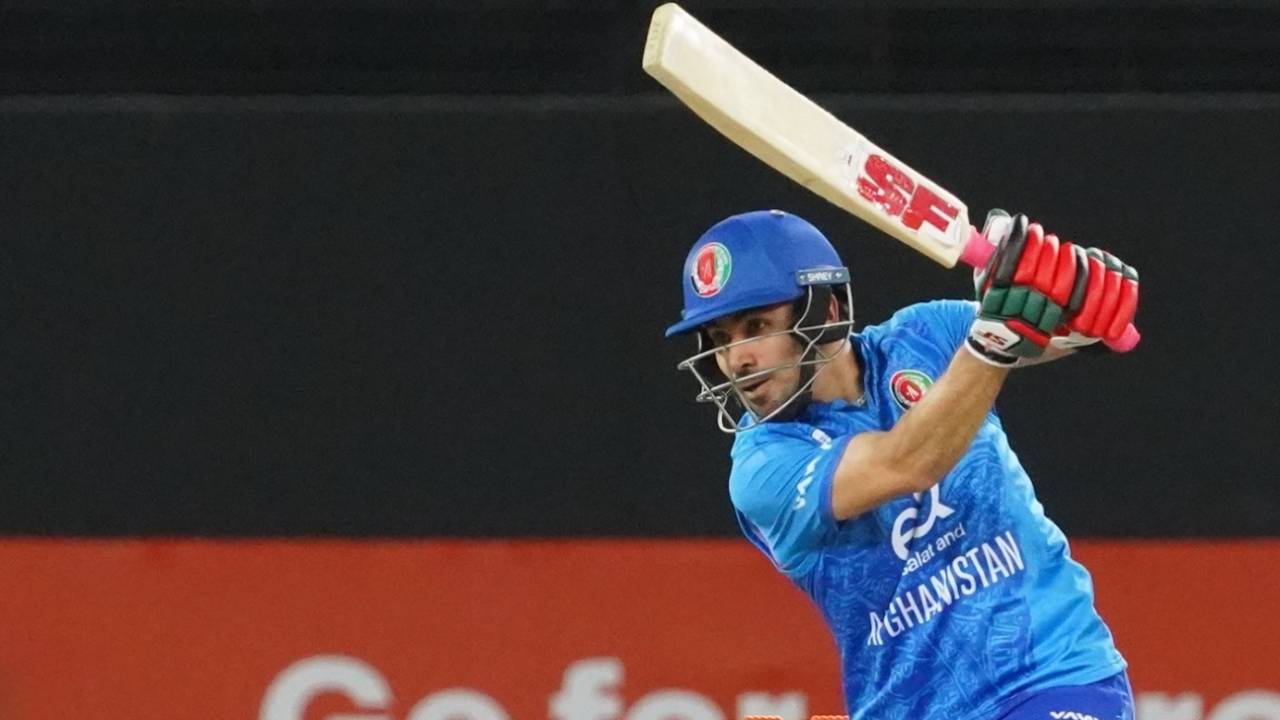
Rahmanullah Gurbaz's half-century went in vain • ACB
Rahmanullah Gurbaz's innings, on Thursday night in Dubai, won't be remembered for long.
He brought up his half-century off 44 balls, in a chase of 152 Afghanistan went on to lose, in a dead rubber of a bilateral series against West Indies, in front of a sparse crowd.
Gurbaz struggled for timing, like most other batters on a slow pitch. His best shot before getting to his fifty was when he shuffled to the off side against the medium pace of Matthew Forde, and got on his knees to sweep past fine leg. Most other times, the ball explored the edges off his bat more than the middle. When he timed it, he found the off side too packed.

The most remarkable bit about his night out might not have involved him at all, it could have been anyone in his place, and the impact would have been just the same.
Gurbaz was on 53, in the 15th over. Darwish Rasooli was on strike. Shamar Springer was the bowler. The ball was driven to mid-off. The batters considered a single, but decided against it. Gudakesh Motie collected the ball and threw it at the non-striker's end.
It was an oddity of physics plus chance: the ball bounced more than you'd expect off the turf and hit Gurbaz, running back to make his ground, flush in the helmet grille. The impact blew the helmet off. The stadium was quiet enough that the sound of ball hitting helmet could be heard with sickening clarity.
Gurbaz collapsed. The umpires, the fielders and Rasooli rushed to him and tried to prop him up even as the medics ran on to give him a concussion check. His jaw had a nasty cut.
One-handed six from @RGurbaz_21!
— Afghanistan Cricket Board (@ACBofficials) January 22, 2026
His first maximum of the innings. #AfghanAtalan | #AFGvWI | #GloriousNationVictoriousTeam pic.twitter.com/AuTXMirgHy
Soon, though, the helmet was back on. The physio was smiling through the concussion test. Motie, his team-mate from the Caribbean Premier League, embraced him almost as a gesture of apology.
For a moment, time had stood still. Now, it was time to get on with the business at hand: 58 off 34 balls was needed. In the same over, after swishing at a ball that went past his arc, Gurbaz stood deep in his crease to bosh a drive through the covers.
****
A show of grit enhances a sporting contest. Not many months ago, Chris Woakes - with a broken arm tucked under his sweater - and Rishabh Pant - with a broken foot tucked into his shoes - had become the defining images during a well-contested Test series.
Physical injury - especially concussions - are an unfortunate byproduct of the game. Yet, underneath the helmets and the neck guards and elbow pads, one plays cricket despite the knowledge that the ball can always knock you down. Or, occasionally, worse.
Gurbaz was knocked off his feet. But he got back up. And, in the 18th over, he got on his knees twice trying to get in line to scoop the ball. Both times - once off a low full toss and then, off a full ball - he got what he wanted.
A fine inning from @RGurbaz_21 in the third T20I. #AfghanAtalan | #AFGvWI | #GloriousNationVictoriousTeam pic.twitter.com/8Vi0Pz8COa
— Afghanistan Cricket Board (@ACBofficials) January 22, 2026
By the time Gurbaz stood back up after the second of those shots, Afghanistan needed just 28 off 15 balls.
****
Even if he had won Afghanistan the match from there, making a statement after 0 and 1 in the first two matches of the series, this game would likely have faded from his memory soon enough. T20s, after all, distil the essence of cricket into powerful focal points. At the same time, they are short-lived, usually overlapping with other narratives, other matches. Even here, Gurbaz eventually became the first victim of the true headline of the night: Springer's hat-trick that won West Indies the match.
The cut on the jaw will soon be a scar fading under the healthy beard.
Not all days are to be remembered. The body might; a few fans, too, no doubt will. However, the majority will forget Gurbaz's innings. Or his show of grit. It's just sport at the highest level as long as nothing goes seriously wrong.
Abhijato Sensarma is a sub-editor at ESPNcricinfo