
Wanted: a players' association for Pakistan
The frequent controversies that seem to dog the country's cricketers could well have been prevented if a players' body existed

Osman Samiuddin
21-Jun-2011
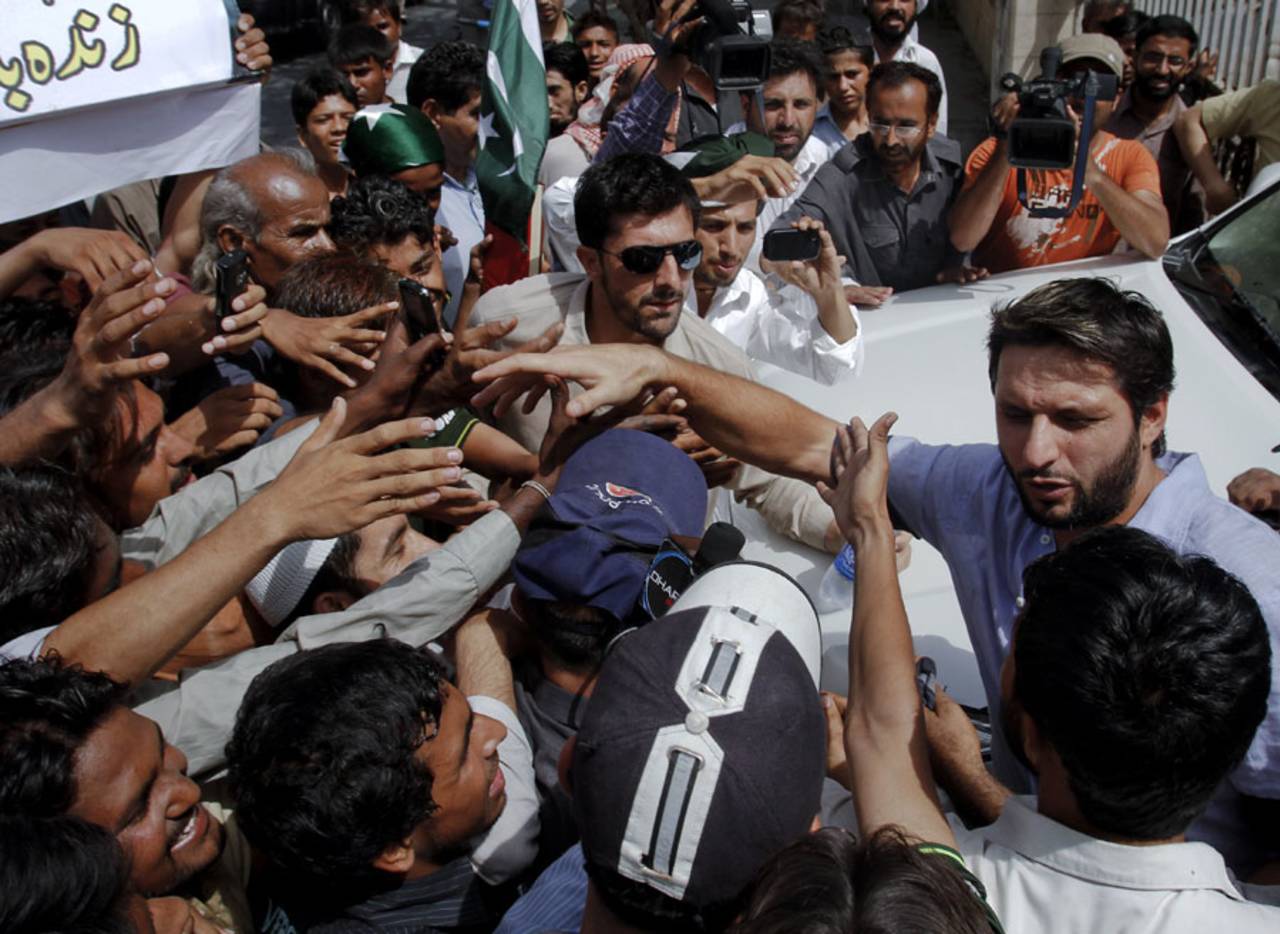
The latest saga involving Afridi may not have ballooned as it has if there was a strong players' association in place in Pakistan • Associated Press
Nearly 35 years ago a pay dispute between six leading cricketers and the BCCP - now the PCB - changed the face of Pakistan cricket. The dispute began with Asif Iqbal, Mushtaq Mohammad, Majid Khan and Imran Khan, among others, demanding better pay from a board headed by AH Kardar, Pakistan's first official Test captain.
The issue swiftly became politicised. Zulfiqar Ali Bhutto, the prime minister, and a close ministerial aide, Abdul Hafeez Pirzada, got involved. Eventually the players won out - Pirzada played the key role in trumping Kardar - and soon demonstrated their strength by joining Kerry Packer's circuit despite the threat of being banned from international cricket. Kardar was removed, the players got pay raises, and they played Packer and for Pakistan again.
They were transformative years. More money turned amateurs into professionals; TV, newspapers and magazines turned professionals into stars and heroes. County cricket expanded the world view, and skills, of top players, and for the first time since the 50s, Pakistan were once again competitive.
The pay battles were both a consequence of this change and an agent of it. They reversed an equation on which Pakistan cricket had run till then. Since then, the game has been an unequal tussle between increasingly big-headed players and increasingly - a few exceptions apart - unfit administrators. It is the redress of this equation, to once again make players subservient to the board, lambs not employees, that appears to be the sole aim of Ijaz Butt's administration. Given the quantity of players cast aside since Butt took over, and particularly the manner of their departures, it is a battle the administration is not losing.
What the pay disputes couldn't do was produce a robust players' association to turn power into player empowerment, which may potentially have prevented much of what we have seen recently. Majid and Iqbal did get one up in the early 80s, but it didn't last and the reasons are instructive.
"It is a unique culture in Pakistan," Iqbal once tried to explain. "When we first started talking about it, the board made sure we were attacked for it. It was said to be about player power. Nobody realised it was for the betterment of players, and the players themselves were unsure about it. Some were playing county cricket, some had jobs in banks, and it never really happened."
Much in the manner of the man, it is a polite explanation. Majid is blunter. "I do not think an association can be formed because of players' vested interests and their willingness to be exploited by the authorities." Both are right.
Egos clash, players form cliques and factions, they look out for themselves, they never trust one another, and they allow themselves to be manipulated by the board. Over the last 20 years the player has gotten bigger but the man has become smaller. This smallness is manifest clearest in the continued absence of a player association, a failure to recognise that though the player's lot has improved financially, he still has no voice.
There has never been a greater need for one than now. Shahid Afridi's needless legal battle with the board is only the latest in a burgeoning collection. Shoaib Akhtar's fight with Nasim Ashraf, the former chairman, went to the Lahore High Court in 2008. Pakistan's ICL players took the PCB to the Sindh High court as well. These will not be the end: there is an activist judiciary currently, so every axed, non-selected or disgruntled player feels he can go straight to the Supreme Court. Both the judiciary and the game can easily do without this kind of nonsense.
An association provides a buffer, a first, mediatory, port of call. It encourages negotiation not confrontation. Avoiding legal battles is the least of its benefits. Pakistan's players have been frozen out of the IPL for the last three seasons, sidelined as players from around the world secure a future. What has been their response? To sulk and complain of being victimised - and not as one at that, but as a disparate and unrepresented bunch. Could not an association aligned with FICA, the world player body, have taken more substantial, progressive action?
The establishment of a players association need not be at the expense of PCB authority. By demanding a base level of uniformity and unity, a players' association imposes its own kind of restraint on player power
There is no end to the issues a Pakistani cricketer needs advice, representation and counselling on. Currently national cricketers are simply handed central contracts by the board and it has been that way since Inzamam-ul-Haq stepped down; Inzamam used to negotiate, with considerable strength, on behalf of the players. Now there is no room for discussion or negotiation. For the last three seasons the monthly retainers of the three categories have not increased - a time in which the annual inflation rate has hovered between 10 and 15%. Incentives have increased but the last batch of contracts, after the spot-fixing scandal, had particularly stringent terms added. One clause stipulates that if a centrally contracted player plays for a county, he will not be paid his national retainer for the duration of that stint. This thus shatters the very central basis of retainers: the continuous financial stability and security they are supposed to provide.
And about those whose misfortune it is to not progress beyond first-class cricket? Nobody seems particularly concerned about their security, for instance. International cricketers have been targeted in this land, and the country's citizens are less safe than ever before, so who can say, with confidence, that domestic matches won't become a target? Who is representing the interests and safety of first-class cricketers? What about their broader condition? Is anyone looking out for them? Aamer Bashir, the much-respected domestic middle-overs giant who died late last year struggled to the end to fund treatment for cancer. He need not have done.
There is every chance that a players' association may create more problems, of that we must be aware. It is easy to imagine, for example, affairs going the farcical, petty way of WIPA and WICB. And union-management relationships in Pakistan can swiftly become cripplingly confrontational; Karachiites know only too well the suffering from an ongoing and self-absorbed dispute between workers and management at the electricity supply company. Neither will anyone bet against the emergence of a breakaway or rival association, set up by players snubbed by the original. It could get messy.
But what are the alternatives? To continue like this is to continue towards bankruptcy. Pakistan's cricketers need a representative body. It need not be at the expense of PCB authority. By demanding a base level of uniformity and unity, for a greater cause than an individual one, a players' association imposes its own kind of restraint on player power.
A gentle, gradual awakening has occurred again over the last two years. As captain, Younis Khan pushed the idea furthest, even contacting FICA head Tim May for advice on setting up an association. But he is disenchanted currently. There are others, such as current captain Misbah-ul-Haq, who know the benefits. Ramiz Raja, who was an important representative for the team on financial matters in his playing days, and Rashid Latif are advocates as well, and capable. Ultimately someone - anyone - must act.
Osman Samiuddin is Pakistan editor of ESPNcricinfo