
When Indians and Pakistanis played together to support Sri Lanka's World Cup cause
Thirty years ago, a joint India-Pakistan XI featuring Sachin Tendulkar, Waqar Younis, Wasim Akram and Anil Kumble played a solidarity match against Sri Lanka ahead of the 1996 World Cup

Andrew Fidel Fernando
Feb 13, 2026, 7:28 AM • 7 hrs ago
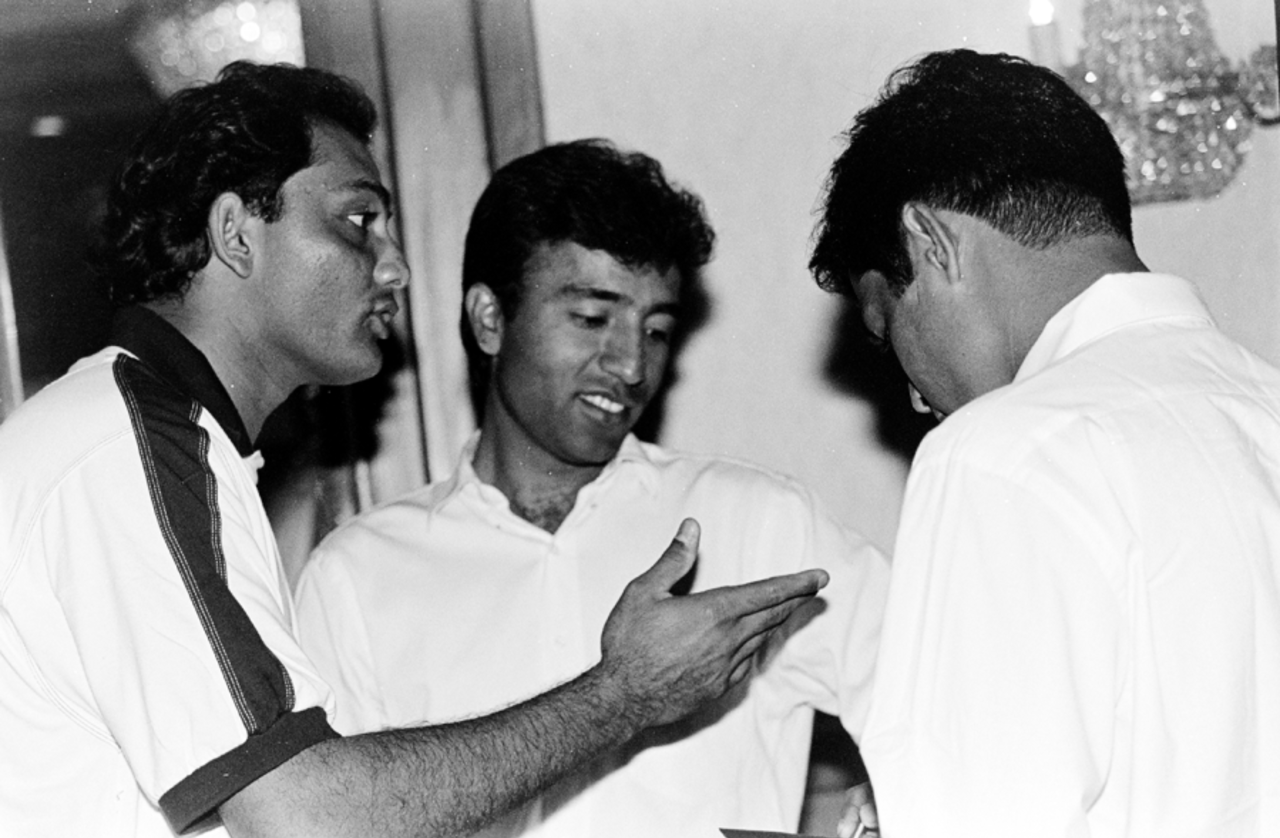
India captain Mohammad Azharuddin chats with Pakistan's Saeed Anwar and Rashid Latif a day ahead of the teams' 1996 World Cup quarter-final • Sondeep Shankar/Getty Images
Thirty years ago to the day on February 13, Wasim Akram and Sachin Tendulkar played in the same team, and India and Pakistan came together to support Sri Lanka in ways the island will always honour.
It was perhaps the high point of South Asian solidarity in the cricketing sphere. On January 31 1996, Colombo suffered one of the worst bomb attacks in the city's history, when the separatist Liberation Tigers of Tamil Eelam (LTTE) exploded a truck full of munitions at the base of Sri Lanka's Central Bank, killing 91 and injuring 1400. This attack, which came in the wake of government forces taking control of the city of Jaffna in the previous months, shut schools, closed offices and caused substantial disruption in Colombo's normal functioning, and yet, when Australia announced they would not tour for security reasons, Sri Lanka reeled. West Indies followed in Australia's footsteps, leaving only Zimbabwe and Kenya as the sides prepared to tour.
This was a problem for the India and Pakistan boards as well, because in the previous years, the South Asian bloc (led by India and Pakistan, with Sri Lanka in tow) at the ICC had campaigned to bring the ODI World Cup to South Asia as part of a joint hosting bid. This bid had been opposed - vociferously at times - by England and the traditional cricketing powers, who believed South Asia incapable of hosting such a substantial showpiece event.
But the South Asian bloc had prevailed in the boardroom, and a 12-team World Cup had been scheduled to be co-hosted by India, Pakistan and Sri Lanka. Australia - and later West Indies - withdrawing from their fixtures in Sri Lanka on security grounds became a significant issue for the bloc as a whole. A plan was hatched between the three boards: India and Pakistan would suspend their own World Cup preparations, and send six players each to Colombo, to play a 40-over match at Khettarama, in order to prove to the world that Sri Lanka was safe for cricket, despite being 14 years into what would become a 27-year civil war.
In fact it was at the World Cup's opening ceremony - on February 11 in Calcutta - that the plan to send over the India-Pakistan Solidarity XI was finalised. This was a mere two days before the match was eventually played. All three South Asian teams had been in Calcutta for the opening.
"When Australia announced they wouldn't come, I remember rushing off to a PILCOM meeting asking how we could solve this," says Ana Punchihewa, who was the president of the Board of Control for Cricket in Sri Lanka (BCCSL) at the time. PILCOM was the Pakistan-India-Lanka-Committee, which had been whipped up to coordinate on the World Cup's organisation.
"I don't know who came up with the idea, but out of that meeting in Calcutta, we decided there was going to be an India-Pakistan joint team that would play a match in Colombo," Punchihewa says.
"They didn't send just any team - it wasn't their second level" says Sidath Wettimuny, who was Sri Lanka's PILCOM manager. "They sent their stars, their very best players."
The team was captained by Mohammad Azharuddin, but also featured both Wasim and Waqar Younis (who would open the bowling together), as well as the likes of Anil Kumble, Saeed Anwar, Ijaz Ahmed, and Tendulkar, who was already one of the most famous cricketers on the planet. This combined team flew down to Chennai with the Sri Lanka side, and then on to Colombo.
"I remember very clearly that a passenger aircraft was asked to wait for us as long as it took for us to arrive in Chennai," Sanath Jayasuriya recalls. "I don't know if some of their players even had passports on them to get into Sri Lanka. But our government got involved and organised all of that."
"Wasim was on the flight, and he was very charismatic," says Punchihewa. "He knew how to get on with the India players, and everyone else."
Jayasuriya, who would go on to become Player of the Tournament, remembers the camaraderie the South Asian sides shared at the time. "We had very close relationships with both those sides. We spent a lot of time with each other whenever we had a tour. It's hard to believe everyone was that close now."
When the teams landed in Sri Lanka, the India-Pakistan combined team were greeted as heroes. Banners in Colombo reflected the gratitude many Sri Lankans felt. "We salute the brave sons of India and Pakistan" read one. "Long live India-Pakistan-Sri Lanka friendship" read another. When the teams got to the Khettarama stadium, a stitched-together flag combining those of India, Pakistan, and Sri Lanka was raced around the ground.
The India and Pakistan players couldn't help but be caught up in the welling-up of solidarity. "This is history," said a joyful Intikhab Alam, Pakistan's team manager at the time. "It's the first time Indians and Pakistanis have played together on the same side. It's a tremendous sight - everyone's mixing like old friends. Let's hope it's a turning point in relations."
Wasim, Pakistan captain at the time, was of a similar view. "This is something for all our countries. I look forward to future joint teams, including Sri Lanka."
No one remembers the match much itself. Local reports suggest that at least 10,000 fans had come to the ground, despite it having been a Tuesday and the game having been announced to the public barely 24 hours before.
"There were a lot of fans supporting the India-Pakistan team," remembers Punchihewa. "Even on the road, which the police had cleared, people were showing their gratitude."
Sri Lanka batted first in the 40-overs-a-side match. Wasim and Waqar opened the bowling, and Tendulkar was first change. The Indian bowlers inflicted most damage, Kumble taking 4 for 12 on a Khettarama dustbowl, and Aashish Kapoor claiming 2 for 34. Sri Lanka made 168 for 9, with Jayasuriya revealing little of the destructive power he would unleash over the next few weeks. The India-Pakistan combined side chased down the target comfortably. Tendulkar top-scored with 36, and Muthiah Muralidaran taking his wicket.
"As far as we could tell, the Indian and Pakistani players were good friends," says Roshan Mahanama, who didn't play this particular game, but was in Sri Lanka's World Cup squad, and would go on to play an important role in their campaign. "They were very supportive and very friendly with us. Even now I have a good relationship with those players who came."
For Jayasuriya, as for much of Sri Lanka, the game was an important staging post in Sri Lanka's eventual gallop to the trophy. "Playing an exhibition match was a turning point for us,"Jayasuriya says. "We showed the world that Colombo was safe and that you can play there. We should be really thankful to the India and Pakistan boards. That was the breakthrough. We also got a lot of confidence."
Having played the match, the India-Pakistan side was rushed out of the country just as quickly, their own actual World Cup opening matches only days away. But the goodwill created by this fixture, plus the solidarity between boards has become part of Sri Lankan cricket lore.
"When we were in India, the fans were fully behind us unless we were playing India," says Wettimuny. "When we were in Pakistan, the fans were fully behind us, except when we were playing Pakistan. We had incredible support from these two countries, which was very weird to us. After the final, Pakistanis were going in buses and vans and cars waving their flag as if they had won the World Cup."
"We will never forget what those teams did for us," says Jayasuriya. "Even if years pass, we remember that. Even if something happens in either of those countries, we remember that they were there for us in that situation. We didn't really see a difference between the India players and Pakistan players. They both came to support us."
Andrew Fidel Fernando is a senior writer at ESPNcricinfo. @afidelf