| Series | Countries | Live Scores | Fixtures | Results | News |
Features
|
Photos | Video & Audio | Blogs | Statistics | Archive | Games | Mobile | ||||||||||||||||||||
|
They may have chosen to be firm with their erring players, but to make them perform, the coach and captain need to be reassuring

March 15, 2013
![]()
|
|||
|
Related Links
News : Arthur outlines 'minor indiscretions that built up'
News : Clarke remains hopeful of Watson return News : 'Captain and vice-captain must sort their issues out' - Pat Howard News : Howard doesn't know the real me - Watson Blogs : The vagueness behind Australia's crisis Features : Where to for Watson? In Focus:
Australia crack the whip
Players/Officials:
Shane Watson
Series/Tournaments:
Australia tour of India
Teams:
Australia
|
|||
That great cover drive that makes us stand up in admiration, that late outswinger that makes us gasp, the offbreak that turns to hit the top of middle, the diving stop at backward point - these are images that allow television to carry sport into our being, to let it reside there and make us reach into it when the world is less thrilling. The stars create these images and television creates that aura, allowing us to believe the players are invincible. That is hero worship, isn't it? Letting your mind believe that your hero can do no wrong.
But because television is concerned with the here and now - this shot, that dismissal, this commercial break - it doesn't allow itself time to look beyond, or indeed into, the hero who succeeds and fails so spectacularly before us. So we can often be led to believe that sportsmen inhabit another planet, that they are made of steel and elastic, that they are not us, they don't have our problems (EMI has gone up, the maid announces she is on long leave, there is a transport strike). We fail to understand them because we measure them with unreal scales.
But meet them away from the cameras and the scorecards and you see different people, ones we can recognise better. People who worry and fret and wake up in the middle of the night and are scared for their future, who look over their shoulder, and maybe are even secretly happy at a colleague's bad patch. Their lives too are governed by where they are on the grid of ambition/frustration and confidence/insecurity. When ambition is in stride with confidence, they approach the image I talked about earlier, but ever so often they are consumed by life in the other quadrant, that of frustration and insecurity, which is where I suspect some of the Australian cricketers find themselves. That is why the job of the leader, whether the captain or the coach, is to try to constantly push them towards the space defined by ambition and confidence.
Good leaders do that regularly, and the incompetent or uncaring ones let their players wallow in insecurity and resultant frustration. Imran Khan was a great leader. Under him Wasim Akram bloomed and Inzamam-ul-Haq was able to grow strong roots. With another captain, two of Pakistan's greatest-ever talents might have been lost, as some others have been. The key to Imran's leadership was to understand the world these extraordinary players sought to inhabit and the hurdles they perceived on the way. Akram could bowl every ball but needed to learn when to bowl it; Inzamam was beset with self-doubt, unaware of how good he really was.
So too with Sourav Ganguly, who was able to understand the person behind the wild talent of Harbhajan Singh, Yuvraj Singh or Virender Sehwag. They needed reassurance, and once given that, they went on to great success. MS Dhoni has tried that, with a little less success, with Rohit Sharma, for example. Ian Chappell did that with a generation of Australian cricketers, as did Mark Taylor. Mike Brearley and Nasser Hussain, in contrasting styles maybe, were able to understand too the insecurity that accompanies a competitive but short-lived profession.
| Winning breeds security that can lead to the generosity that is at the heart of team spirit. Losing, on the other hand, can leave people feeling edgy, which translates to selfishness | |||
It is through this prism that we need to see where Australia's cricketers are and whether the insecure world they now inhabit is dictating their approach. It is easy to demand team spirit. It is a strange animal, for no one has yet established whether winning creates team spirit, or whether it is indeed, as some of us believe, the other way around - that a great team ethic leads to winning. What we do know is that winning breeds security that can lead to the generosity that is at the heart of team spirit. Losing, on the other hand, can leave people feeling edgy, which translates to selfishness. And so it is when a team is losing that managers need to remind people that skill doesn't desert you, only confidence does.
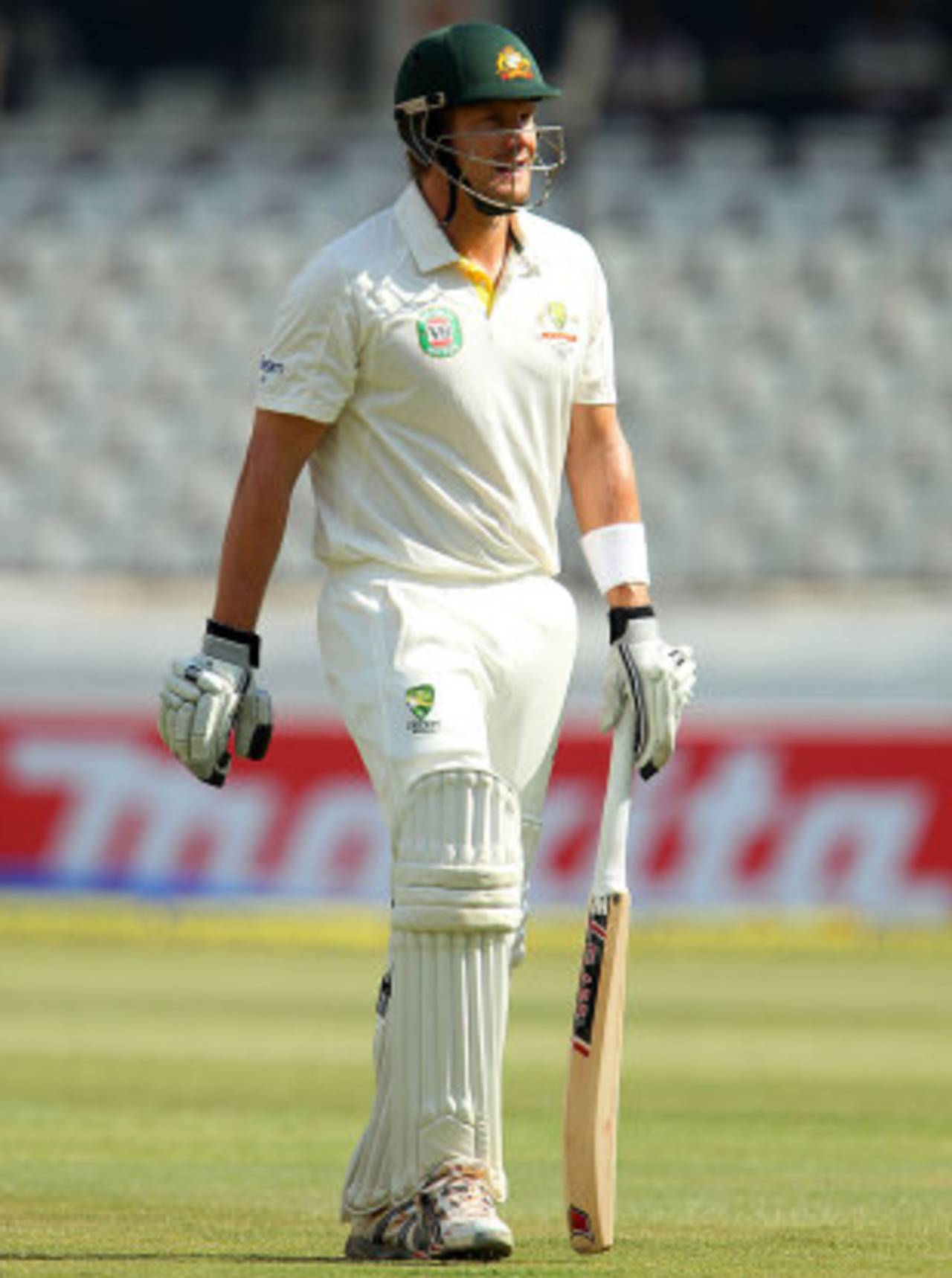
Shane Watson, in the eye of the storm, is someone who, I believe, can be understood on this ambition/frustration and confidence/insecurity platform. A hard-hitting, unusually gifted batsman who can bowl over 135kph is rare in our sport. Understandably Watson was celebrated, admired, and would have resided in the ambition/confidence quadrant. Ten years later, with injuries afflicting him at key moments and well into the second half of his career, he is aware that he couldn't become the player he believed he could have been, and is slipping into insecurity and frustration. But he is still a fine player and, from this distance, clearly one of the two best opening batsmen in Australia. Watson's problem at this stage is not skill but reassurance. He needs to be led.
But it is not a situation that Australian cricket, so abundantly successful, has often encountered. It has responded with an iron hand.
Of course the administrators might have tried, offered support and understanding, and might have been rebuffed. Too much reassurance can lead to a feeling of being indispensable, and maybe they have now reined in prima donnas. We don't know. But Australia need to be careful here in ensuring that the rest of the team and the wider cricket-playing world in their country agree with what they have done. If people think they have exacerbated the problem, not found the solution, they risk driving more players towards insecurity and frustration, a state that England knew very well and that they would relish in their opponents.
Australia need a firm, understanding leadership. They have shown the firmness, but it is in the understanding part that their success might still lie.
Harsha Bhogle is a commentator, television presenter and writer. He is currently contracted to the BCCI. His Twitter feed is here
© ESPN EMEA Ltd.
| ||||||
| Comments have now been closed for this article |
||||||
Harsha Bhogle is one of the world's leading cricket commentators. Starting off as a chemical engineer and going on to work in advertising before moving into television, he is also a writer, quiz host, television presenter and talk-show host, and a corporate motivational speaker. He was voted Cricinfo readers' "favourite cricket commentator" in a poll in 2008, and one of his proudest possessions is a photograph of a group of spectators in Pakistan holding a banner that said "Harsha Bhogle Fan Club". He has commentated on nearly 100 Tests and more than 400 ODIs.

Jayaditya Gupta: Gauging from the official broadcast of the IPL you'd be hard-pressed to guess there has been a spot-fixing scandal over the past few days
Go Figure: S Rajesh and Andy Zaltzman explore the hidden secrets behind 222
Rewind to 1978: When the felling of a tailender by Bob Willis triggered a push for helmets. By Martin Williamson
Player education outside franchises' ambit
Amrit Mathur, Sharda Ugra and Nitin Sundar discuss the implications of the spot-fixing revelations for IPL franchises
Jarrod Kimber: In this week's News Hurl, Warner rages, Yusuf kicks, a political party moralises, and Maxwell remains awesome
As we go into the last week of the league games of IPL 2013, seven teams have a mathematical chance of making the last four. Here's what each of those teams needs to do
Pollard sledges Watson, Dravid is angry
Plays of the day from the IPL match between Mumbai Indians and Rajasthan Royals in Mumbai
A talent that didn't know its own worth
Sreesanth wasn't the most likeable team-mate or opponent, but he had skill beyond doubt, which we might have seen the last of
Unfortunate Sunrisers let match slip away
For 36 overs, Sunrisers painstakingly built a position of strength only for one terrible over to spoil it for them
Kartik wins in Royal Challengers' loss
It is hazardous to go by bowlers' figures in T20, but his figures of 4-0-17-1 in defence of just 115 were possibly an accurate reflection of how well he bowled
Unfortunate Sunrisers let match slip away (73)
For 36 overs, Sunrisers painstakingly built a position of strength only for one terrible over to spoil it for them
As we go into the last week of the league games of IPL 2013, seven teams have a mathematical chance of making the last four. Here's what each of those teams needs to do
Dravid and the art of T20 captaincy (56)
Despite a small squad bereft of big names, Rajasthan Royals' captain has churned out win after win
Pollard sledges Watson, Dravid is angry (43)
Plays of the day from the IPL match between Mumbai Indians and Rajasthan Royals in Mumbai
'I have decided to return to my natural game' (39)
Misbah-ul-Haq talks about his approach to the captaincy, the criticism he has copped for his defensive style, and the lessons from the drubbing in South Africa
ICICI Bank M2I. Register Now and Get A Gift Offer.
Safe & simple online money transfer. Apply Now!
Buy Wisden 2013 & get a FREE Playfair
Available now at Cricshop
An insightful piece written by a keen student of the game. Beautiful writing Harsha. I think we have found this generation's Cardus!
We often go to great lengths to distinguish leading from managing in the business world. In fact the term coaching in the business vernacular finds its origins in sport. Unfortunately for Australia Clarke has yet to show he is capable of leading versus managing. I hope for Australia's sake he figures this out sooner than later.
As for Arthur the fundamental issue, and this stretches back to Nielsen and Buchanan before him, is that he is clueless as to what it takes to succeed at that level. Stop this madness. Bring in someone like Chappeli, Simpson, AB, Tubby, Steve Waugh or even Warne as the coach.
Team India's been in a transitional down-cycle for almost 2 years - wrought with attrition caused by injuries, fatigue, slumps & compounded by retirements of key senior players. Yes, it's bending but not breaking apart. Despite all the media brickbats, the Dhoni-Fletcher duo & senior leadership have endured the crisis, quietly & steadfastly. The cycle of renewal continues, with new players eagerly assuming key team slots & responsibilities. The team's bouncing back. Importantly, it's coping without any of the public dirty-linen washing seen with the Aussies. The "My-way-or-the-highway" leadership style doesn't cut it. It didn't work for Greg Chappell. Also, Hussey & Ponting are sorely missed by Clarke. CA's "summary dismissals" of Katich, Ponting (ODIs) & Hussey's "fear of being dropped" have created mistrust. The winning culture has disappeared. No quick fix: It will take years to rebuild. Yes, Oz needs an "understanding leadership". But it also needs "crisis management leadership"!!
Posted by atul2110 on (March 17, 2013, 20:03 GMT)Great Article defining a sportsman away from cricket field.. What it takes to go at top and be there... True leaders are leaders of men of all the time...
Posted by jay57870 on (March 17, 2013, 15:53 GMT)Harsha - The real test of leadership is when the chips are down. The rebuilding job that Ganguly & John Wright did - in lifting India out of the abyss of the 2000 match-fixing scandal - was masterful. It succeeded because of the coach-captain rapport as well as the support of a core group of solid players like Dravid, Tendulkar, Kumble & Laxman. Together, they instilled by example the work ethic, discipline & trust: building blocks of a stable foundation. They acted as role models to motivate youngsters - like Viru, Yuvi, Bhajji, Zaheer & Co - to build team spirit. So began a winning culture. Similarly, the Gary Kirsten-Kumble/Dhoni leadership - after the debacle of Greg Chappell's coaching - built on this stable foundation & advanced India to the top. Again, senior players & team management played a key leadership role. Team India passed the test of leadership - by surmounting crises - with their inbuilt winning culture. But it took years of painstaking leadership effort to build it!
Posted by Azfar on (March 16, 2013, 19:51 GMT)Very insightful article, Harsha. If you look at pure facts that have come out, Watson and co. have no excuse for not doing what they were asked to do, they had all the time in the world, it was just a few bullet points. The fact that they chose not to do it and and something so apparently trivial resulted in their sacking clearly shows that there are bigger issues with communication etc within the team. And for that the Captain and coach have to take equal blame. This series is the acid test for Michael Clarke's leadership abilities. Before he became the captain there was a big question mark whether he is the man for the job. But since then he has at least shown that the extra responsibility has done wonders for his batting. He hasn't shown any great leadership skills like say Ian Chappell did in 1972 tour of England or Mark Taylor in the 1995 tour of West Indies. In fact since 1985-86 I have never seen an Australian team going down without a fight like this.
Posted by@Quater Mani: Well, the Aussies were never ruthless. They simply had wonderful test cricketers. The youngsters in Australia and for that matter in many parts of the world sadly don't like test cricket much. They think it's like T20 and try to be flashy and aggressive without putting in the hard yards. That's exactly what's happening to the current Australian team. India suffered whitewashes against ENG and AUS not too long ago. It's nice to see the Indian team realize their problems and try to be good in the BEST format of the game. Test cricket needs different skills and endurance levels. T20 is fun and all, but it can NEVER be Test Cricket. So Aussie fans should hope for some raw talent to emerge once again down under.
Posted by ARad on (March 15, 2013, 23:24 GMT)Some people respond better to stick and some to carrot. Some needs a push and others need guidance. Inflexible leaders should learn flexibility. One size does not fit all.
Posted by Jaijo on (March 15, 2013, 23:07 GMT)Nice article.. Not long ago everyone was writing about Indian team's leadership (or lack of it) Now the attention is diverted to Aussies.. But they are least bothered about these issues. they will be back on top by end of this year if not in this series... Dont write off Aussies on such issues...
Posted by capros on (March 15, 2013, 19:42 GMT)hmmm for all those that wanted Clarke at 3 ...worked well hmmmm.. maybe he should have stayed where he was doing his best for the team
Posted byEnough with playing useless t20 leagues and rubbing shoulders with Half-talented players, Warnie. Please do coach your struggling countrymen. You've got the wickedest brain in international cricket. You're such a gambler, a successful gambler. Only you can make the aussies ruthless once again. Warnie for coach(he's won an IPL with rajasthan, mind you)