
From surplus to strike force, Matt Henry is ready to take centre stage
He has quietly become one of New Zealand's best all-format bowlers in the last three years

Alagappan Muthu and Deivarayan Muthu
30-Jan-2026 • 14 hrs ago
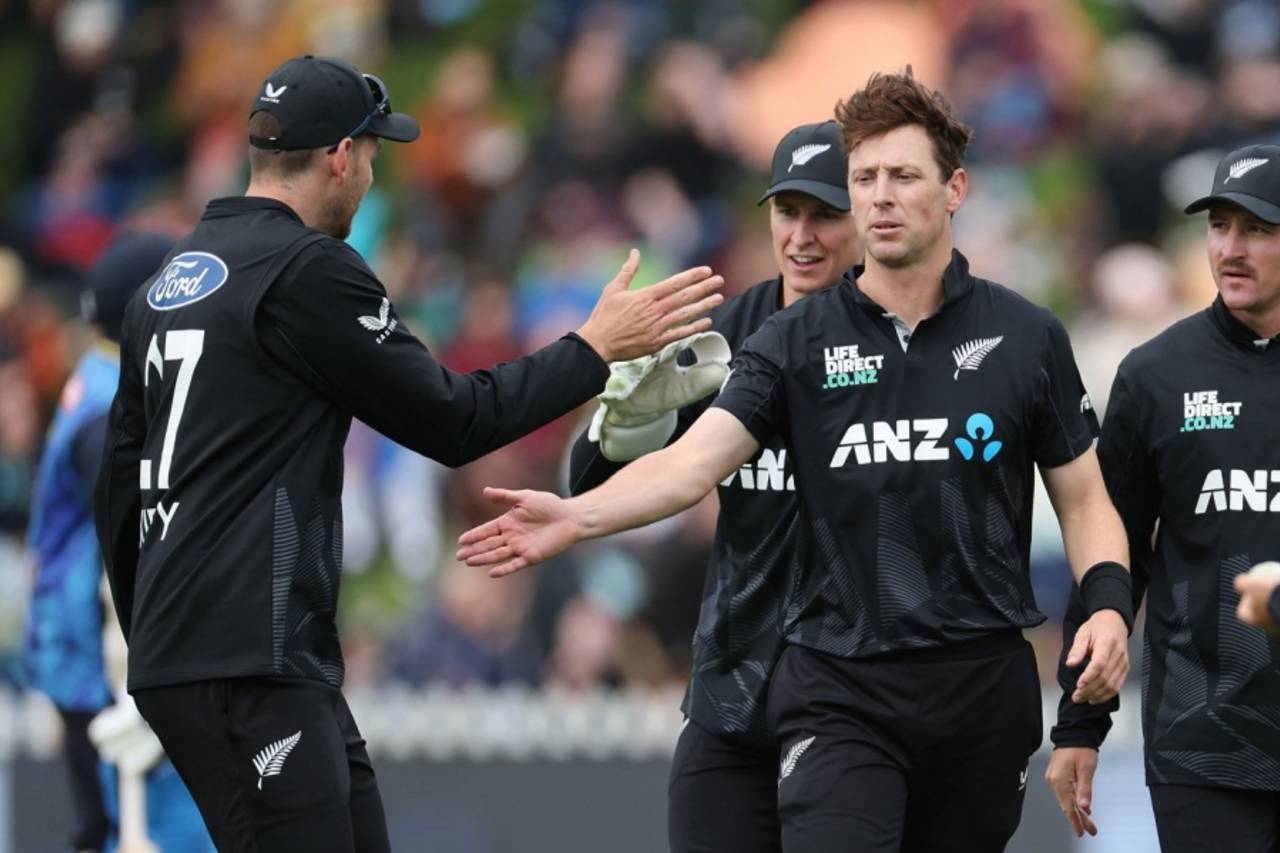
Since the start of January 2023, Matt Henry has taken 179 international wickets, the most for any bowler • AFP/Getty Images
Cricket owes a great deal to big brothers - generations of bowlers have been shaped by siblings who turned every backyard game into a private batting session.
"That's probably why I'm a bowler," Matt Henry says as he recalls his childhood with his brother Ken. "I could never get him out. And he'd get me out straight away. So I just kept on spending most of my time... I was pretty much just his bowling machine. And he was the one kind of forcing me out to play, because he was far better than me as well."
For the first five years of his international career Henry was a second-teamer, able to take part in just 51 of a possible 177 matches. Over the next five, he started pushing at the doors of the first team.
It was a determined rise, from accidental World Cup finalist in 2015, the year after his New Zealand debut, to being a first-choice pick in 2019 ahead of Tim Southee. The Champions Trophy in 2025 was bittersweet. He finished it as the highest wicket-taker but couldn't play the final.
"Obviously, such an unfortunate accident on the shoulder and then leading [into] the build-up, trying to get that right, I ended up having back spasms the night before.
"I had one in a Test match once. It was actually after the birth of our first [child]. Probably must have been the dodgy bed I was staying on. But I had a wee back spasm during that Test, and I managed to kind of get through it and finish the Test and I was okay, and I kind of thought, I've done it before, I'll be all right [for the Champions Trophy final].
"But as soon as I took one step, it just went bang. I tried to bowl one ball and that mix of the shoulder, it just, yeah..."
Henry left the field just before the toss, in tears. "The hard part was probably getting there and thinking, okay, I can still get a job done here. And then just failing at the last hurdle. Yeah, it was absolutely devastating."
The T20 World Cup has come around at a time when Henry is at his peak, more so in the two longer formats. No other bowler has more than his 179 wickets over the last three years. Plus there's the aesthetics, starting with a bowling action smoother than a Hollywood pick-up line.
"For me, the alignment piece is really important," he said. "I had a coach when I was younger, Denis Aberhart, and he told me once [to align] everything towards the target, and it was great advice because it works with everything, whether it's my front arm, whether it's my head position and my back-leg drive, whatever it may be, you're wanting everything working in together."
Put into practice, it renders a run-up, gather and release all reminiscent of Shane Bond.
"The awayswing for me is natural. So I'm confident in getting the ball to leave the right-hander," he says. That was what he used to dismantle India in the 2019 World Cup semi-final. Through that tournament, he generated enough movement (1.061 degrees on average), according to data gathered by Hawk-Eye, to keep up with the likes of Jasprit Bumrah (1.049), Jofra Archer (1.081), Pat Cummins (0.892) and Mohammed Shami (0.922).
To threaten the inside edge, Henry perfected the wobble-seam ball. "Shane Jurgensen [former New Zealand bowling coach] and myself - it would've been 2016 - we really talked about that delivery and how to be effective with bounce. I think, for me. I think it's the ability to be hitting the wicket as hard as you can and trying to extract bounce and variation at the same time. So that's where it became really important.
"That's the beauty about cricket, and bowling in general as well - it's different for everyone. I mean, the way Tim [Southee] did his [wobble-seam ball], his would always run across the leftie. He's got this beautiful outswing wrist and it locks in." Henry criss-crosses two fingers of one hand over the other, the top two to denote Southee's grip and the bottom ones the seam of an imaginary ball. "So his is probably a little bit more pronounced and it would track lovely, where for myself, I'm a bit more behind the ball and over the top. So for me, it's probably slightly less an angle on the seam. So everyone's different and you just have to figure out what works for you and that's the cool part."
At the Champions Trophy, Hawk-Eye had Henry neck and neck with Archer for the most seam movement (0.606 vs 0.614 degrees) on average among bowlers who took at least five wickets in the tournament.
Henry and his largely orthodox methods have somehow been able to rival fast bowling's chosen ones, but not quite in T20 cricket. It diminishes his appeal, if not his impact. Henry has only played one T20 World Cup game and isn't on too many franchise shortlists. He tends to be involved with New Zealand in December and January, which effectively rules him out for the BBL, the SA20, ILT20 and BPL.
In the New Zealand winter, he travels to England, where he has been a T20 Blast champion with Somerset and, last year in the Hundred produced a 20-ball spell in which 16 were dots. Now the next few weeks in India and Sri Lanka, and later in the IPL, where he has only played six games in total - Chennai Super Kings waited till the accelerated rounds of the auction to pick him up - could be an acid test for a bowler who isn't unconventionally spectacular, is simple, is repeatable. And as much as he gets turned away, he never actually goes away.
"Early in my career," Henry said, "even if I did really well, I'd probably find myself on the bench because Tim or Trent [Boult] would come back in and I could only control what I could do. So from my point of view, that mental side of the game, keep trying to grow your game, is really important. And yeah, I suppose that's probably something that I've been proud about, the ability to do that."
He didn't do it alone, though, he asked for help. "There's lots of people that have been really key through those periods. Todd Astle was one, actually. We spent a lot of time together at Canterbury. And he was a great guy to kind of talk to and keep level around those things.
"And also we've got Quinnie [John Quinn, who has worked with Olympic athletes and Rugby New Zealand] who does our sports psych here for Canterbury as well, who's been awesome to talk to. And I suppose the mental skills piece is so important in your performance and how you're putting your energy and giving you some tools as well to deal with what the pressures are of international cricket. Because it's easy to sit there waiting for your chance and to let that kind of overwhelm you.
"I've got a very supportive wife, Holly, and we've been together since we were quite young as well." A rare benefit of Henry being on the sidelines has been that the two of them recently had the unexpected pleasure of spending the holidays together.
"It's the first time I've had Christmas off since... I can't even remember really," Henry said. "So I suppose it's never good being injured, but in terms of doing a rehab period, spending time with the family and friends has been really nice.
"We went down south for a bit for a few days, and then my wife's family's down that way as well, so we ended up spending a little bit of time in Arrowtown, then we spent Christmas in Twizel and then back here in Christchurch. A little bit of travelling around and seeing some countryside, so that's been nice."
Henry and Holly are expecting their second child soon. "I mean, the timing's not perfect being involved in the World Cup but we're just really excited."
He's already got a crucial piece of advice for the little one. "Don't be a fast bowler, unless you can be really fast."
Alagappan Muthu and Deivarayan Muthu are sub-editors at ESPNcricinfo