| Series | Countries | Live Scores | Fixtures | Results | News |
Features
|
Photos | Blogs | Statistics | Archive | Video & Audio | Games | Mobile | |||||||||||||||||||||
|
The recent Super Over result illustrates just why having multiple leaders doesn't wash
April 26, 2009
![]()
|
|||
|
Related Links
Series/Tournaments:
Indian Premier League
|
|||
The game of cricket has an amazing capacity to voice an opinion in subtle ways. It did so in the frenetic confrontation that followed the first ever IPL tie.
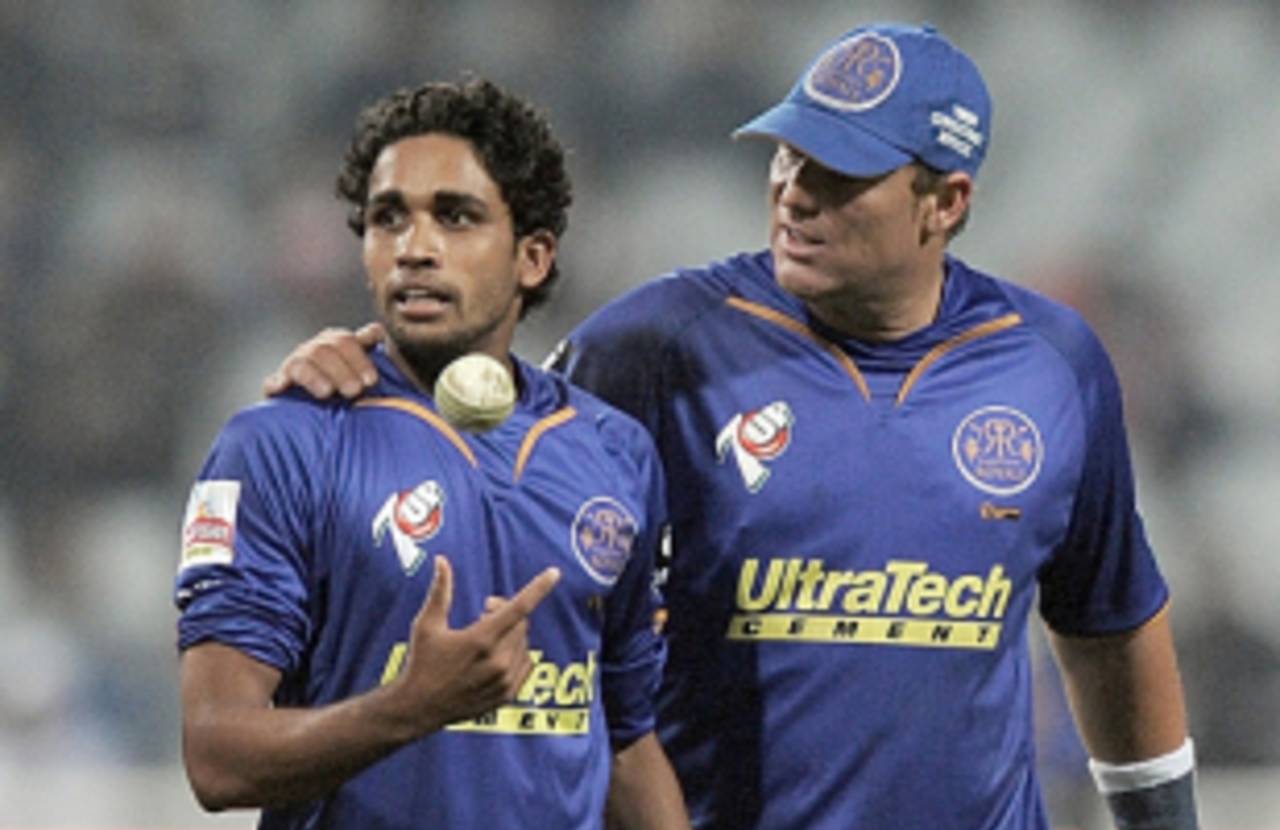
The nail-biting finish resulted in a Super Over shootout between the Rajasthan Royals, the classic one-man-in-charge team, and the Kolkata Knight Riders, a side currently experimenting with the concept of multiple leaders. Not surprisingly, the mercurial Royals' captain, Shane Warne, opted for a daring ploy. He bowled a tyro in the drama-filled situation - Kamran Khan, who eventually prevailed over the Knight Riders' internationally acclaimed Ajantha Mendis.
It's worth pondering the machinations that led to Warne anointing Kamran to bowl the match-deciding over to a highly explosive Chris Gayle.
A good leader empowers his players; he endows them with the confidence to believe in their own ability and to be prepared to take a risk. When Warne opted to bowl Kamran for only one over in an IPL trial match in Cape Town (so as to not advertise the unorthodox slinger's attributes), he empowered his player. Here was a complete unknown being paid a huge compliment by his captain, one of the best bowlers the game has ever seen. If Warne correctly judged Kamran's temperament, he was assured of that extra effort from the tyro in an hour of need.
Before they reached the Super Over stage, Kamran had already repaid his skipper's faith by taking three wickets in the innings, including the crucial one of Sourav Ganguly in the final, desperate over. Having then been awarded the onerous task of bowling the Super Over, Kamran had two choices: to wilt or raise his game. Warne had seen something in his young bowler that led him to believe it would be the latter.
Compare that style of management with the Knight Riders', where they nominate a captain but extol the virtues of multiple leadership. In Kamran's case he knows he's been anointed by Warne, but Mendis could easily be wondering if he was chosen in a split vote by a committee.
Imagine the discussion in the Knight Rider's camp. First, Brendon McCullum asks Gayle: "Who do you think should bowl?" And then he asks Ganguly and Brad Hodge and anyone else who might either have been co-opted onto the committee or wandered past at the appropriate time and voiced an opinion.
| At times of high tension on a cricket field the last thing a captain needs is to have his train of thought derailed by input from three co-captains | |||
Eventually McCullum hands the ball to Mendis. After watching the consultation process Mendis is entitled to ask, as an Indian batsman once did when he was selected to replace an injured team-mate against an Australian Test side that included Jeff Thomson: "Why me?" Any doubts Mendis might have harboured about succeeding in such a pressure-cooker situation would have been elevated the moment he was handed the ball after a committee meeting.
Kamran on the other hand had already been empowered by Warne before the tournament started. Now here was his illustrious skipper maintaining his faith with a gesture that screamed loudly: "I believe you can win us this match."
Warne had the advantage of having already attained right royal miracle-worker status for Rajasthan. Once a team believes a captain can guide them home in a tight situation, there's a fair chance it'll become a self-fulfilling prophecy. Warne succeeds more often than not in tense situations because he's brave enough to seek victory rather than wait for it to come knocking on his door.
In the case of the Knight Riders' multiple-leadership experiment, the players aren't exactly sure who is putting faith in their ability. Is it McCullum alone or was it decided by a split vote?
At times of high tension on a cricket field the players look to the captain to show them a successful way through the fog. That calls for a clear and positive thinking leader. At such a crucial time the last thing a captain needs is to have his train of thought derailed by input from three co-captains.
The Super Over shootout emphasises the need for a team to have a strong-minded man in charge; one man. Or at least that's the way the cricket gods appeared to want it in Cape Town.
| Comments have now been closed for this article |
||||||
Widely regarded as the best Australian captain of the last 50 years, Ian
Chappell moulded a team in his image: tough, positive, and fearless. Even
though Chappell sometimes risked defeat playing for a win, Australia did not lose a Test series under him between 1971 and 1975. He was an aggressive batsman himself, always ready to hook a bouncer and unafraid to use his feet against the spinners. In 1977 he played a lead role in the defection of a number of Australian players to Kerry Packer's World Series Cricket, which did not endear him to the administrators, who he regarded with contempt in any case. After retirement, he made an easy switch to television, where he has come to be known as a trenchant and fiercely independent voice.

Watson should remain at the top of the order
Ian Chappell: His batting skills are too good for him to be saddled with a frontline bowler's job too
You may not get many homegrown cricketers in Canada but you can get a homegrown bat. By Liam Herringshaw
'I did not have a lethal weapon'
Sarfraz Nawaz mastered the art of swing - conventional and reverse - by trial and error, and formed a formidable partnership with Imran Khan
Aakash Chopra: Why the idea of having those in the top order take turns at playing is flawed
Someone, please explain the D/L method
Michael Jeh: India's target at the MCG didn't make sense
Afghanistan's remarkable rise achieves new heights
Afghanistan cricket will reach a new high when they take on an ICC Full Member for the first time
Which teams are the worst travellers?
A look at how Australia, South Africa and England have fared in Asia, and vice versa
Plays of the Day from the second ODI of the CB series, between India and Sri Lanka at the WACA
Unravelling the mystery of Ajmal
The ICC have explained the science behind the offspinner's action after a TV interview caused confusion
Plays of the Day from the third ODI of the CB series, between Australia and Sri Lanka at the WACA
Which teams are the worst travellers? (142)
A look at how Australia, South Africa and England have fared in Asia, and vice versa
Pakistan rewarded for smart rebuilding (137)
After the events of 2010 Pakistan cricket could have withered away, but due to a combination of determination and desire they are now flourishing
Unravelling the mystery of Ajmal (114)
The ICC have explained the science behind the offspinner's action after a TV interview caused confusion
India beaten in battle of strategies (101)
The plan to go in with a spin-strong attack is fraught with risk in Australian conditions, as India were made to realise at the MCG
Does rotation work for India? (85)
Why the idea of having those in the top order take turns at playing is flawed
Access your Indian Rupee earnings from anywhere in the world.
ICICI Bank Money2India brings " locked exchange rate" and a free gift
on registering and transfer of USD 250 and above.
FREE copy of Playfair with Wisden pre-order
At Cricshop.com
Ohh dear, cant believe Ian Chappel is saying all this; I didn't realize it was him until I saw one of the comments. It almost sounded like one of those over stretched scenes in one of the tv serials. firstly, it is 100% speculation and fluff as Ian didnt give us any insights into what his source of information was and in his own words, he was just guessing what the conversation would have been. All that fluff from Ian after we already got the info from the captains themselves, Warne ("I thought about myself & Yusuf as spin options and decided on Kamran as he just bowled a great last over") & McCullum ("Mendis was raring to have a go and I didn't have to look for someone else" ). Very disappointing and unfortunate that an article like this was even published; Hope the editors does some sort of review next time they receive similar articles...
Posted by Ska. on (April 28 2009, 09:19 AM GMT)Anybody knows who the 'Why me?' guy was?
Posted by crocker on (April 28 2009, 06:43 AM GMT)Chappell has made a valid point against the multiple captains theory citing a recent example to support it. Rules of cricket do not support it since the penalties for slow over rate are to be borne by the nominated single captain (captain going for the toss?). Anyway, multiple captain theory has been in practice till now when the captain solicited opinion from other team members. Buchanan should have taken the responsibility of gathering opinions of so called special captains and conveyed the final decision to nominated captain as part of coach's responsibility. Too many cooks spoil the broth!!!
Posted by nashdwaj on (April 28 2009, 05:48 AM GMT)Since we are talking about captaincy and leadership, I want to add my take on what makes Shane Warne a great captain and why KP is not able to display great leadership capabilities at this stage. By the looks of it, i.e on TV, I tend to think Shane Warne genuinely want to help the domestic cricketers to become great. We all know how much he has helped YK pathan, Jadeja. He genuinely wants to give them his expertise and has raised their confidence to new levels. In the case of KP, I feel he is not there personally, emotionally where he is secure with his ego to be able to whole heartedly be able to play mentor or coach role to younger players of RCB. There are many ingredients that goes to a successful captain, if they are younger players with not much experience captain has to play the coach or mentor role, for experienced internationals you have to able to listen, delegate. Also in the case of Mccullum he just does not have authority (given and taken) to be successful.
Posted by nashdwaj on (April 28 2009, 05:05 AM GMT)I do not agree with this example that Ian Chappell has chosen to blow holes in the Multiple Captain theory. But I agree that Multiple captaincy theory does not work. One man should have complete leadership responsibility and authority. Even in the case of Shane Warne, Ian Chappell should not forget that he consulted with Graeme Smith, YK Pathan and many team members before taking the decisions that was taken. It depends on the style of leadership that works for your team. In the IPL where the team members are from various countries and are quite good at what they do, generally the captain should be strong with good charisma, knowledge of the game and shrewd and also be able be consultative and make decisions on his own and also take responsibilities on this own. In some cases, leadership can be delegated example may be bowling captain and fielding captain to those experts to share responsibility. But still ultimately captain is the main man.
Posted by wizman on (April 28 2009, 03:37 AM GMT)What we are talking about here is the difference between "Who wants to bowl the SuperOver and try to win it?" and "I believe you are the man to bowl this over and win it!" Not sure it has much to do with a captain or a committee. Ultimately the captain wears the decision, regardless of how it was made. It is up to the captain to decide the process: inclusive, exclusive, committee, or whatever. When the coach gets sacked because of the captain's decision, then they can tell the captain what to do and how to do it.
Posted by sjavvadi on (April 27 2009, 19:59 PM GMT)I do not entirely agree with Mr. Chappell. What happened was a simple mistake in decision making for that one match and has nothing to with one captain or multiple captains. All that had to be realized by the Knight Riders was that one of the batsmen would be YK Pathan and he's an excellent player of spin and the over should have been given to Ishant or someone else. Doing all this over analysis just to post an article is ridiculous and plain exaggeration. All this "reading between the lines" makes me roll my eyes.
Posted by plumbunion on (April 27 2009, 18:34 PM GMT)Another typical Ian Chappell article - forthright and relevant. I agree with the main theme of the article that cricket is a one-man-in-charge game. However, I am not convinced that the super over really drives home the point of the article. Shane Warne announced Kamran Khan as a bowler to reckon with, even before he had bowled a ball. The KKR team management made Ajantha Mendis warm the benches the entire first season of the IPL. He then famously went on to dismantle the Indian top order in the test series in Sri Lanka. And therein lies the difference. On the day, prior to the super over being bowled, both Kamran and Mendis did a fantastic job. So the decision to ask them to bowl was almost the default. Anyone with a sensible head would have asked Kamran to bowl, given that he had just prevailed over one of the game's veterans in Saurav Ganguly. The fact that Kamran was able to keep his chin up despite being carted in the super over, speaks volumes of Warne's influence as a captain.
Posted by anoopbal on (April 27 2009, 02:38 AM GMT)It all depends on the situation. You cannot conclude that one captain theory was successful just by looking at one single match and one single over. That's just poor way to come to conclusions and a great example of people jumping on to conclusions based on their biases. Tendulkar is best because he proved that in over 300-400 matches not just from one single match.
Posted by kgashok on (April 27 2009, 02:36 AM GMT)One-captain or many co-captains? The short, simple, elementary answer is the much cliched response: It depends. It depends upon the captain. It depends upon the talent/capabilities available in the team that you are leading. It depends upon the followership quotient in the team. It depends upon what you want to achieve. "Success is not an option" - is that the clear message coming from the owners? Pose those perspectives to the situation at hand and it becomes obvious: One captain theory is what will maximize results for Shane Warne/Royals. Many-captain theory is what will maximize results for Buchanan/McCullum/KKR. How such elementary common sense is lost on people like Gavaskar and Chappell beats me. But then, if they make us belief that this is so elementary they obviate the very need for an article such as this. So is the case for 20,000+ management/leadership books that get published every year. So we will live and let them live as well. QED.