
Grind before glory: how Mitchell Starc went from wicketkeeper to left-arm legend
At almost 36, Australia's Ashes hero has never been faster or in better form, and that's down to decades of discipline and diligence he has put into his craft

Greg Chappell
08-Jan-2026
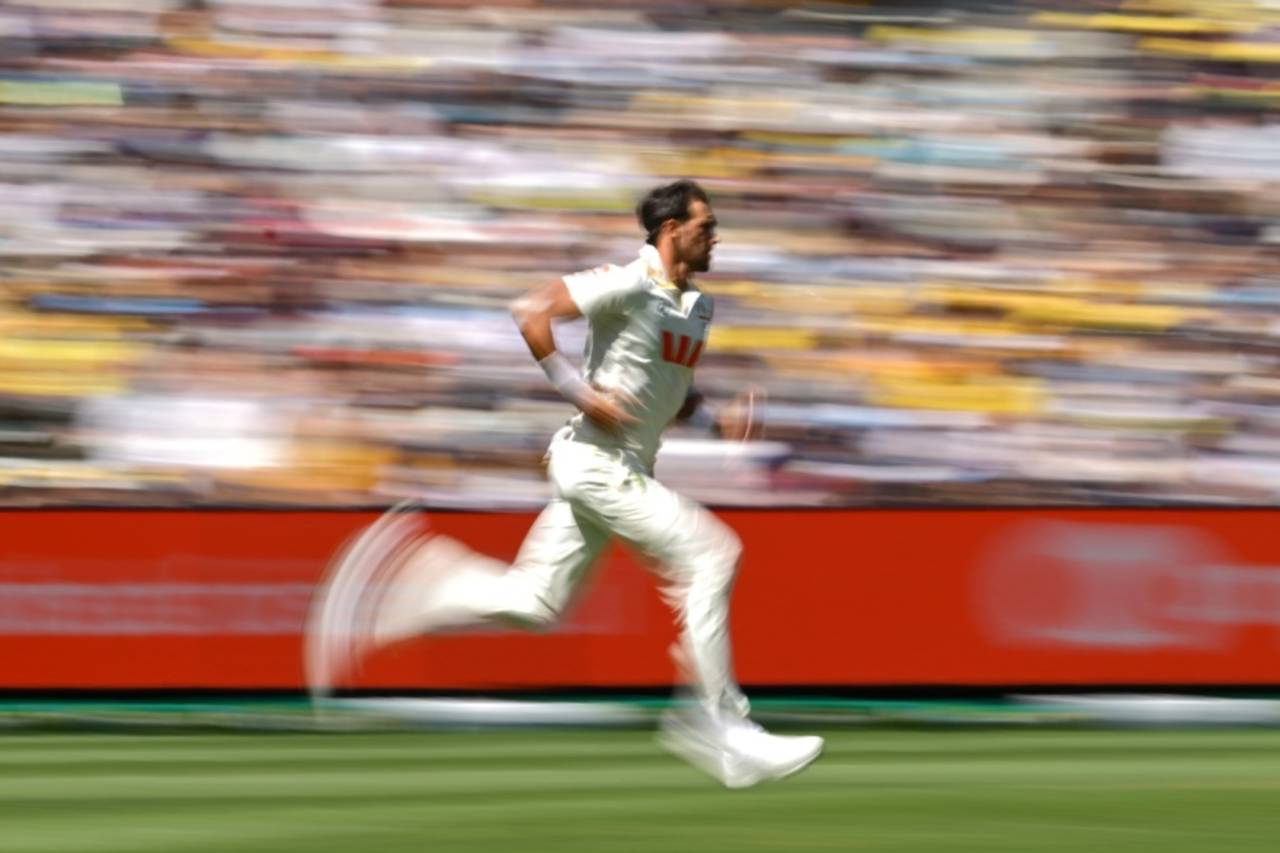
Still fast, still furious: Since the start of 2025, Mitchell Starc has taken 60 wickets at 18.6, and 31 of those have come in this Ashes • Getty Images
The legend of Mitchell Starc is defined by the same relentless pursuit of excellence that governed the career of the great baseball pitcher Nolan Ryan. Ryan famously noted that pitching in the big leagues is a dream but preparing to pitch in those leagues is a nightmare. This sentiment captures the essence of Starc's journey. Both men understood that to maintain extreme velocity for decades, they could not rely on raw talent alone. They had to become masters of the unseen work: the gruelling gym sessions and meticulous recovery routines that keep a high-performance body from shattering under the strain of elite sport.
During the 2025-26 Ashes, we witnessed the fruits of that labour. Starc has moved beyond being just a strike bowler to become a master craftsman. He has displayed a level of control and belief that only comes with years of dedicated service to his craft. He has once again been Australia's spearhead, taking critical wickets and delivering spells of such high intensity that left the English batting order in tatters. His performance in Perth, where he claimed career-best figures of 7 for 58, was a vintage display of left-arm fast bowling that proved he is still the most dangerous force in the game.
To understand the Mitchell Starc of today, one must look back to the lanky youngster who first appeared at the youth level. When I returned from India to take up the role of head coach at Australia's Centre of Excellence in 2008, Troy Cooley was already buzzing with excitement about a crop of young fast bowlers. Cooley, who had just finished as England fast bowling coach, identified Starc alongside Josh Hazlewood and James Pattinson as the future of the Australian attack.
However, Starc's path was not as smooth as his peers. In those early years, particularly during the Under-19 programme, he did not get many opportunities because he was not yet as strongly built or as accurate as Hazlewood and Pattinson. Cooley often remarked that Starc's best three balls in an over would test the greatest batters in the world, but his other three balls might not even hit the cut portion of the wicket. What got Cooley excited the most was his pace. He was an athletic project with an efficient action but one who carried a degree of self-doubt about his place among the elite.
Starc's career is a glowing example of what can be achieved when immense natural talent is paired with an uncompromising work ethic. He has navigated the pressures of the modern game with a level of grace and perspective that is rare
The most fascinating part of Starc's origin story is that he was not always a bowler. He began his journey as a wicketkeeper, a role that perhaps instilled in him the discipline and focus required to succeed. The transformation from a boy behind the stumps to one of the most exciting fast bowlers of his time is one of the great developmental stories in Australian sport. This transition was fuelled by a childhood steeped in athletic variety. Mitchell and his brother Brandon, who became a world-class high jumper, spent their early weekends in a blur of activity at Parramatta and Auburn Little Athletics. They played soccer, went ten-pin bowling, and competed on the track, all under the watchful eyes of parents who emphasised a roll-up-your-sleeves work ethic.
This athletic synergy has been the secret to the longevity of both brothers. Brandon, a Commonwealth gold medalist, has often cited Mitchell as his primary inspiration, noting that witnessing his brother's dedication taught him the value of putting one's head down and doing the work. For Mitchell, this meant making choices that often went against the grain of modern professional cricket. He has famously prioritised Test cricket over the riches of the IPL for much of his career, a decision that has allowed his body the necessary windows for rest and reset. He has stated clearly that Test cricket is the pinnacle and far above white-ball formats in his priority list.
His career is littered with performances that have become the stuff of legend. Long before his current Ashes heroics, he was the Player of the Tournament in the 2015 World Cup and a vital part of the 2023 victory. In the Sheffield Shield, his brilliance for New South Wales was immortalised in 2017 when he became the first bowler in the competition's long history to take two hat-tricks in the same match. These are not merely statistics; they are markers of a man who has learned how to prepare his body to deliver peak performance when it matters most.
The diligence Starc applies to his preparation and recovery is where the Nolan Ryan analogy truly shines. Ryan's career lasted a staggering 27 years because he was a workout freak who understood that his arm was just a whip and the true power came from his legs and core. Starc has followed a similar blueprint, building a high-performance home gym and meticulously managing his weight and strength to ensure he can still bowl at 150kph well into his 30s. He has evolved from the inconsistent youngster Cooley described into a master who understands every nuance of his action.
This evolution was clearly on display during the Brisbane Test. Not only did he terrorise the English batsmen with the ball, but he also scored a vital 77 at No. 9, setting a record for the most Test runs in that position and proving himself to be a dual threat. He has become the consummate professional, a man who has replaced early self-doubt with a deep-seated belief in his own methods. His 400th Test wicket, taken in July 2025 during his 100th Test match, was a fitting tribute to a player who has refused to take shortcuts.
Starc's career is a glowing example of what can be achieved when immense natural talent is paired with an uncompromising work ethic. He has navigated the pressures of the modern game with a level of grace and perspective that is rare. By leaving social media and focusing on his own small circle, including his wife and fellow cricket champion, Alyssa Healy, he has found a way to compartmentalise the noise and focus purely on the next ball.
As we reflect on his wonderful Ashes series, we see a bowler who is now essentially his own chief engineer. He knows when to push his body and when to protect it. He understands that the explosive violence of fast bowling requires a foundation of absolute physical readiness.
Like Nolan Ryan before him, Starc has realised that the nightmare of preparation is the only way to sustain the dream of being the best in the world. He has turned himself from a gangly boy with an uncertain future into an all-time great of the game, and his legacy as a master of his craft is now forever secure. He's on track to be the first fast bowler to continue into his 40s bowling in excess of 140kph if he so chooses.
As the sun sets on another glorious summer of cricket, Starc running in with his trademark smooth action remains one of the most thrilling sights in the sport. He has not only reached the heights that Cooley once envisioned, but has surpassed them, proving that the lanky teenager from Berala was always destined for greatness. He has done it his own way, with a smile on his face and a fire in his heart, leaving a trail of broken stumps and shattered records in his wake.
Former Australia captain Greg Chappell played 87 Tests for them in the 1970s and '80s. He has also coached India, and been an Australia selector