

Mitchell upstages Rahul as New Zealand level series
NZ ace chase of 285 to set up a series decider in high-scoring Indore

Sidharth Monga
14-Jan-2026 • 1 hr ago
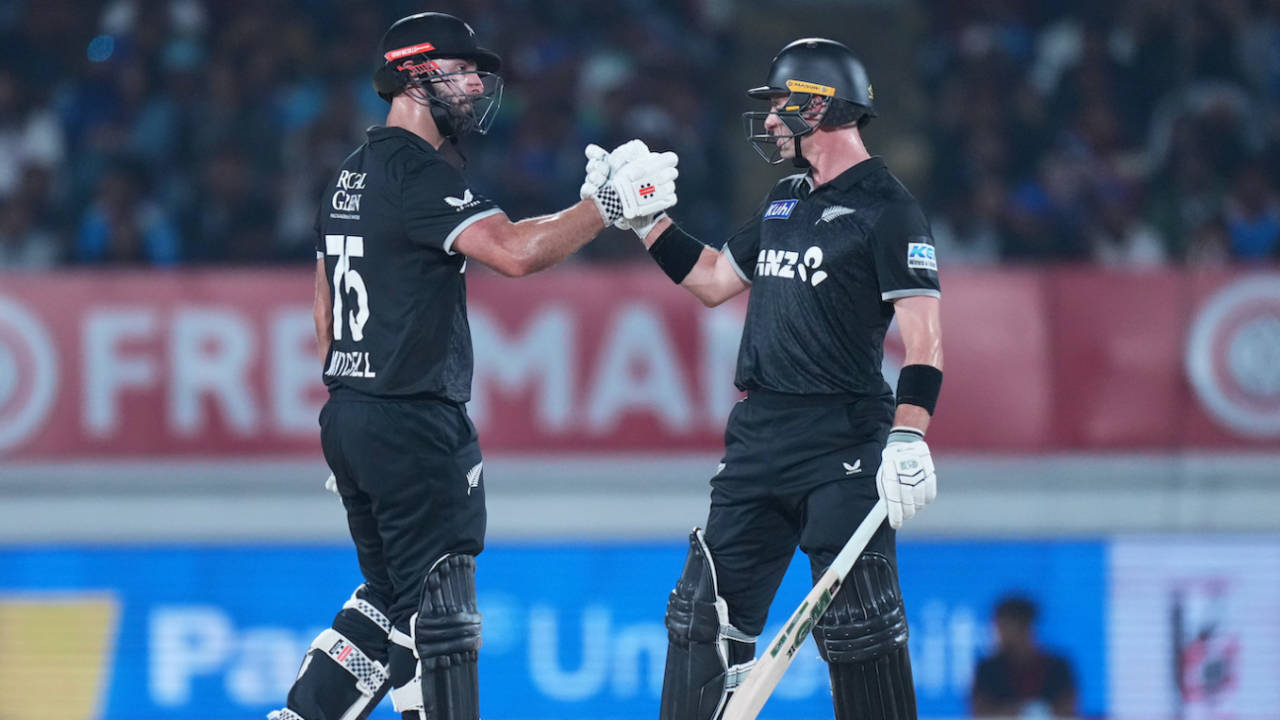
Daryl Mitchell and Will Young helmed New Zealand's chase • Associated Press
New Zealand 286 for 3 (Mitchell 131*, Young 87, Prasidh 1-49) beat India 284 for 7 (Rahul 112*, Gill 56, Clarke 3-56) by seven wickets
Daryl Mitchell and Will Young powered New Zealand's highest successful chase in India to end their eight-match losing streak against India. They might not have been chasing that high a total had it not been for a masterful KL Rahul century when the ball gripped the surface in the afternoon. India's fast bowlers were superb in the early goings, reducing New Zealand to 46 for 2, but from the moment Mitchell targeted Kuldeep Yadav on his introduction, New Zealand didn't look back.
The pitch quickened up in the cooler evening even though there was no dew, Kuldeep went for 82, Mitchell and Young added 162, Mitchell went on to get his eighth hundred, Rajkot's new stadium had its first successful chase in five ODIs, and the high-scoring Indore was set for a decider. Rahul's century in the afternoon was his eighth in 85 innings, an impressive feat in itself, which puts Mitchell's eighth in his 53rd innings in elite echelons, especially given how Mitchell has been a career middle-order batter.
Mitchell now has 2553 runs, which, for a start to an ODI career, is matching Shubman Gill, who looked imperious in getting 56 off 53 earlier in the piece. Kyle Jamieson and Zak Foulkes started well with the ball, conceding just 10 in the first five overs, but, led by Rohit Sharma's charge, Gill carried India to 70 for 0 in 12 overs. Rohit, though, was already showing signs of getting stuck: his innings had phases of 1 off 11, 18 off 9, and 5 off 18, ending with a catch at deep cover off Kristian Clarke.
Gill and Virat Kohli still looked in control even though debutant left-arm spinner Jayden Lennox started with five overs for just 18 runs. The slowness of the pitch was apparent when Gill's pull off Jamieson ended up with short midwicket. Michael Bracewell then put the squeeze on in the middle overs with fast bowlers getting the wickets. Kohli played Clarke on, which tends to happen in such conditions, and Shreyas Iyer hit Clarke straight to mid-off.
The game had changed dramatically once the balls became soft. The first 100 legal balls produced 99 for 1 with 15 fours and a six, the next 100 went for just 58 for 3 with two fours. It was only Rahul, who injected some momentum into the innings.
At full strength, India will probably want Hardik Pandya and Axar Patel at Nos 6 and 7, but they must try their other options. Given the conditions, Jadeja fought hard for his 27 off 44, but fell to the returning Bracewell. Nitish Kumar Reddy didn't do much wrong in his 21-ball 20, but India were still short of the power they needed to go past 300.
Rahul scored 112 off 92 out of the 169 that came while he was at the wicket for 28.3 overs, playing some delightful shots along the way, including a reverse-swept four, the only sweep of any kind played by India in 23 overs of spin, which went for just 2 for 89. By comparison, New Zealand played 13 sweeps for 23 runs in 18 overs of spin.
While 284 seemed a good effort for the conditions India had to face when they were batting, ODI cricket in India is seldom that straightforward. You have to almost always score above par because batting gets easier in the night even when there is no dew.
It is also imperative you do a lot of damage with the new ball when defending totals in India. For some reason, the new ball seamed more for India than it did for New Zealand, which threw them a bone. Mohammed Siraj, Harshit Rana and Prasidh Krishna were excellent in their first spells of five overs each, conceding just 53 in their 15 overs put together, getting rid of Devon Conway and Henry Nicholls. With the ball still seaming, Gill tried to get Reddy into the game before spin came on, but Mitchell started transferring the pressure back when he lofted hard length from Reddy down the ground for a six.
Prasidh and Jadeja still kept scoring under wraps, which meant New Zealand would have to take risks when Kuldeep was introduced at 82 for 2 in 20 overs. The second ball he faced from Kuldeep, Mitchell charged him and cleared deep midwicket not by much. He followed it up with a lap sweep for four. This was enough for Kuldeep to go largely defensive and flat. The one time he tossed up a wrong'un, he drew a false shot from Young, but it fell short of long-off. He eventually got Young for 87 off 98, which perhaps only saved him from the ignominy of the costliest analysis of his career by two runs.
That the returning fast bowlers couldn't extract the same amount of grip from the surface with the older balls compounded India's problems. Young, who had struggled his way to 40 off 61, and Mitchell batted in cruise mode once they had neutralised the Kuldeep threat. Mitchell, who narrowly missed out on a hundred last game and also dropped a catch that could have given New Zealand an outside chance, was reprieved twice in the 36th over when Jadeja missed a run-out from close range and Prasidh dropped him in the deep. However, needing only 98 in 15 overs, it can be argued New Zealand would still have won from there.
When Glenn Phillips drove Kuldeep for a four in the 40th over, the ask, which never reached seven an over, was now down to under a run a ball. Despite doing most things right, India were beaten handsomely by the transformation in the conditions. India would have batted first if they had won the toss anyway.
Sidharth Monga is a senior writer at ESPNcricinfo