
A Mhatre of time - grounded by the Mumbai grind, Ayush readies for take off
India's Under-19 captain enters the World Cup having reached dizzying heights at a young age

Vishal Dikshit
14-Jan-2026 • 15 hrs ago
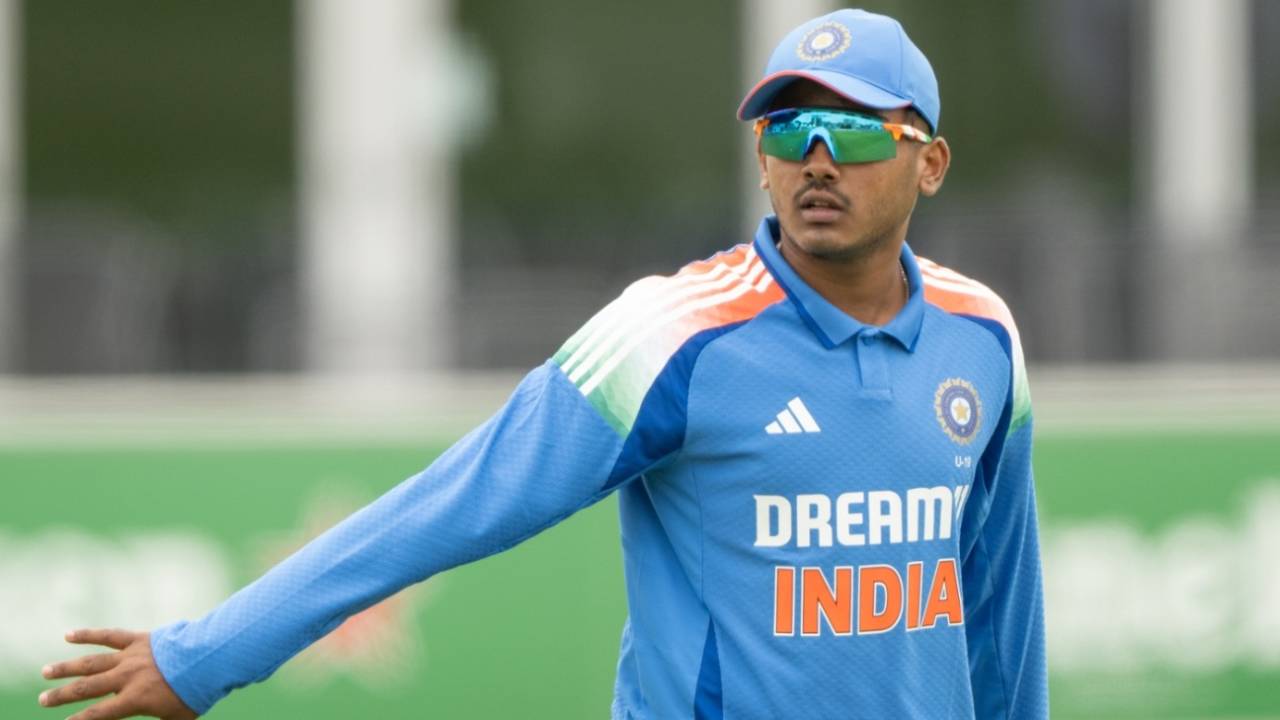
Ayush Mhatre is India's captain at the 2026 Men's Under-19 World Cup • Bipin Patel
When Ayush Mhatre was barely two and a half, just old enough to hold a plastic bat, his father Yogesh Mhatre was throwing a plastic ball at him outside their house in Virar, a town far beyond the suburbs of Mumbai. Ayush middled an instinctive pull so well that the ball sailed past their bungalow, beyond a patch of trees, and nearly landed in someone else's house.
His father, uncle and grandfather stood stunned. Yogesh recalls that moment vividly: "Usne aisa uthakar, udhar phainka tha (He picked the length of the ball and just smashed it)," he tells ESPNcricinfo.
While that one shot had Yogesh mesmerised about 15 years ago, he's not surprised any more at how quickly his son is progressing. Ayush dominated Mumbai's competitive age-group cricket and has now made his state debut in all three formats. He also got an IPL deal with Chennai Super Kings (CSK) at the age of 17, and is now leading India at the 2026 Under-19 World Cup in Zimbabwe and Namibia from January 15.
From that day all those years ago, cricket became an integral part of Ayush's life. He carried a ball on beach trips. At relatives' houses, anything spherical - even an onion or a potato - would keep him occupied for hours. When Ayush turned five in 2012, Yogesh enrolled him at a local academy in Virar, and the compliments came quickly.
"Ye ladka bada hoke achha cricketer banega (he will become a big player when he grows up)."
"100% sona hai (he is pure gold)."
"Ghar ja ke uski nazar utaro (Make sure you ward off the evil eye)."
"100% sona hai (he is pure gold)."
"Ghar ja ke uski nazar utaro (Make sure you ward off the evil eye)."
Sensing Ayush needed exposure beyond the local circuit, Yogesh zoned in on south Mumbai, home of the Wankhede and Brabourne stadiums along with numerous maidaans where budding cricketers play. On calling former India captain Dilip Vengsarkar's ELF academy, he was told to bring Ayush for formal coaching once he was around eight. Yogesh persisted.
"There's something different about this kid," he says he told a coach, before tempering expectations with, "Every parent thinks their child will be the next Tendulkar but just have a look once." The coach agreed, and at the trial Ayush middled balls with an ease that was uncommon even in a city familiar with prodigies.
Ayush cleared every selection trial while looking for admission in academies or schools. He often outperformed boys double his age and scored runs in crisis situations. One such instance was when he was just six years old, playing an under-12 game at Vengsarkar's academy. He opened the batting and was the last boy out - a run out - after scoring 67 of the team's 107 runs. For the first time Ayush was taken to Vengsarkar, who watched the game and said to Yogesh: "Isko academy mein chhodo aur bhool jao (leave him in the academy and leave the rest to us)."
There were obstacles, though. For the Mhatre joint family of 45 people in Virar, the biggest challenge was to take Ayush to the academy - about 80kms away - every day. With nobody in the family following the game seriously and both parents working full-time, his retired nana (maternal grandfather) stepped up to accompany Ayush in the infamously crowded Virar-Churchgate local train.
For nearly a decade, Ayush awoke at 5am, attended school, got on the train with his grandfather to south Mumbai, returned home at 8pm, and did more knocking for 45 minutes with a ball hanging from the ceiling. Not once, Yogesh says, did Ayush complain about his rigorous schedule.
Ayush soon enrolled in a school in Mumbai to make his days smoother and also to get noticed on the circuit. Yogesh knew one had to commit with an unwavering single-mindedness to make it in Mumbai. He gave Ayush freedom to focus on his game with this message: "You do what you can in studies, I will handle the rest." He also ensured Ayush's performances didn't affect the environment at home. A double-hundred and a duck, Yogesh says, were treated the same because "I didn't want his big or low scores to get to his head."
"Ayush enters the Under-19 World Cup as a familiar archetype - shaped by Mumbai's grind, carried by family sacrifice, and grounded by a temperament that reflects an age older than his own"
Ayush was not even 10 when Yogesh began to plan for his son making Mumbai's senior team. He switched to Rizvi School, famous for producing Rohit Sharma, Ajinkya Rahane and Shardul Thakur, among others. With three double-centuries there, Ayush swiftly progressed to the Under-14s at age 11, and it was around then that he met another pivotal influence - Prashant Shetty.
Shetty, of the MiG Cricket Club in Mumbai's suburbs and a mentor of Prithvi Shaw and Jemimah Rodrigues, helped ease the burden of long-distance travel that had begun to weigh on the Mhatres. "The way he met the ball... some players show sparks," Shetty says of the first time he watched Ayush bat. "So I could sense that he had some special talent. His back-foot play stood out immediately."
Ayush's technique didn't need much altering but Shetty worked on his bat swing, preparing him for deliveries on the fourth and fifth-stump line, since his bat was going too far away from his body. The only thing that put brakes on Ayush's year-long schedule was the Covid-19 pandemic, but once cricket resumed, he was in the Mumbai Under-19 squad within a couple of years. Leadership followed quickly and he started piling up more centuries.
Everything changed for Ayush in 2024. Playing a KSCA pre-season series (the Thimmappiah Tournament) with a red ball alongside senior professionals, Ayush scored 52 in his first game and 173 in the second, totalling 271 runs in four innings at an average of 67.75. Two weeks later, he got a sudden call for his first-class debut in the Irani Cup, and a week after that he top-scored with 52 on Ranji Trophy debut for Mumbai in their first innings on a turning track against Baroda.
In his next Ranji match, Ayush smashed 176 off 232 balls with 22 fours and four sixes against a Maharashtra side led by Ruturaj Gaikwad, also the CSK captain. So when CSK needed a replacement for the injured Gaikwad in the middle of IPL 2025, Yogesh and Shetty believe that Gaikwad himself recommended that Ayush be signed up.
By then, Ayush had also made his 50-over debut in the Vijay Hazare Trophy. He had ended 2024 by smashing 181 off 117 balls, with 11 sixes, surpassing Yashasvi Jaiswal as the youngest to score 150-plus in an innings.
Ayush's attacking abilities were evident. Six-hitting - especially straight down the ground - was his signature strength. Shetty says he has the rare skill of being able to hit back-of-a-length deliveries over long-on or back past the bowler. Some of it, he says, comes from Ayush's role model Rohit Sharma, especially the pulls, the hooks, the stillness at the crease.
"I think the outstanding part, which I have seen, is that at this age also he's hitting huge sixes," Shetty says. "If you see in T20s, he has scored hundreds in about 53-55 balls, that is amazing. For an 18-year-old, it is not easy."
CSK head coach Stephen Fleming and batting coach Michael Hussey were so impressed with Ayush's trial that they signed him even before he had played a domestic T20 game. He scored 32 off 15 balls on IPL debut in front of his home crowd at the Wankhede Stadium, and three matches later hammered 94 off just 48 against Royal Challengers Bengaluru (RCB), which pretty much ensured he would be among CSK's retained players for the 2026 season.
Ayush was also lucky, Yogesh says, that senior CSK and Mumbai players took him under their wing. Fleming and Hussey advised him to play his natural game, and MS Dhoni told Ayush not to do things just to impress him. "They didn't let him feel alone in the dressing room," Yogesh says.
With his son scaling dizzying heights at a young age, Yogesh helped keep the noise out of Ayush's head by always being in touch with him. Ayush does not manage his own social media, he barely checks WhatsApp, and stays away from the average teenager's distractions.
Yogesh believes that "targets will tire you out and lead to disappointments if you don't achieve them," so they focus on Ayush's day-to-day wins. As a result, after multiple debuts in the space of 16 months - first-class, List A, IPL, Syed Mushtaq Ali Trophy, India Under-19 and India A - Ayush remains remarkably unchanged.
He had initially been left out of the India Under-19 probables in 2024, but the magnitude of his feats in the 2024-25 season meant he had a compelling case not just for selection but also to be made captain. Shetty describes Ayush as firm in his ideas, clear in communication, and someone who doesn't get easily swayed.
He enters the Under-19 World Cup as a familiar Indian archetype - shaped by Mumbai's grind, nurtured by family sacrifice, and grounded with a temperament that reflects an age older than his own. The toddler who once pulled a plastic ball improbably far now carries a nation's expectations on his teenage shoulders.
Vishal Dikshit is an assistant editor at ESPNcricinfo